

Meaningless Eco Certifications: How to Spot Real Ones



Content
- What Makes an Eco Certification Meaningless
- What a Credible Eco Certification Requires
- Certifications That Actually Matter for Compostable Foodware
- How to Verify an Eco Certification Before You Trust It
- What the FTC Green Guide Says About Certification Claims
- How Greenprint Backs Its Compostability Claims
- Frequently Asked Questions
Meaningless Eco Certifications: How to Spot the Real Ones
Most “green” labels on a product are not certifications at all. They’re marketing words a company chose for itself, with no test, no standard, and no outside party checking the claim. That’s what makes so many eco certifications meaningless. A real certification works differently, and once you know what to look for, the difference between an empty badge and a verified one is easy to see.
What Makes an Eco Certification Meaningless
A label is meaningless when nobody independent stands behind it. Words like “green,” “natural,” or “planet-friendly” sound reassuring, but they measure nothing and are not tied to any published standard. Anyone can print them.
There are a few common ways a label ends up empty. The first is self-certification, where a company invents its own seal and awards it to itself. The badge looks official, yet no outside body ever tested the product.
The second is the single-attribute claim. A package might tout one recycled component while the rest of the product tells a different story. A narrow, true-sounding fact gets stretched to imply a whole-product benefit that was never verified.
The third is the irrelevant seal. Some certifications are real but have nothing to do with the claim on the front of the box, like a food-safety mark used to suggest compostability. The logo is genuine; the implication is not.
A fourth is the expired or unauthorized mark. A supplier may have earned a certification years ago, changed the material, and kept the old logo on the artwork. The seal is real in a database somewhere, but it no longer describes the product in your hand.
All three are versions of the same tactic: greenwashing, or dressing up an ordinary product to look verified. We cover the full playbook in our guide on how to recognize greenwashing tactics. For now, the rule is simple. If a claim can’t be traced to a test and a testing body, treat it as a marketing phrase, not proof.
What a Credible Eco Certification Requires
Every certification worth trusting shares three traits. Check for all three, and you can sort real marks from decoration in seconds.
First, an independent third party. The organization that grants the certification can’t be the company selling the product. It has to be an outside body that runs its own testing process and has no stake in the result.
Second, a published standard. A credible certification measures the product against a documented technical standard, such as an ASTM D6400 compostability standard. ASTM International is a standards organization whose methods define exactly how a product must perform to pass. The standard is public, so the bar is the same for everyone.
Third, a traceable mark. A real certification comes with a certificate number you can look up in the certifier’s public database. That record ties a specific product to a specific test result. If you can’t find the product in that database, the logo alone means little. Our primer on what certified compostable products actually are walks through how to read one, and our look at emerging compostable certification standards shows where the rules are heading.
Miss any one of these, and the “certification” is really just a claim with better graphic design. The presence of all three is what makes a claim verifiable, defensible, and worth your trust.
Certifications That Actually Matter for Compostable Foodware
For foodservice packaging, only a short list of certifications actually verifies compostability. These are the ones to trust. For the full breakdown of how each one works, see our guide on composting certifications explained.
BPI Certified Compostable
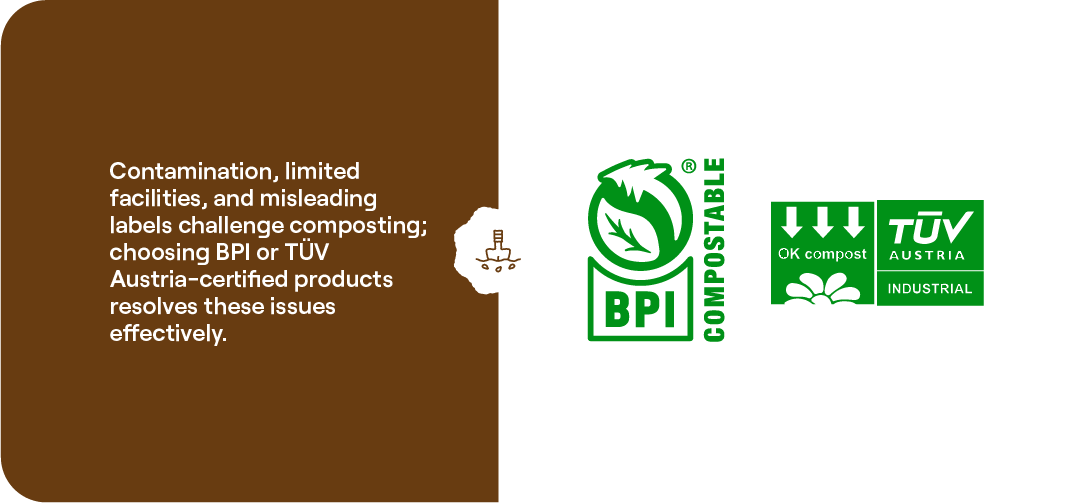
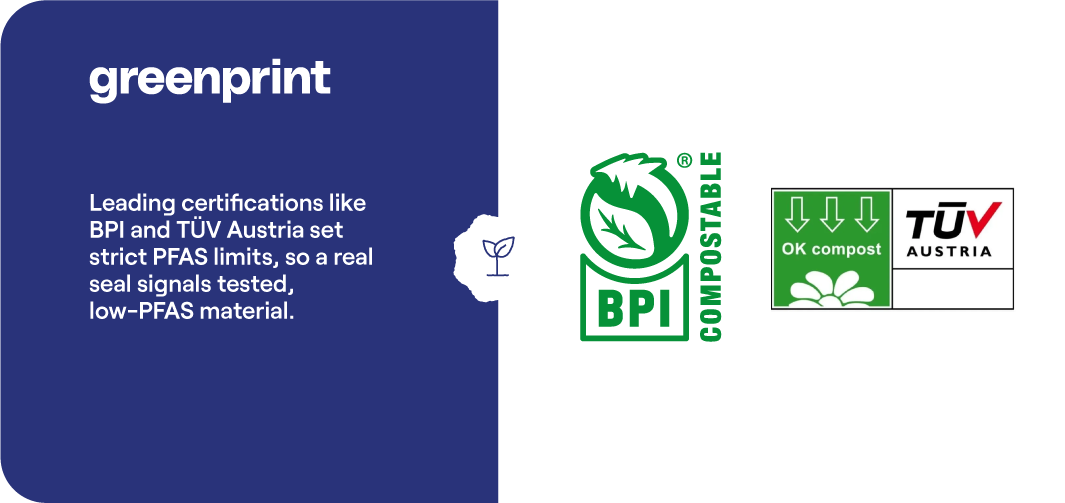
BPI, the Biodegradable Products Institute, is a North American non-profit that certifies products against ASTM standards for commercial composting. Its mark confirms a product was independently tested to break down completely in an industrial facility without leaving harmful residue. Our BPI-certified commercial compostable agave cutlery holds BPI Commercial Compostability certification.
TÜV Austria OK Compost
TÜV Austria issues two separate marks: OK Compost INDUSTRIAL and OK Compost HOME. The HOME mark is much harder to earn, because the product must break down at ambient backyard temperatures rather than the high heat of a commercial facility. Our TÜV home compostable agave straws carry TÜV Austria OK Compost HOME certification, achieved through an enzyme-enhanced compound that lets the material break down at home compost temperatures.
ASTM D6400 and D6868 Standards
ASTM D6400 and ASTM D6868 for compostable coatings are the test standards those certifications measure against. D6400 covers compostable plastics; D6868 covers compostable coatings on paper and board. A certifier runs the product through the standard, and the certification is proof it passed. When a package cites a real standard and a named certifier together, the claim is defensible rather than decorative.
How to Verify an Eco Certification Before You Trust It
You don’t need to be a chemist to check a claim. You need three things off the package, and a minute of looking.
Look for a named certifier. A trustworthy mark names its body, like BPI or TÜV Austria, not just a generic leaf icon or a made-up phrase. A seal with no organization behind it is a seal with no accountability.
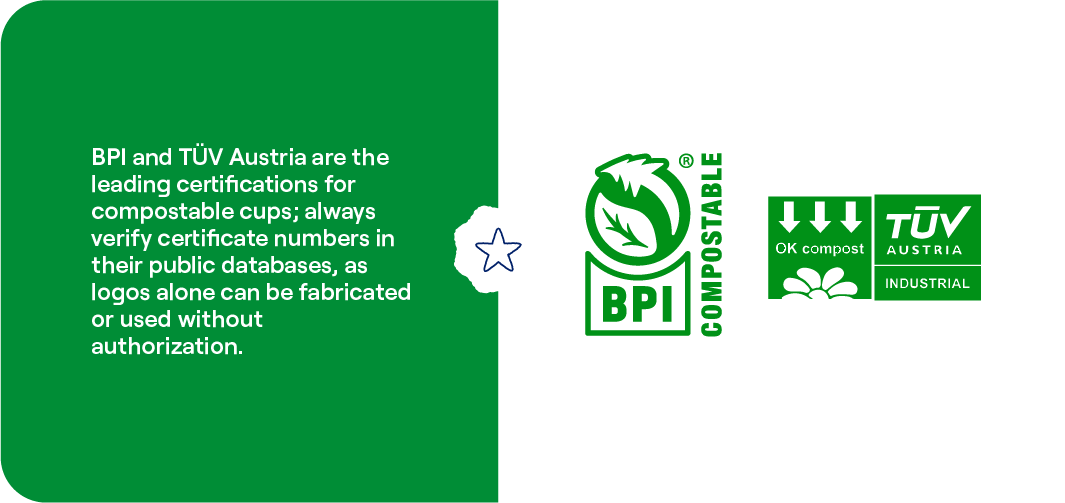
Look for a certificate number, then confirm it. Both BPI and TÜV Austria publish certified-product databases you can search: BPI’s searchable database of BPI-certified products and TÜV Austria’s database of certified products. A logo can be copied, expired, or used without permission, so the database entry is your proof, not the badge on the box. If the product isn’t listed, the mark doesn’t apply to it. Our walkthrough on how to spot genuine compostable cups shows the check in practice.
Read the qualifier language. Real compostability marks state whether the product needs commercial composting or works at home, and they note that access to home and community composting varies by region. That fine print isn’t a loophole; it’s a sign the certification is honest about how the product actually behaves once you’re done with it.
What the FTC Green Guide Says About Certification Claims
The FTC Green Guide on environmental marketing backs up everything above. It tells companies not to make broad, unqualified claims like “green,” because those claims are difficult to substantiate and easy to misread.
The FTC Green Guide is also direct about seals. It warns marketers not to use certifications or seals that fail to convey the specific basis for the claim, since a vague seal implies a general benefit the product may not deliver. It also expects companies to disclose any material connection to the group doing the certifying, so a buyer can judge whether the review was truly independent.
The guidance goes further on specific terms. It asks marketers to qualify a recyclable claim when facilities aren’t available to most buyers, and to hold “free-of” claims to real evidence rather than convenient wording. The theme running through all of it is substantiation: say what you can prove, in terms a buyer can check.
In plain terms, the regulator agrees with the shopper. A certification only counts when it says exactly what it verified and who verified it. Everything else is language.
How Greenprint Backs Its Compostability Claims
We built Greenprint® around the opposite of a vague label. Every claim we make points to a named certification and a document you can check.
Our agave straws hold TÜV Austria OK Compost HOME, and our Compostable Agave Cutlery holds BPI Commercial Compostability. Our certified lines are tested for PFAS by independent labs, not self-declared, and our internal biodegradation study (GP-BIO-001) supports those certifications with data. We follow the FTC Green Guide on every surface, which means we tie each statement to a specific, verifiable standard instead of a broad promise.
That’s the difference between a real certification and a meaningless one, built into the product rather than printed on top of it. Ready to switch? You can explore our certified compostable foodware or contact our team to match the right certified line to your operation.
Frequently Asked Questions
What Are Eco Certifications?
Eco certifications are marks granted by an independent body confirming a product met a defined environmental standard through testing. Only third-party marks tied to a named standard carry real weight.
Is “Compostable” the Same as Certified Compostable?
No. “Compostable” on its own is an unverified claim. Certified compostable means an outside body, like BPI or TÜV Austria, tested the product against a standard such as ASTM D6400 and confirmed it passed.
Can a Product Be Labeled Compostable Without Certification?
Yes, and that’s the problem. Nothing stops a company from printing “compostable” without proof, which is why you should look for a named certifier and a certificate number instead.
What Certification Should I Look For on Foodservice Packaging?
Look for BPI or TÜV Austria OK Compost, and confirm the certificate in their public database. Match the mark to your composting access: HOME for backyard composting, INDUSTRIAL or Commercial for facility composting.


Illinois plastic bans and regulations explained: hotel bottle law, Chicago bag tax and foodware rules, local bans, and pending bills. Plan your compliance now.

Learn how to reduce carbon footprint at home with simple steps for energy, heating, food, and waste. Start with easy swaps your whole household can keep up.

Are styrofoam cups safe? See how styrene, heat, microwaving, and reuse change foam cup safety, and find foam-free cup options for hot and cold drinks.