

Marketing Compostable Certified Products: Best Practices



Best Practices for Marketing Compostable Certified Products
Marketing compostable products comes with a real responsibility: get the claims right, or risk eroding the trust you’re trying to build. Greenwashing accusations, FTC enforcement actions, and a growing number of state labeling laws mean that vague language on packaging isn’t just a branding problem; it’s a compliance risk. The good news is that when you back your marketing with legitimate certifications and precise language, you earn the kind of credibility that actually drives purchasing decisions.

Certifications That Build Consumer Trust
Consumer skepticism around environmental claims is at an all-time high, and for good reason. Years of overused terms and unsubstantiated packaging claims have trained buyers to question what “compostable” really means. Certifications from recognized third-party organizations cut through that noise. They give your customers a concrete, verifiable reason to believe your product does what you say it does.
A certification mark on your packaging tells a specific story: an independent lab tested this product against a published standard, and it passed. That’s a different conversation than printing the word “compostable” in green ink and hoping for the best.
BPI and ASTM Standards
Two ASTM standards form the backbone of compostable product certification in the United States:
-
ASTM D6400 covers compostable plastics. It sets requirements for the rate and extent of biodegradation, disintegration during composting, and the absence of negative effects on compost quality. If you’re marketing a compostable cup, straw, or cutlery item made from bioplastics like PLA, this is the standard your product needs to meet.
-
ASTM D6868 covers packaging that incorporates paper or other traditionally compostable substrates combined with non-traditional materials (like bio-coatings). Think paper cups with compostable liners or coated paperboard containers.
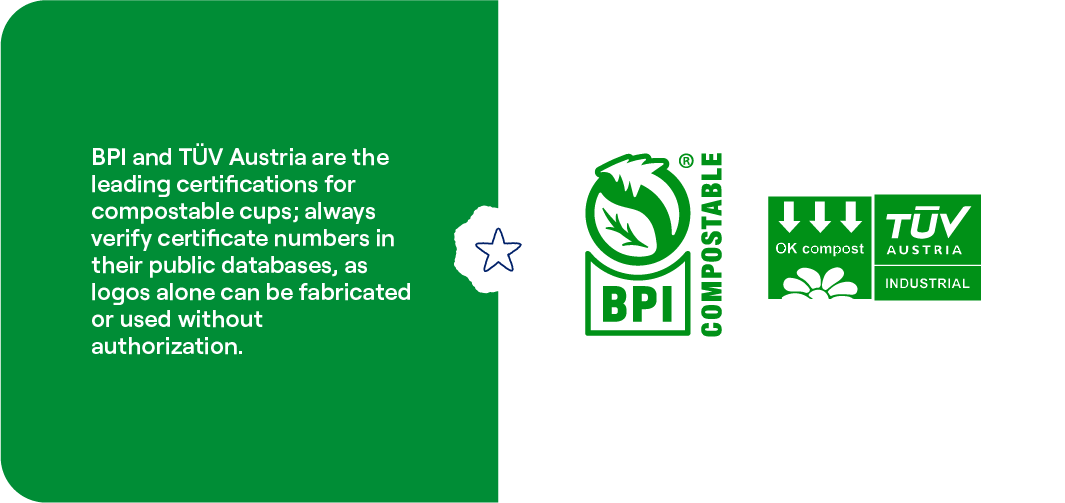
BPI is the primary third-party certification body in the U.S. that tests products against these ASTM standards. When a product carries the BPI certification mark, it means the product has been independently verified to meet ASTM D6400 or D6868, the manufacturer has submitted the product for testing and ongoing review, and the product is listed in BPI’s publicly searchable certified products database.
BPI certification also includes PFAS screening. Certified products must contain less than 100 ppm total organic fluorine, which addresses a growing concern among consumers and regulators about forever chemicals in food packaging.
For international markets, TÜV Austria’s OK Compost certification is the equivalent standard to reference. TÜV offers both INDUSTRIAL and HOME certification tiers; a distinction that matters significantly for marketing claims, as we’ll cover below.
Displaying Certification Marks Effectively
Earning the certification is step one. Making it visible and understandable to your customer is step two. BPI provides specific labeling guidelines for how to use their certification mark:
-
Place the BPI logo on the primary display panel of your packaging, the face your customer sees first.
-
The mark must be reproduced at a minimum size that ensures legibility (BPI specifies minimum dimensions in their brand guidelines).
-
Pair the mark with clear text: “BPI Certified Compostable” communicates more than the logo alone.
-
Don’t alter the colors, proportions, or elements of the certification mark.
The certification mark communicates a specific, testable claim. When you display it correctly, you’re leveraging the credibility of an independent third party; something your own brand language alone can’t replicate.
Green Marketing Claims That Hold Up
Having a certification is essential, but it doesn’t automatically make every claim on your packaging or website compliant. The language you use around that certification matters just as much as the certification itself.
What the FTC Green Guides Require
The FTC Green Guides are the federal framework governing environmental marketing claims in the United States. They aren’t regulations with the force of law on their own, but the FTC uses them to determine whether marketing claims are deceptive, and deceptive claims trigger enforcement.
Key requirements you need to follow:
-
Qualify your claims. Don’t say “compostable” without specifying the conditions. If your product requires industrial composting at 55-60 degrees Celsius, say “commercially compostable” or “industrially compostable.” Calling a product “compostable” without qualification implies it’ll break down in any composting setting, including a backyard bin, and if that’s not true, the claim is misleading.
-
Distinguish home from industrial composting. This is one of the most common areas where marketers get it wrong. A product certified to ASTM D6400 through BPI is certified for industrial composting conditions. Unless it also carries a HOME certification (like TÜV Austria OK Compost HOME), you can’t imply it works in home compost.
-
Substantiate with science. The FTC Green Guides require that environmental claims be backed by competent and reliable scientific evidence. Third-party certifications like BPI and TÜV meet this threshold. Self-declared claims without testing documentation do not.
-
Don’t overstate the benefit. If your product is compostable but your customer doesn’t have access to a composting facility, the practical environmental benefit is limited. The FTC expects you to account for this reality in your claims.
How To Avoid Greenwashing
Greenwashing isn’t always intentional. Often it’s the result of marketing teams using language they think sounds right without checking whether it’s defensible. A few guidelines to keep your claims clean:
Do:
-
Use specific, qualified language: “Industrially compostable; certified to ASTM D6400 by BPI.”
-
Reference the certification body and standard by name.
-
State the composting conditions required: “Requires commercial composting facility.”
-
Disclose limitations honestly: “Not suitable for home composting.”
Don’t:
-
Use broad, unqualified terms like “green,” “natural,” or “earth-friendly” as standalone claims.
-
Imply that a product will break down in a landfill; compostable products require specific composting conditions.
-
Use imagery (green leaves, earth tones, nature scenes) in ways that suggest environmental benefits you haven’t verified.
-
Claim “100% compostable” if only specific components of the product or packaging meet the standard.
The strongest marketing position you can take is one built on specificity. “BPI Certified Compostable to ASTM D6400; requires industrial composting” is less catchy than “green packaging,” but it’s a claim that holds up under scrutiny from regulators, journalists, and informed consumers.
Labeling That Communicates Clearly
Even with the right certifications and compliant language, your message fails if your customer can’t quickly understand what to do with your product after use. Labeling design is where marketing meets waste diversion.
Effective compostable labeling techniques include:
-
Color coding. The composting industry has increasingly standardized around green and brown/beige tones to signal compostable items. Use these consistently to help customers distinguish your compostable products from recyclable (typically blue) or landfill-bound items.
-
Clear disposal text. Add a short instruction directly on the product: “Please compost in a commercial composting facility.” Keep it under ten words. You’re competing with the two seconds of attention someone gives a wrapper before tossing it.
-
Distinguish from recyclable. This is critical. Compostable plastics can contaminate recycling streams, and recyclable plastics can contaminate compost. Your labeling needs to prevent both errors. Use contrasting colors, distinct iconography, and explicit text to separate the two.
-
Work within space constraints. On smaller items like straws or cutlery, you may not have room for detailed text. Prioritize the certification mark, a single-word descriptor (“Compostable”), and the appropriate color coding.
Greenprint® approaches labeling with this philosophy across our product lines. Our color-coded dot system; Green Dot for compostable products, Blue Dot for recycled-content products; gives foodservice operators and consumers a quick, intuitive visual cue for proper disposal.
State Labeling Laws To Watch
Federal guidelines from the FTC Green Guides provide the baseline, but a growing number of states have enacted their own compostable labeling laws; and they’re often stricter.
California has been the most aggressive. SB 343 restricts the use of the chasing arrows symbol and the word “recyclable” on products that aren’t actually recyclable in practice. AB 1201 specifically targets compostable claims: products labeled “compostable” in California must meet ASTM D6400 or D6868, carry BPI or equivalent third-party certification, and cannot use the chasing arrows symbol. Penalties for non-compliance are real.
Washington state has enacted similar legislation requiring that products marketed as compostable meet ASTM standards and carry third-party certification. The law also restricts the use of green and brown color coding to products that are genuinely compostable; preventing brands from using color associations to imply compostability without certification.
Colorado has introduced labeling requirements that align with California’s framework, focusing on truth-in-labeling for both recyclable and compostable claims.
The trend is clear: more states are moving toward requiring third-party certification as a prerequisite for making compostable claims on packaging. If you sell in multiple states, the smartest compliance strategy is to meet the strictest applicable standard; currently California’s, and apply it across your entire product line.
Educating Your Customers on Compostability
Certifications and compliant labeling are necessary, but they’re not sufficient on their own. Most consumers and many foodservice operators still don’t fully understand the difference between compostable, recyclable, and landfill-bound packaging. That gap is your marketing opportunity.
Turn your compliance work into a customer education advantage:
-
In-store signage. If you’re a foodservice operator, clear bin signage showing which items go in which stream reduces contamination and reinforces the value of your compostable products. Pair images of your actual products with the correct disposal stream.
-
Digital content. Blog posts, social media content, and email campaigns that explain what compostable certification means, and why it matters to build trust and differentiate you from competitors making vague claims.
-
Disposal instructions on packaging. Short, direct guidance like “Commercially compostable; please place in compost bin” takes the guesswork out of the customer’s decision.
-
Staff training. Your front-line team should be able to answer basic questions: “Is this really compostable?” “Where does it go?” A confident, informed answer reinforces the brand promise.
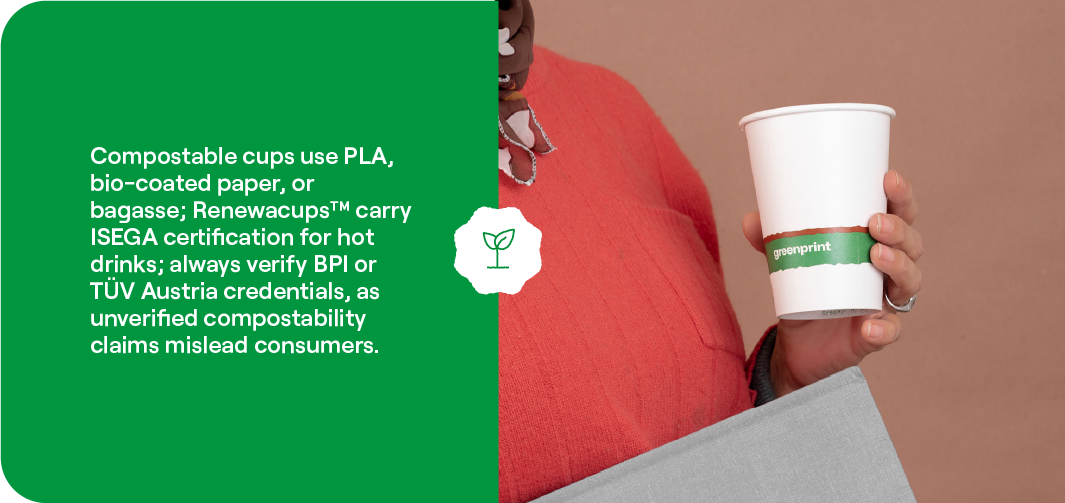
At Greenprint®, we build education into our partnerships with foodservice operators. Our BPI-certified product lines; from Compostable Agave straws and cutlery to Fiberware™ clamshells and containers; come with clear labeling, disposal guidance, and the certification documentation operators need to communicate confidently with their own customers.
The brands that win in this space aren’t just the ones with the right certifications; they’re the ones that help their customers understand and act on what those certifications mean.
Frequently Asked Questions
What Certifications Should Compostable Products Carry?
At a minimum, compostable products sold in the U.S. should carry BPI certification, which verifies compliance with ASTM D6400 (for plastics) or ASTM D6868 (for packaging with paper substrates). For brands selling internationally, TÜV Austria OK Compost certification is the recognized standard; available in both INDUSTRIAL and HOME tiers depending on the composting conditions your product requires.
Why Does “Compostable” Mean More Than Just “Breaks Down”?
“Compostable” means a product has been certified to break down completely within a specific timeframe under defined composting conditions; either industrial (55-60 degrees Celsius) or home (ambient temperatures), leaving no toxic residue. The term carries a specific, testable meaning backed by standards like ASTM D6400. Vague alternatives that lack defined conditions or timeframes don’t offer the same accountability. That’s why qualified compostable claims with certification references are the defensible approach for marketing.
Do Compostable Labeling Laws Vary by State?
Yes. California (SB 343, AB 1201), Washington, and Colorado have each enacted specific compostable labeling requirements that go beyond federal FTC Green Guides. These state laws typically require third-party certification (such as BPI) and restrict the use of symbols or color coding that could mislead consumers. If you market products across multiple states, comply with the strictest applicable law; currently California’s, to ensure you’re covered everywhere you sell.
References
- https://www.astm.org/d6400-23.html
- https://www.astm.org/d6868-21.html
- https://bpiworld.org/
- https://bpiworld.org/BPI-Public
- https://www.ftc.gov/legal-library/browse/federal-register-notices/guides-use-environmental-marketing-claims-green-guides
- https://leginfo.legislature.ca.gov/faces/billNavClient.xhtml?bill_id=202120220SB343
- https://leginfo.legislature.ca.gov/faces/billNavClient.xhtml?bill_id=202120220AB1201


Earth Day facts that show the scale of the environmental crisis, from plastic and landfill waste to CO2 and wildlife loss. See what the numbers mean for you.

Minnesota plastic ban rules for businesses, including city bag fees, Green To Go takeout packaging, PFAS limits, compostable labels, and EPR dates to plan for.

Reduce reuse recycle explained in plain terms. Learn what each of the 3 Rs means, why the order matters, and how compost completes the set as the 4th R.