

The Science Behind Compostability Testing | How It Works



The Science Behind Compostability Testing
When you see a “certified compostable” label on foodservice packaging, that claim is backed by a specific testing process. A compostability test confirms whether a product actually breaks down in a composting environment; and whether it leaves anything harmful behind. Understanding this science helps you make better procurement decisions and avoid products with unverified claims.
What Does Compostability Testing Measure?
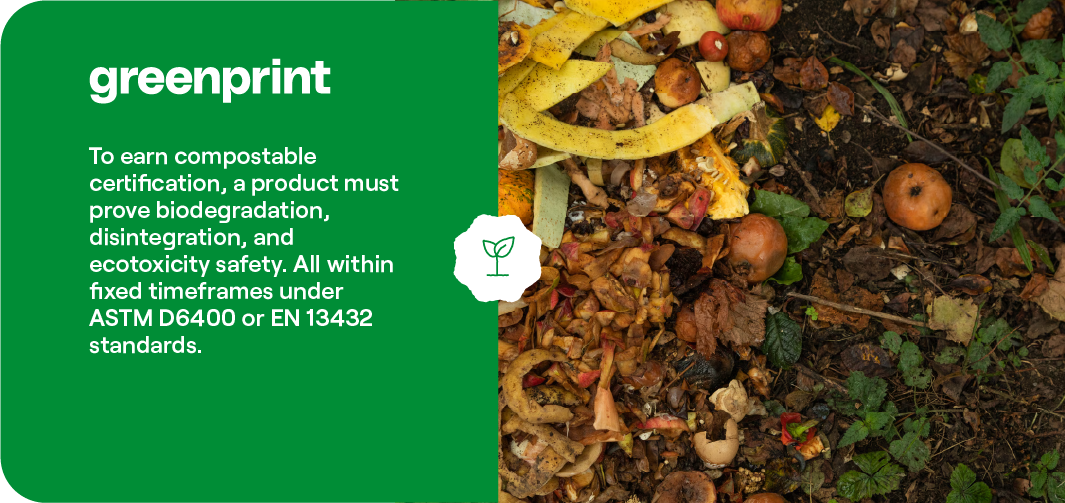
Compostable products must meet a defined standard before they earn certification. In the U.S., that standard is ASTM D6400 — a set of testing criteria developed by ASTM International (formerly the American Society for Testing and Materials). ASTM D6400 measures three things: how completely a material breaks down, how fast it physically falls apart, and whether the remaining material is safe for soil.
A product that passes all three tests can apply for certification from bodies like BPI (the Biodegradable Products Institute), which verifies ASTM D6400 compliance for commercial composting. TUV Austria issues certifications under different programs — OK Compost INDUSTRIAL for facilities operating at high temperatures, and OK Compost HOME for products that break down at lower, ambient temperatures. These certifications give you a specific, verifiable claim — not a marketing label. If you’re new to this landscape, our guide to composting certifications explained covers the key differences.
The distinction between industrial and home compostability is significant. Industrial composting facilities maintain temperatures between 55–60°C and carefully control moisture, aeration, and feedstock. Home composting happens at ambient temperatures, typically 20–30°C, with far less control. A product certified only for industrial composting should not be placed in a home compost bin — it won’t break down as intended.
Per FTC Green Guides, any compostability claim on packaging must be backed by competent and reliable scientific evidence. ASTM D6400 testing provides exactly that. Without it, a “compostable” label is just a word.
How Lab Testing Works
Lab testing is the first stage. Each of the three ASTM D6400 criteria has its own method and its own pass/fail threshold. Here’s what happens in the lab for each one.
Biodegradation
Biodegradation measures how completely microorganisms consume a material and convert it to carbon dioxide, water, and biomass. The lab technique used is called respirometry — a process that tracks the CO2 a material produces as microbes break it down. The test material is placed in a controlled composting environment alongside a reference material (usually cellulose).
Over the test period, lab technicians measure how much CO2 the sample generates compared to the reference. If the sample produces CO2 at a rate comparable to the reference, it confirms that microorganisms are actively consuming the material. This is the core measurement that separates a genuinely compostable material from one that simply fragments into smaller pieces.
It’s worth understanding the distinction here. The term “biodegradable” is often used loosely in marketing, but it has no legal standard for timeframe or conditions in the U.S. A product can technically biodegrade over decades in a landfill and still be called “biodegradable.” Compostable certification under ASTM D6400 requires biodegradation to happen within a defined timeframe under composting conditions. That’s a far more specific and verifiable claim.
Disintegration
Disintegration measures how quickly a product physically breaks apart into small fragments. In this test, samples are placed in a composting vessel with organic waste and monitored over time. At the end of the test period, the remaining material is screened through a sieve.
The material must break down into pieces small enough to pass through the screen. If large fragments remain, the product fails. This matters because even a material that biodegrades fully won’t work in a real compost facility if it doesn’t break apart fast enough.
Large fragments contaminate finished compost and create problems for facility operators. Composters screen their final product before selling it. Visible packaging fragments reduce the compost’s market value and undermine confidence in accepting compostable packaging in the first place. Disintegration testing protects the integrity of the composting system you’re relying on.
Ecotoxicity
Ecotoxicity testing — also called plant toxicity testing — checks whether the composted material is safe for soil and plant life. After the sample has fully composted, the resulting material is mixed with soil and used to grow plants. Germination rates and plant growth are compared against a control group grown in compost without the test material.
If the composted product inhibits germination or stunts growth, it fails. This test catches materials that might break down physically but leave behind chemical residues — heavy metals, coatings, or additives — that could harm the soil ecosystem.
For you as a buyer, ecotoxicity testing is the safeguard that a compostable product won’t damage the composting facility’s output. This is especially relevant given growing scrutiny around PFAS (per- and polyfluoroalkyl substances) in food packaging. Ecotoxicity testing doesn’t replace dedicated PFAS testing, but it’s one layer of verification that the composted material is safe for its intended next life as soil amendment.
How Field Testing Validates Lab Results
Lab testing happens under controlled conditions. Field testing checks whether those results hold up in actual composting environments. This is where organizations like the Composting Facility Testing Program (CFTP) — a joint initiative of BPI and the Composting Consortium — come in.
CFTP places certified products in real compost facilities and tracks their breakdown alongside normal organic waste. Conditions in a working facility are less uniform than a lab. Temperature, moisture, turning frequency, and feedstock mix all vary. Compost testing in the field reveals whether a product that passed in the lab also performs where it counts. You can learn more about the BPI compostability certification process on their site.
Field testing also builds trust with composting facility operators. Composters are understandably cautious. If a facility accepts certified compostable products but they don’t break down on schedule, that facility may stop accepting them altogether. This creates a downstream problem for you as a buyer — your packaging may be certified, but if local facilities won’t take it, the certification is less useful in practice.
Field validation closes the gap between laboratory conditions and the real-world composting operations that process your packaging after use. It’s one of the best signals that a product will actually perform in your region’s waste infrastructure.
At Greenprint®, we view field testing as a necessary check on lab data. Our products carry certifications from BPI and TUV Austria, and we support ongoing field testing efforts that verify real-world performance. Our proprietary biodegradation study (GP-BIO-001) documented full breakdown of our agave-based straws under home compost conditions, validated in triplicate. That internal data supports and corroborates our TUV Austria OK Compost HOME certification — it’s not a standalone claim, but it shows our commitment to verification beyond the minimum.
Why Compostability Testing Matters for Buyers
If you’re sourcing foodservice packaging, testing standards are your best tool for cutting through vague claims. Here’s what to look for and why it matters.
First, testing protects you from regulatory risk. FTC Green Guides for environmental claims require that compostability claims be backed by competent, reliable scientific evidence. If you’re purchasing products with unverified “compostable” labels, you’re exposed to the same scrutiny as the manufacturer.
Second, testing tells you the composting pathway. ASTM D6400 and BPI certification cover industrial composting — facilities operating at high temperatures. TUV Austria OK Compost HOME certification covers home composting at ambient temperatures. These are different disposal pathways, and the distinction matters for your operations. A product certified only for industrial composting won’t break down in a backyard bin.
Third, testing confirms safety. Ecotoxicity results mean the product won’t contaminate finished compost with harmful residues. This matters to compost facilities, to the farmers who use their output, and to the municipalities that regulate them.
Fourth, testing gives you procurement language that holds up. When you specify “BPI-certified to ASTM D6400” in a purchasing agreement, you’ve set a concrete, auditable standard. Your team can verify compliance. Your sustainability report can cite it. That’s different from specifying “compostable” — which, without a standard attached, can mean almost anything.
When you’re comparing suppliers, ask for the specific certification — not just the word “compostable.” Ask for the standard (ASTM D6400, EN 13432), the certifying body (BPI, TUV Austria), and the certificate ID. If a supplier can’t provide those, that’s your answer. Our guide on how to spot greenwashing in packaging can help you evaluate claims more critically.
Certified Compostable Products You Can Trust
We build our products around these testing standards because we believe certification should be the minimum, not the differentiator. Every Greenprint® product line carries third-party compostability certification tied to a specific standard and certifying body.
Our Compostable Agave straws carry both TUV Austria OK Compost HOME and BPI Commercial Compostability certifications. The Compostable Agave cutlery holds BPI Commercial Compostability certification. Our Fiberware™ clamshells, plates, and bowls carry TUV Austria OK Compost INDUSTRIAL certification. And every certified product line is third-party verified PFAS-free.
If you’re ready to source packaging backed by real testing — not just labels — explore our BPI-certified compostable foodservice products.

Frequently Asked Questions
What Is the Difference Between Biodegradable and Compostable?
The term “biodegradable” means a material can be broken down by microorganisms, but it sets no timeframe, temperature, or conditions. A plastic bag that takes decades to break down in a landfill can still technically be called “biodegradable.” “Compostable” means a material meets a specific standard (like ASTM D6400) for complete breakdown within a defined period under composting conditions, with no toxic residue. Per FTC Green Guides, unqualified compostable claims should be backed by certification.
How Long Does Compostability Testing Take?
The full ASTM D6400 testing process — including biodegradation, disintegration, and ecotoxicity — typically spans several months. Each test phase has its own duration, and certification review adds additional time after lab work is complete.
Do Compostable Products Break Down in a Home Compost Bin?
Only if they carry a home compostability certification, such as TUV Austria OK Compost HOME. Products certified only under ASTM D6400 or BPI Commercial require industrial composting facilities operating at higher temperatures. Home compost environments don’t reach the sustained heat that industrial facilities maintain, so most commercially certified products won’t fully break down in a backyard bin. Always check the specific certification on the packaging before placing a product in your home compost.


Compare PHA vs PLA, starch blends, and traditional plastic on composting conditions, cost, and performance. Find the right sustainable packaging material for your needs.
Learn best practices for marketing compostable certified products, from BPI certification and FTC Green Guides compliance to state labeling laws and customer education.
What Are Eco-Labels? A Guide for Foodservice Buyers Eco-labels help foodservice buyers identify products that meet verified environmental standards, but…