

What Are Eco-Labels? A Guide for Foodservice Buyers



Content
- Key Takeaways
- What Are Eco-Labels and Why Do They Exist?
- The Three Types of Eco-Labels You Should Know
- Eco-Labels That Matter for Foodservice Packaging
- Why Eco-Labels Matter for Your Business and Your Customers
- How to Spot Greenwashing and Choose Trustworthy Eco-Labels
- Choose Certified Compostable Foodware With Greenprint
What Are Eco-Labels? A Guide for Foodservice Buyers
Eco-labels help foodservice buyers identify products that meet verified environmental standards, but not all labels carry the same weight. This guide breaks down the types of eco-labels, explains which certifications matter most for foodservice packaging, and shows you how to tell credible claims from greenwashing.
Key Takeaways
- Eco-labels fall into three categories, and only third-party certified labels (Type I) give you independently verified proof that a product meets a published environmental standard.
- Foodservice buyers should look for specific certifications like BPI and TÜV Austria OK Compost rather than relying on vague, self-declared claims like “green” or “natural.”
- Matching the right certified product to your local waste infrastructure is just as important as choosing a certified product in the first place.
What Are Eco-Labels and Why Do They Exist?
Eco-labels are standardized marks placed on products to communicate specific, verified environmental attributes. This means when you see an eco-label on a cup or container, someone has tested that product against a published standard and confirmed it does what the label claims.
These labels exist because without them, any company could print “green” or “sustainable” on packaging with no accountability. The FTC Green Guides address this problem directly. They require that all environmental claims be specific, backed by competent and reliable scientific evidence, and clearly qualified so buyers aren’t misled.
For you as a foodservice operator, this matters every time you make a purchasing decision. A label that says “compostable” without naming a certification body could leave you exposed during an inspection. A label backed by a named third-party certifier gives you documentation you can point to. That’s the difference between a marketing claim and ecolabeling regulatory support you can actually use.
Think of eco-labels as a shortcut through the noise. Instead of researching every manufacturer’s claims yourself, you can look for recognized certifications that have already done the verification work. The challenge is knowing which labels to trust, which is exactly what we’ll cover next.
The Three Types of Eco-Labels You Should Know
The International Organization for Standardization (ISO) classifies ecological labels into three types. This classification system helps you quickly assess whether a label represents independent verification, a manufacturer’s own claim, or a detailed lifecycle data report.
Understanding these categories matters because each type carries a different level of credibility. A Type I certification from BPI, which has certified over 51,000 products as commercially compostable, means something very different from a Type II claim that a manufacturer printed on their own packaging. Let’s walk through all three so you know exactly what you’re looking at.
Type I. Third-Party Certified Eco-Labels (ISO 14024)
Type I eco-labels are independently verified by an accredited certification body against published criteria. This means a qualified third party, not the manufacturer, tests the product and confirms it meets the standard. These represent the highest level of credibility among all ecolabels examples.
The certification process typically involves laboratory testing, facility audits, and ongoing compliance reviews. The certifying organization publishes its criteria so anyone can look up exactly what the label means. This transparency is what separates Type I labels from marketing language.
In foodservice packaging, the most relevant Type I ecolabels examples include:
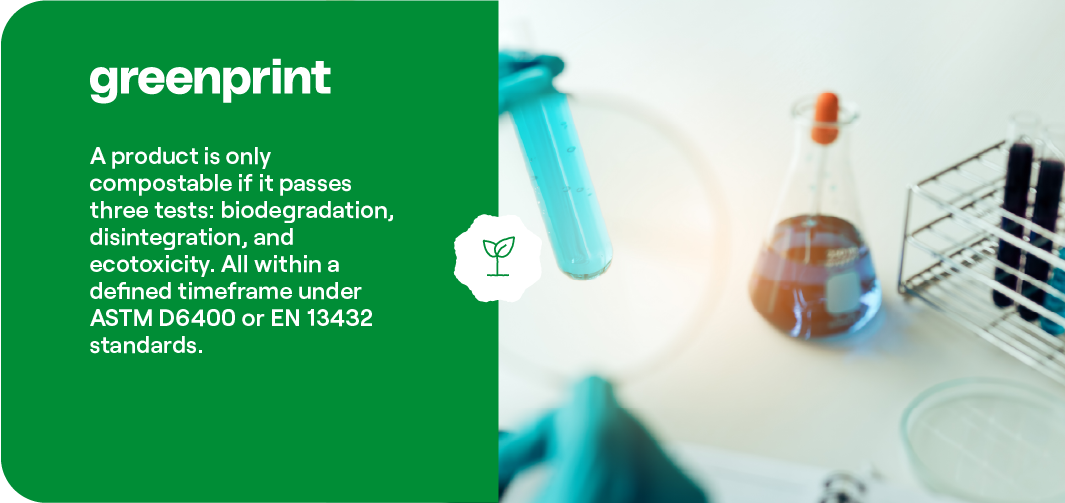
- BPI: Certifies that a product meets ASTM D6400/D6868 standards for composting in industrial facilities; a metric required by every U.S. state with regulatory language around the definition of compostability.
- TÜV Austria OK Compost HOME: Certifies that a product breaks down fully in a home compost environment at lower temperatures.
- TÜV Austria OK Compost INDUSTRIAL: Certifies that a product breaks down in a managed industrial composting facility.
When you see these certifications on foodservice products, you know an independent lab has tested them. You can request the certificate number from your supplier and verify it yourself.
Type II. Self-Declared Environmental Claims (ISO 14021)
Type II eco-labels are claims made by the manufacturer without independent verification. This means the company itself decided to print “recyclable,” “natural,” or “made with plant-based materials” on the packaging. No outside organization tested or confirmed these claims.
These claims aren’t automatically false, but they carry real risk for buyers. The FTC Green Guides specifically warn against broad, unqualified environmental claims because they’re hard to prove. Under these guidelines, any green labeling claim needs scientific evidence behind it, and qualifications must be clear and prominent.
Here’s the practical problem for foodservice operators. If your city requires certified compostable packaging, a self-declared “compostable” label won’t satisfy the legal requirement. You need a named certification body and a certificate number. A cup with only a Type II claim could mean fines during an inspection or customer complaints when the product doesn’t perform as expected.
The takeaway is simple. When you see environmental claims without a named certifier, ask questions. Request documentation. If the supplier can’t provide third-party verification, treat the claim with skepticism.
Type III. Environmental Product Declarations (ISO 14025)
Type III eco-labels, called Environmental Product Declarations (EPDs), are quantified reports that detail a product’s environmental impact across its entire lifecycle. A third party verifies the data, but unlike Type I labels, EPDs don’t pass or fail a product. Instead, they present measurable information so buyers can compare products directly.
EPDs cover things like energy use during manufacturing, transportation emissions, and resource consumption. They’re designed for buyers who want to dig into the numbers rather than rely on a simple pass/fail certification.
These declarations are less common in everyday foodservice purchasing today. You’re more likely to encounter them if you work with large institutional buyers, corporate sustainability teams, or supply chain transparency programs. However, as reporting requirements grow and more companies track their environmental footprint, EPDs are becoming more relevant in B2B procurement.
For most restaurant operators, Type I certifications remain the most practical tool for purchasing decisions. But it’s worth knowing what EPDs are so you recognize them when they come up in vendor conversations.
Eco-Labels That Matter for Foodservice Packaging
Now that you understand the three types of eco-labels, let’s focus on the specific certifications you’ll encounter when buying disposable cups, plates, clamshells, cutlery, and straws. Each one certifies something different, and knowing the distinction helps you match products to your local waste systems.
| Certification | Issued By | What It Certifies | Disposal Path |
|---|---|---|---|
| BPI Certified Compostable | BPI | Meets ASTM D6400/D6868 standards for industrial composting | Industrial composting facility |
| TÜV Austria OK Compost HOME | TÜV Austria | Breaks down fully in home compost conditions | Home compost bin or pile |
| TÜV Austria OK Compost INDUSTRIAL | TÜV Austria | Breaks down fully in industrial composting conditions | Industrial composting facility |
| PFAS-Free Verification | Third-party lab (e.g., Intertek) | Confirms absence of per- and polyfluoroalkyl substances | Applies to any disposal path |
Each of these is a Type I certification or third-party verification. An independent organization tested the product and confirmed it meets the published standard. PFAS-free verification, while not a compostability certification, is increasingly important as states pass legislation restricting PFAS in food packaging. BPI’s certification also requires a maximum of 100 ppm total organic fluorine and a signed declaration of no intentionally added PFAS.
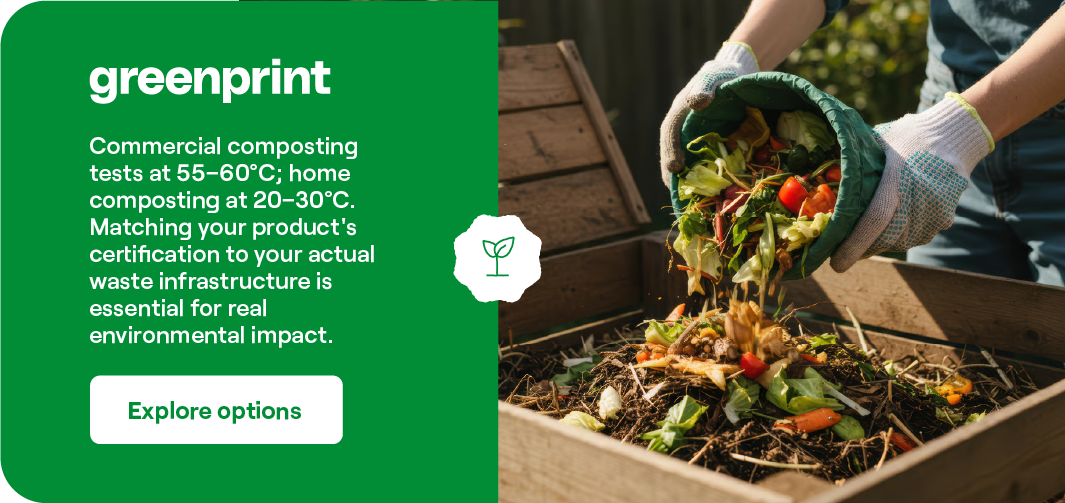
The key point here is that the certification tells you exactly how a product should be disposed of. A product certified for industrial composting won’t necessarily break down in your backyard compost pile. A home compostable product may not need industrial infrastructure at all. Matching the label to your available waste systems is essential for both compliance and environmental impact.
When evaluating suppliers, ask for the specific certification documents. A credible supplier will provide the certificate number, the certifying body, and the expiration date without hesitation.
Why Eco-Labels Matter for Your Business and Your Customers
Verified eco-labels protect your business from regulatory risk, build customer trust, and create transparency across your supply chain. They turn sustainability from a vague promise into something you can document and defend.
On the compliance side, cities and states across the U.S. are passing legislation that bans conventional single-use plastics in foodservice. Many of these laws specifically require that replacement products carry recognized compostability certifications. If you’re using products with only self-declared claims, you may not meet the legal standard. Verified ecolabeling regulatory support through Type I certifications gives you the documentation you need for inspections and audits.
The FTC Green Guides also require that certifications and seals clearly convey the basis for the claim. This means you should be able to explain to a customer or inspector exactly what your product’s certification means. Displaying a product’s BPI or TÜV Austria certification at your point of service tells your guests exactly what the product does and how it should be disposed of.
Customer trust is the other major benefit. Today’s diners increasingly expect transparency about sustainability claims. When you can point to specific certifications rather than vague language, you build credibility. Your staff can answer questions confidently rather than guessing. And you avoid the reputational risk that comes with products that don’t perform as advertised.
How to Spot Greenwashing and Choose Trustworthy Eco-Labels
Greenwashing happens when a product’s green labeling suggests environmental benefits that aren’t backed by evidence. You can avoid it by applying a simple checklist every time you evaluate a new product or supplier.
Start by looking for these indicators of a trustworthy eco-label:
- Named certification body: The label identifies who issued the certification (e.g., BPI, TÜV Austria), not just a generic leaf or globe icon.
- Published standard: The certification references a specific testing standard (e.g., ASTM D6400 for industrial composting) that you can look up independently.
- Third-party testing documentation: The supplier can provide a certificate number, expiration date, and test results from an accredited lab.
- Specific claims: The label says exactly what was tested, such as “certified compostable in industrial facilities,” rather than vague phrases like “earth-friendly.”
Now compare those indicators to common red flags:
- No certifier named: A product says “compostable” but doesn’t reference any certification body or standard.
- Broad, unqualified language: Terms like “natural,” “green,” or “sustainable” appear without any explanation of what they mean.
- “Free-of” claims without context: The FTC Green Guides warn that “free-of” claims can be deceptive if the substance was never associated with the product category in the first place.
The practical test is straightforward. Ask your supplier for the certification document. If they can provide a certificate number, certifying body, and expiration date, you’re dealing with a credible claim. If they can’t, or if they deflect with marketing language, consider that a warning sign.
Remember that even well-intentioned suppliers may not understand the difference between Type I and Type II claims. Your job is to ask the right questions and verify the answers. The few minutes you spend checking certification documents can save you from compliance headaches and customer complaints down the road.

Choose Certified Compostable Foodware With Greenprint
At Greenprint®, every product line we sell carries a named, third-party certification. We don’t rely on self-declared claims or vague green labeling. Instead, we build each product around a specific, verified end-of-life pathway so you can match it to your local waste infrastructure.
Our Upcycled Agave Straws carry both TÜV Austria OK Compost HOME certification and BPI certification, with certification documents available for verification. The home compostability of these straws is made possible by our proprietary enzyme technology. The enzyme masterbatch is integrated during compounding at 160–190°C and catalyzes hydrolysis of PLA polymer chains, enabling full biodegradation at ambient temperatures (20–30°C). This is what enables TÜV Austria OK Compost HOME certification. Standard PLA without enzyme technology, like our Compostable Agave Cutlery, requires industrial composting at 55–60°C and cannot achieve HOME certification.
Our Compostable Agave Cutlery holds BPI certification for industrial composting, with certification documents available for verification. These products are designed for facilities that maintain the temperatures required for standard PLA materials (55–60°C).
Our Fiberware™ clamshells, plates, and bowls are made from sugarcane bagasse and carry TÜV Austria OK Compost INDUSTRIAL certification, with certification documents available for verification. Our Renewacups™ hot cups and Fiberware™ line have also undergone third-party PFAS testing through Intertek, with all tested compounds coming back as not detected.
We designed these distinct product lines so you don’t have to guess. If your community has curbside composting that feeds an industrial facility, our Compostable Agave Cutlery and Fiberware™ products fit that system. If your customers take packaging home and compost it themselves, our Upcycled Agave Straws are built for that path.
Ready to make the switch to certified compostable foodware? Explore our products to find the right fit for your operation, or contact us today for guidance on choosing the right certifications for your local waste systems.


See the Hawaii plastic ban and single-use plastic laws for Honolulu, Maui, Hawaii County, and Kauai, with dates, fines, and compliant foodware tips for 2026.

Nanoplastics vs. microplastics comes down to size. Learn how they differ, why researchers worry more about nanoplastics, and simple ways to reduce exposure.

Earth Day facts that show the scale of the environmental crisis, from plastic and landfill waste to CO2 and wildlife loss. See what the numbers mean for you.