

What Does Upcycled Mean in Packaging? A Clear Guide


Content
- What Does Upcycled Mean?
- How Is Upcycled Packaging Different from Recycled Packaging?
- Why Upcycled Packaging Matters for Foodservice
- Examples of Upcycled Packaging in Practice
- What to Look for When Choosing Upcycled Packaging
- How Greenprint® Uses Upcycled Agave in Foodservice Packaging
- Frequently Asked Questions
What Does Upcycled Mean in Packaging?
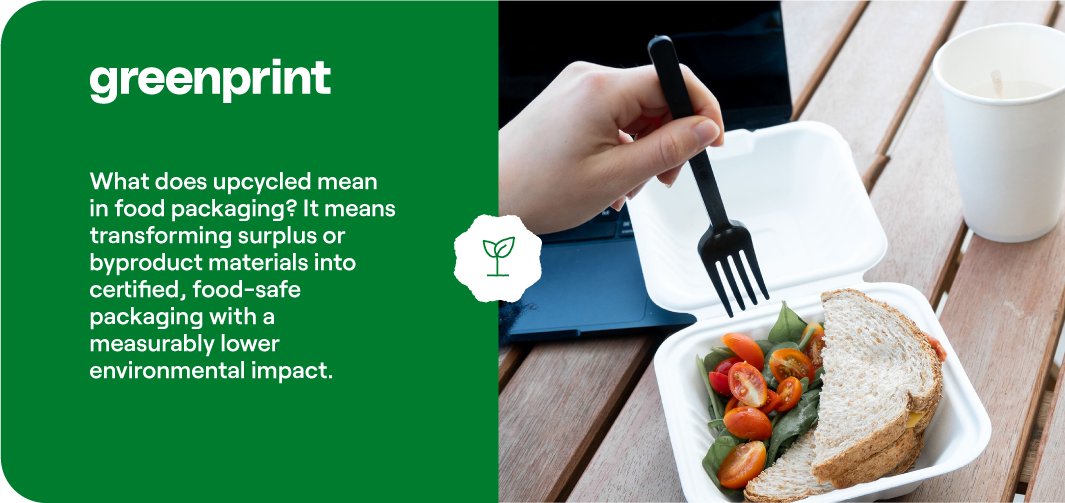
The word “upcycled” shows up more often on packaging labels, but its meaning in the context of food packaging is specific and worth understanding. So, what does upcycled mean in packaging? It means the product is made from materials that would have been thrown away, and those materials have been transformed into something of equal or higher value.
What Does Upcycled Mean?
Upcycling takes waste materials and transforms them into products of equal or higher value. That’s the key distinction. The original material doesn’t get broken down into its raw components. Instead, it gets repurposed directly into something new and functional.
This is not the same as downcycling, where materials lose quality with each cycle. Think of a plastic bottle turned into a lower-grade park bench. The material is reused, but its value decreases.
In packaging, upcycling means the finished product is made from materials that would otherwise be discarded. Agricultural byproducts, food processing waste, and industrial leftovers can all serve as feedstock. The goal is to keep those materials in the economy at a higher value than where they started.
What is upcycling in practice? It’s a supply chain decision. Someone identifies a waste stream, finds a way to process it, and creates a product that performs as well as (or better than) one made from virgin materials.
The concept applies across industries: furniture, fashion, construction, and food packaging. But in packaging specifically, the opportunity is massive. Food processing and agriculture generate enormous volumes of organic waste every year. Upcycling channels that waste into functional, marketable products instead of sending it to a landfill or incinerator.
How Is Upcycled Packaging Different from Recycled Packaging?
The words “upcycled” and “recycled” both suggest reuse, but the processes are fundamentally different. Understanding the difference between upcycling vs recycling helps you evaluate packaging claims more accurately.
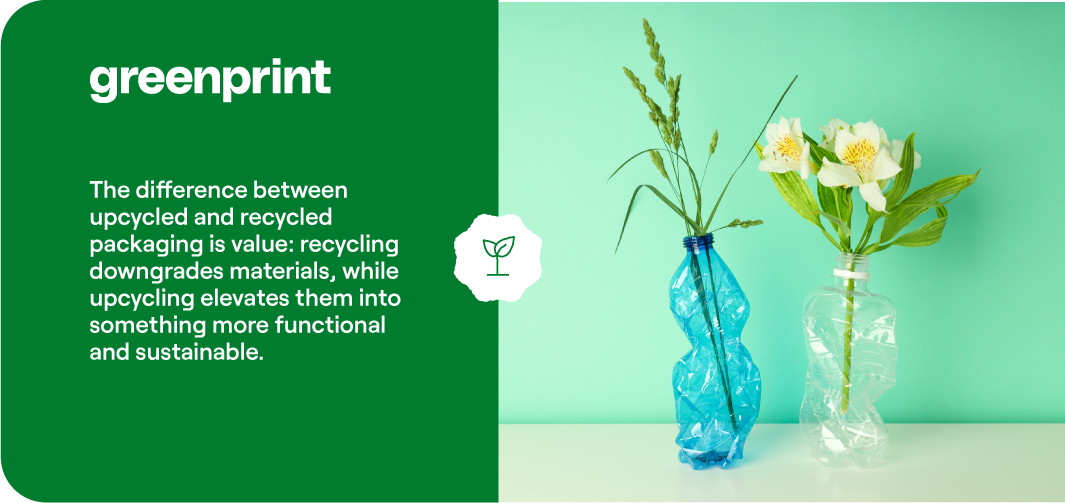
Recycling breaks materials down to their raw form. Plastic gets shredded, melted, and reformed. Paper gets pulped and re-pressed. Each cycle typically degrades material quality.
Upcycling repurposes materials without that full breakdown. The waste material is processed into a new product at a higher or equal value point. The transformation adds function, not just extends the material’s life.
The table below breaks down the key differences:
| Factor | Recycled Packaging | Upcycled Packaging |
|---|---|---|
| Process | Breaks material to raw form, then reforms | Repurposes material into new product without full breakdown |
| Material quality | Often degrades with each cycle | Maintained or improved |
| Energy use | Typically high (melting, pulping, reprocessing) | Varies, but often lower than full recycling |
| End product value | Usually equal or lower than original | Equal or higher than original waste material |
| Waste diversion | Keeps materials out of landfill | Keeps materials out of landfill and adds value |
When you see “upcycled” or “recycled” on a product label, the FTC Green Guides require that these claims be specific and substantiated. A package labeled “made from upcycled materials” should identify what the source material is and how it was transformed. Vague claims without that context don’t meet FTC standards. When you upcycle vs recycle, the distinction matters for both compliance and consumer trust.
Why Upcycled Packaging Matters for Foodservice
Foodservice generates a massive amount of waste. Single-use packaging is a big part of that. Upcycled packaging offers a practical way to address the problem without overhauling your entire operation.
Waste reduction at the source. Upcycled packaging uses materials that already exist in waste streams. You’re not pulling new resources out of the ground. You’re pulling value out of what someone else already discarded.
Circular economy packaging in action. Circular economy models keep materials cycling through the economy at their highest possible value. Upcycled packaging fits that model directly. It takes agricultural or industrial waste and turns it into a product your customers use every day.
Regulatory trends are shifting. Extended Producer Responsibility (EPR) laws are expanding across states and countries. These laws hold brands and operators accountable for the packaging they put into the market. Choosing upcycled products now positions your business ahead of tightening regulations.
Your customers are paying attention. Diners and retail buyers increasingly look for packaging that reflects their values. Upcycled packaging gives you a specific, verifiable story to tell. It’s not a vague green claim. It’s a material sourcing decision you can explain in one sentence.
Supply chain resilience. Packaging made from upcycled materials taps into waste streams that already exist in high volume. You’re not competing for the same virgin raw materials as every other buyer. For operators managing tight margins, that kind of sourcing stability matters.
For foodservice operators weighing the switch to compostable food packaging materials, upcycled options offer a tangible starting point. The claims are specific, the sourcing is traceable, and the benefits extend beyond your kitchen to the broader supply chain.
Examples of Upcycled Packaging in Practice
Upcycled products show up across several industries. Here are a few real-world examples that demonstrate what upcycled packaging looks like in practice.
Agave fiber from tequila production. After agave hearts are cooked and pressed for tequila and mezcal, the leftover fibrous waste (called bagasse) is typically discarded or burned. That fiber can be processed and blended into bioplastic compounds for foodservice packaging. It’s a textbook case of agricultural waste becoming a higher-value product.
Coffee grounds in packaging materials. Spent coffee grounds from cafes and roasters have been incorporated into packaging and food containers. The grounds add structural properties and divert organic waste from landfills. Some manufacturers blend spent grounds with natural binders to create molded trays and cup sleeves.
Fruit and vegetable peels. Peels from citrus processing, apple pressing, and other food manufacturing can be dried and processed into molded packaging. These agricultural byproducts replace virgin fiber in certain applications.

Textile and fiber waste in fashion packaging. Outside food packaging, brands in fashion and consumer goods use textile scraps and recycled fibers for shipping materials and product wrapping. The principle is the same: waste becomes value.
In food packaging specifically, agave fiber stands out because the waste stream is consistent, abundant, and has no competing use. Unlike bamboo (which requires long-haul shipping from Asia) or wheat straw (which competes with animal feed), agave bagasse from the tequila industry is a pure waste-to-value material. The tequila industry in Jalisco, Mexico, processes over 100 million agave plants annually, generating massive volumes of fibrous waste with no existing market.
What to Look for When Choosing Upcycled Packaging
Not all upcycled claims are created equal. If you’re sourcing packaging for your business, a few checkpoints will help you separate real upcycled products from marketing spin.
Look for the Upcycled Certified mark. The Upcycled Food Association offers a third-party certification that verifies a product contains upcycled ingredients or materials. This mark removes guesswork and provides a credible, independent validation.
Check for FTC Green Guides compliance. Any environmental claim on packaging should be specific. “Made from upcycled agave fiber” is a defensible claim. “Green packaging” is not. Ask your supplier what the source material is, where it comes from, and how it’s processed.
Ask about sourcing transparency. A credible upcycled packaging supplier should be able to tell you exactly what waste stream the material comes from, where it’s sourced, and how it’s processed. If they can’t answer those questions, the claim deserves scrutiny. For a deeper look at how sourcing works in practice, see our guide on upcycled material sourcing in foodservice.
Consider complementary certifications. “Upcycled” tells you where the material came from. It doesn’t tell you what happens to it after use. Composting certifications like TÜV Austria OK Compost HOME or BPI address end-of-life performance. The two claims work together but are separate. For more on how composting certifications compare, see our breakdown of BPI vs. TÜV OK Compost vs. DIN CERTCO.
How Greenprint® Uses Upcycled Agave in Foodservice Packaging
At Greenprint®, our core material innovation starts with Upcycled Agave fiber. We source post-tequila agave bagasse from small farming families in Jalisco, Mexico. This agricultural waste would otherwise be discarded or burned. We give it new life by blending it into our proprietary agave-PLA/PBAT bioplastic compound at our vertically integrated manufacturing facility.
The agave fiber makes up 30 to 50 percent of our compound by weight. The rest is a PLA/PBAT polymer blend combined with our enzyme masterbatch. For a closer look at the material itself, see our article on agave fiber composition and the science behind agave foodware.
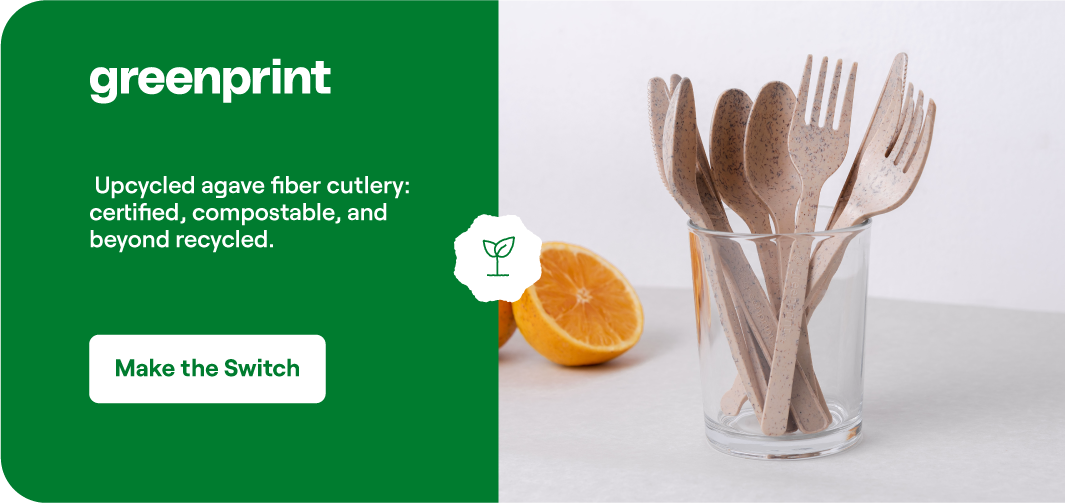
The result is a line of sustainable packaging, including Upcycled Agave forks, spoons, and knives and TÜV Austria OK Compost HOME certified agave straws, that performs like conventional foodware. We control every step: from agave fiber sourcing to in-house compounding to finished product manufacturing.
Our products carry TÜV Austria OK Compost HOME and BPI certifications. They are also PFAS-free. These aren’t vague sustainability promises. They are third-party verified, testable claims backed by named certification bodies. To understand the differences between home and industrial composting standards, see our guide on home vs. industrial composting.
Ready to make the switch? Explore our full line of certified compostable agave foodservice packaging.

Frequently Asked Questions
Is Upcycled Packaging the Same as Recycled Packaging?
No. Recycled packaging is made from materials broken down to their raw form and reformed. Upcycled packaging repurposes waste materials into a product of equal or higher value without that full breakdown. The two terms describe different processes.
What Is the Upcycled Certified Mark?
The Upcycled Certified mark is a third-party certification administered by the Upcycled Food Association. It verifies that a product contains upcycled ingredients or materials sourced from waste streams that would otherwise be discarded.
Can Upcycled Packaging Be Composted?
It depends on the specific material and its certifications. “Upcycled” describes where the material came from. “Compostable” describes how it breaks down after use. The two are separate claims, and a product can be one, both, or neither.

PLA only breaks down in industrial composting facilities at 55-60°C. Learn why standard PLA cannot home compost and what BPI certification means for your operation.
Learn how agricultural waste material innovation turns crop residues like sugarcane bagasse and agave fiber into compostable foodservice packaging with third-party certification.
Learn how bagasse is made into tableware step by step. From sugarcane fiber to finished plates, bowls, and clamshells, see the full manufacturing process.