

Why PLA Requires Industrial Composting to Break Down



Why PLA Requires Industrial Composting
PLA (Polylactic Acid) is one of the most common bioplastics in foodservice packaging. It looks and feels like conventional plastic. But here is the catch: PLA only breaks down inside an industrial composting facility. Home compost bins, landfills, and open soil do not generate enough sustained heat to decompose it. If your operation uses PLA products, understanding why matters for setting up the right end-of-life program.
What Happens to PLA in an Industrial Composting Facility
Industrial composting facilities are engineered environments. They maintain sustained temperatures between 55 and 60 degrees Celsius, humidity levels of 50 to 65 percent, and consistent aeration that feeds oxygen to microbial communities. These conditions are not accidental. Facility operators monitor and adjust them continuously.
When PLA-based compostable packaging enters this environment, the combination of heat, moisture, and microbial activity begins breaking it down. Under these controlled conditions, PLA disintegrates within 45 to 90 days. That timeline aligns with the requirements of ASTM D6400, the standard that governs compostable plastics in the United States.

The industrial composting temperature range is not arbitrary. PLA has a physical property called a glass transition temperature, which sits around 60 degrees Celsius. Below that threshold, the polymer chains in PLA remain rigid and resistant to water penetration. Above it, those chains soften and become vulnerable to hydrolysis, the chemical process that initiates decomposition. This is why the facility’s heat matters so much.
Consistent aeration also plays a role. Oxygen-rich conditions promote aerobic microbial activity, which drives the final stage of biodegradation. Without adequate airflow, decomposition slows or shifts to anaerobic pathways that produce methane, a potent greenhouse gas.
How PLA Breaks Down: The Two-Step Process
Bioplastic composting follows a specific two-step process. Understanding these steps clarifies why PLA cannot break down in lower-temperature settings.
Step 1: Abiotic hydrolysis. Heat and moisture penetrate the PLA material and break the long polymer chains into smaller fragments. This is a chemical reaction, not a biological one. It requires temperatures at or above PLA’s glass transition point (approximately 60 degrees Celsius). Water molecules attack the ester bonds that hold the polymer together, splitting them into shorter chains called oligomers and monomers. This step is the bottleneck. Without sufficient heat, hydrolysis barely begins.
Step 2: Microbial biodegradation. Once hydrolysis has reduced PLA into small enough fragments, microorganisms in the compost pile consume them. Bacteria and fungi metabolize the oligomers and monomers, converting them into carbon dioxide, water, and biomass. This biological phase proceeds relatively quickly once the chemical phase has done its work.
So, is PLA compostable? Yes, but only when both steps can occur. The first step demands industrial-level heat. The second step demands an active microbial community. Industrial composting facilities provide both. Backyard bins do not.
Why PLA Does Not Break Down in Home Compost
Home compost piles typically reach temperatures of 20 to 30 degrees Celsius. Even a well-managed backyard bin rarely sustains temperatures above 40 degrees Celsius for extended periods. That falls well short of the 55 to 60 degrees Celsius PLA needs for hydrolysis to begin.
The result: PLA persists for years in home compost. It does not visibly degrade. It does not fragment. It sits there, intact, alongside your food scraps and yard waste. The same is true in soil and landfill environments. Without sustained high heat and moisture, PLA behaves more like conventional plastic than a compostable material.
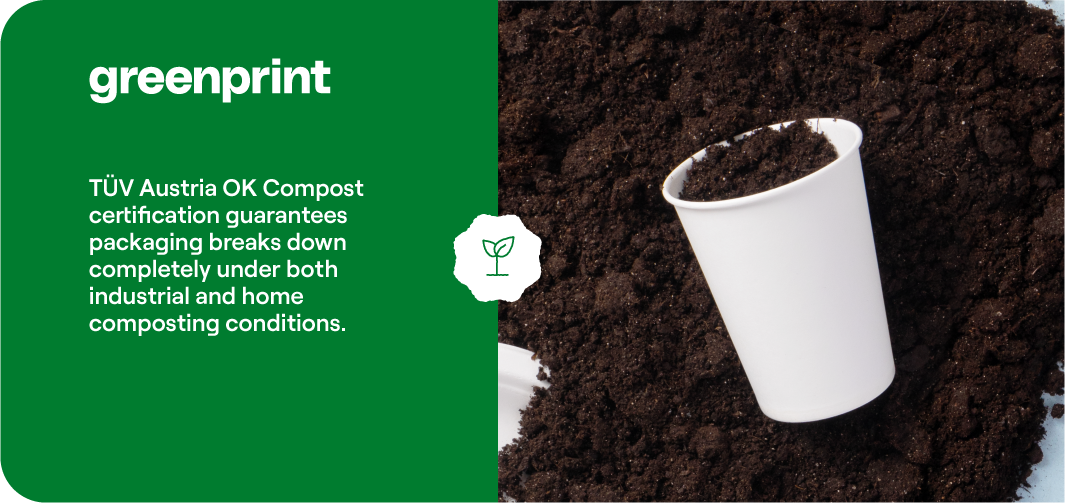
This distinction matters when evaluating claims about compostable vs biodegradable packaging. A product labeled “compostable” under ASTM D6400 is certified for industrial composting, not home composting. These are different end-of-life pathways with different temperature requirements. For a detailed comparison, see our guide on home vs. industrial composting differences.
What BPI Certification and ASTM D6400 Mean for PLA Products
BPI (Biodegradable Products Institute) is the leading third-party certifier for compostable products in North America. When a PLA product carries the BPI certified compostable label, it means the product has been independently tested and verified to meet ASTM D6400 standards under industrial composting conditions.
ASTM D6400 sets three key requirements:
-
Biodegradation: At least 90 percent of the material must convert to carbon dioxide within 180 days in an industrial composting environment.
-
Disintegration: The material must physically fragment so that no more than 10 percent remains on a 2-millimeter sieve after 12 weeks.
-
Ecotoxicity: The resulting compost must not harm plant growth. Germination rates and biomass in compost containing the test material must be comparable to control compost.
These standards specifically mandate industrial composting conditions. The test environment maintains the sustained temperatures, humidity, and microbial activity found in commercial facilities. No version of ASTM D6400 tests for home compost performance.
For PLA products, this means BPI certification confirms the material will break down in an industrial facility, but it says nothing about home compost, landfill, or marine environments. Foodservice operators should understand this distinction when choosing verified compostable foodservice products and communicating with customers about disposal.
For a full comparison of composting certifications (including TÜV Austria HOME and INDUSTRIAL, and DIN CERTCO), see our PLA certification standards and composting requirements guide.
How to Find an Industrial Composting Facility
Access to industrial composting infrastructure varies by region. Not all areas have commercial composting facilities, and not all facilities accept compostable bioplastics. This is an honest infrastructure gap that the industry is working to close.
The best starting point for U.S.-based operators is FindAComposter.com, a directory maintained by the U.S. Composting Council. The site lets you search by zip code and filter for facilities that accept compostable packaging.
Before committing to a composting program, confirm directly with your local facility that they accept BPI-certified compostable products. Acceptance policies differ. Some facilities only take food scraps. Others accept certified compostable foodservice ware but require BPI labeling on every item. A quick phone call saves surprises down the line.
If your area lacks industrial composting access, that does not mean compostable products are the wrong choice. It means the disposal pathway needs planning. Some operators partner with private haulers, and others work with regional composting programs that are expanding their accepted materials. Learn more about how PLA recycling compares to composting as an end-of-life pathway.
Greenprint® offers certified compostable foodservice packaging that fits multiple composting pathways. Clearly Compostable™ cups carry both BPI and TÜV Austria OK Compost INDUSTRIAL certification. They are designed for industrial composting at 55 to 60 degrees Celsius. For operations without industrial composting access, Greenprint’s agave fiber straws carry TÜV Austria OK Compost HOME certification. They break down at ambient temperatures of 20 to 30 degrees Celsius.
This dual approach is possible because Greenprint uses an enzyme masterbatch compound blended with PLA and PBAT (Polybutylene Adipate Terephthalate). This compound catalyzes hydrolysis at lower temperatures, enabling home composting certification where standard PLA cannot.
Explore BPI-certified compostable PLA cups and lids from Greenprint.
Frequently Asked Questions
How Long Does PLA Take to Break Down in an Industrial Composting Facility?
PLA disintegrates in 45 to 90 days under controlled industrial composting conditions. This timeline meets ASTM D6400 requirements, which mandate disintegration within 12 weeks and 90 percent biodegradation within 180 days.
What Is the Difference Between Compostable and Biodegradable?
“Compostable” means a product meets a specific standard (like ASTM D6400) and breaks down fully in a defined composting environment within a set timeframe. “Biodegradable” is a broader, less regulated term that does not specify conditions or timelines. For a full comparison, see our bioplastic material comparison guide.
Can PLA Be Recycled Instead of Composted?
PLA can technically be recycled, but most material recovery facilities (MRFs) reject it. PLA looks similar to PET plastic and contaminates PET recycling streams when mixed in. Composting remains the intended end-of-life pathway for PLA foodservice products.
What Happens to PLA in a Landfill?
PLA does not break down in a landfill. Landfills lack the sustained heat, moisture, and oxygen that PLA needs for hydrolysis and microbial biodegradation. In a landfill, PLA behaves like conventional plastic and persists indefinitely.


See the Hawaii plastic ban and single-use plastic laws for Honolulu, Maui, Hawaii County, and Kauai, with dates, fines, and compliant foodware tips for 2026.

Nanoplastics vs. microplastics comes down to size. Learn how they differ, why researchers worry more about nanoplastics, and simple ways to reduce exposure.

Earth Day facts that show the scale of the environmental crisis, from plastic and landfill waste to CO2 and wildlife loss. See what the numbers mean for you.