

Home vs. Industrial Composting: A Restaurant Guide



Content
- Key Takeaways
- What Is Composting?
- What Is Home Composting?
- What Is Industrial Composting?
- What Are the Key Differences Between Home and Industrial Composting?
- Why Compostability Certifications Matter for Your Restaurant
- How to Choose the Right Composting Path for Your Restaurant
- Frequently Asked Questions About Home and Industrial Composting
- Match Your Packaging to the Right Composting Path With Greenprint®
Home vs. Industrial Composting: What Every Restaurant Owner Needs to Know
Choosing the right compostable packaging for your restaurant starts with understanding the two composting pathways available and which certified products fit each one. This guide breaks down home composting and industrial composting, explains the certifications that matter, and helps you match your disposables to the infrastructure in your area.
Key Takeaways
- Home composting and industrial composting operate at different temperatures and timelines, which means they accept different types of certified compostable products.
- Only products carrying named certifications like TÜV Austria OK Compost HOME or BPI Commercial Compostability are verified to break down in their designated composting pathway.
- Matching your disposables to the composting infrastructure available in your community is the single most important step in making compostable packaging actually work.
What Is Composting?
Composting is a managed process where microorganisms break down organic material into a nutrient-rich soil amendment. This means food scraps, plant matter, and certain certified products get turned into something useful rather than taking up space in a landfill.
Think of it as nature’s recycling system. You provide the right mix of materials, moisture, and air, and microorganisms do the work of breaking everything down. The end result is finished compost that can enrich soil and support plant growth.
There are two distinct composting pathways, and they aren’t interchangeable. Home composting happens at smaller scales and lower temperatures in backyards or small bins. Industrial composting uses controlled, high-temperature facilities designed to process a much wider range of materials at commercial scale.
The composting path you have access to determines which certified compostable products will actually break down after your customers use them. A product certified for industrial composting won’t fully decompose in a backyard bin, and sending any compostable product to a landfill defeats the purpose entirely.
What Is Home Composting?
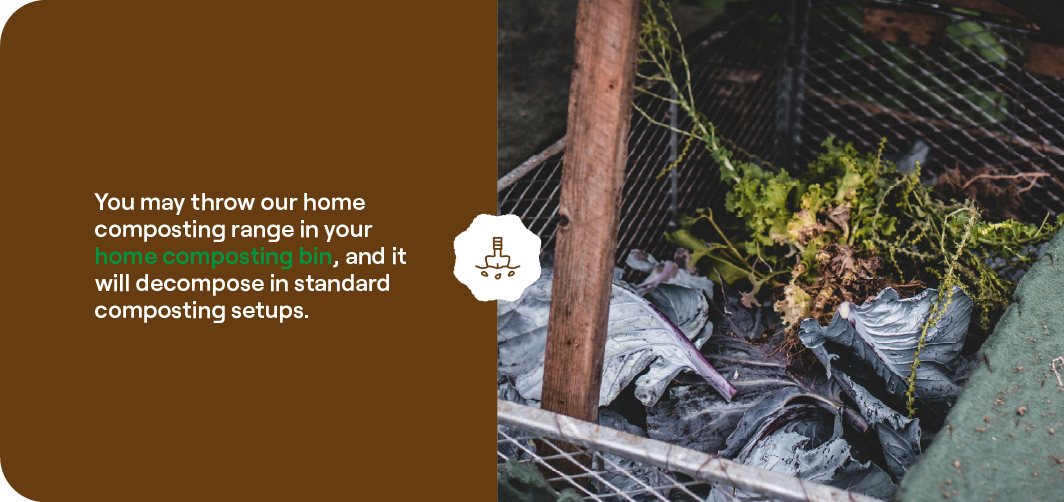
Home composting is a lower-temperature, smaller-scale process you can manage in a backyard, community garden, or small bin. This means it relies on ambient outdoor temperatures rather than specialized equipment, so it works more slowly and handles a narrower range of materials than an industrial facility.
For restaurant owners, home composting matters most when your customers take packaging home with them. If they have a backyard compost bin, products certified for home composting give them a verified disposal pathway. Products without that certification will just sit in their pile without breaking down.
How Does Home Composting Work?
A home compost system works by layering two types of materials. You combine nitrogen-rich “greens” with carbon-rich “browns,” and microorganisms feed on these layers to gradually break them down into finished compost.
Here’s what goes into each category:
- Greens (nitrogen-rich): Food scraps, coffee grounds, fresh grass clippings, and vegetable trimmings.
- Browns (carbon-rich): Dry leaves, cardboard, paper, and wood chips.
To keep the process moving, you need to maintain consistent moisture and turn the pile regularly to introduce airflow. The pile should feel like a damp sponge, not soaking wet or bone dry. Turning it every week or two brings oxygen to the microorganisms doing the work.
Because home compost piles depend on outdoor temperatures, the timeline is slower than what you’d see at an industrial facility. A well-managed home bin can produce finished compost in several months, but results vary with climate, pile size, and how actively you maintain it.
What Can You Home Compost?
Common home-compostable inputs include fruit and vegetable scraps, coffee grounds, eggshells, yard waste like leaves and grass clippings, and uncoated paper products. These materials break down reliably at the lower temperatures found in a backyard bin.
You can also add certified home compostable foodservice products, but this is where it gets specific. Only products carrying TÜV Austria OK Compost HOME certification (S0541) are verified to break down at home compost temperatures.
Standard compostable plastics, including most PLA products, require the sustained high heat of an industrial facility and won’t fully break down in your backyard. If a product doesn’t carry a home compostability certification, it doesn’t belong in a home bin. Putting the wrong products in a home pile just creates contamination and frustration.
What Is Industrial Composting?
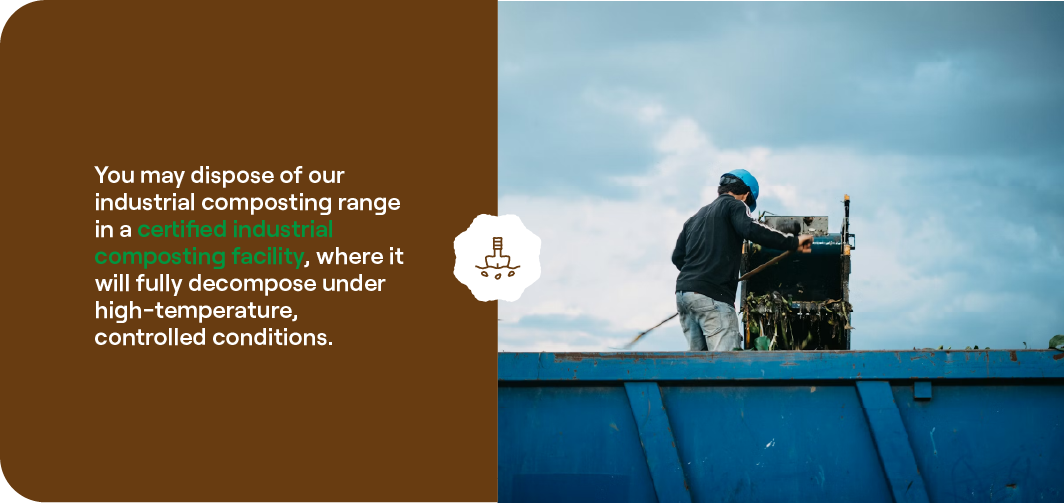
Industrial composting is a controlled, high-temperature process operated by commercial facilities specifically designed to break down organic waste at scale. This means these facilities can accept a much wider range of materials than a home bin, including certified industrial-compostable packaging that requires sustained heat to fully decompose.
For restaurant owners, industrial composting is relevant when your municipality or waste hauler offers commercial composting pickup. If that service is available, you can use a broader range of certified compostable products for dine-in service and takeout containers.
How Do Industrial Composting Facilities Work?
Industrial composting facilities maintain sustained high temperatures through active management of large compost piles or enclosed vessels. This means operators control moisture levels, aeration, and pile composition to create ideal conditions for rapid decomposition.
Facilities typically use one of these methods:
- Windrow composting: Long rows of material turned regularly by machinery to maintain airflow and temperature.
- Aerated static piles: Large piles with built-in air circulation systems that eliminate the need for turning.
- In-vessel systems: Enclosed containers or drums that give operators precise control over temperature, moisture, and oxygen.
This controlled environment allows facilities to process materials that home composting simply can’t handle. The sustained heat also speeds up the overall timeline compared to a backyard bin, producing finished compost more quickly and consistently.
What Can Be Industrially Composted?
Industrial facilities accept everything a home bin can handle, plus a broader range of certified compostable foodservice products. This includes standard PLA cutlery, molded fiber containers like bagasse clamshells and plates, and other packaging certified to break down at commercial facility temperatures.
Products carrying BPI Commercial Compostability certification or TÜV Austria OK Compost INDUSTRIAL certification are designed specifically for this pathway. If your local waste hauler offers commercial composting pickup, these certified products can be diverted from the landfill and processed into finished compost alongside food scraps and other organic waste.
The key is making sure your certified products actually reach the composting facility. That means setting up clearly labeled bins, training your staff on proper sorting, and confirming with your hauler that they’re processing compostables correctly.
What Are the Key Differences Between Home and Industrial Composting?
The core difference between home and industrial composting comes down to temperature, scale, and the range of materials each pathway can process. This means the composting path you have access to determines which certified products will actually work for your restaurant.
| Factor | Home Composting | Industrial Composting |
|---|---|---|
| Temperature | Ambient outdoor temperatures | Sustained high temperatures maintained by facility operators |
| Timeline | Several months or longer | Faster due to controlled conditions |
| Accepted Materials | Food scraps, yard waste, TÜV HOME certified products | All home compostable materials plus BPI and TÜV INDUSTRIAL certified products |
| Scale | Backyard bins, small community setups | Large commercial facilities processing high volumes |
| Required Certification | TÜV Austria OK Compost HOME | BPI Commercial Compostability or TÜV Austria OK Compost INDUSTRIAL |
| Accessibility | Available to anyone with outdoor space | Requires municipal or commercial composting service |
Understanding these distinctions helps you choose the right certified products for the composting infrastructure available in your area. A product certified only for industrial composting won’t break down in a customer’s backyard bin, no matter how well they manage their pile.
Which Method Is Better for the Environment?
Neither method is universally better. The environmental benefit comes from certified compostable products actually reaching the correct composting stream, not from one method being superior to the other.
Here’s how to think about it:
- If your community has reliable commercial composting pickup: Industrial compostable products are a strong fit because the infrastructure is already in place to process them.
- If your area lacks industrial composting access: Home compostable products give your customers a verified disposal pathway they can manage themselves.
- If your customers take packaging home: Home compostable products matter most because you can’t control whether they have access to commercial composting.
The worst outcome for any compostable product is ending up in a landfill — the third largest U.S. methane source — where it loses its composting benefit entirely regardless of which certification it carries. Matching products to the right pathway is what delivers the actual environmental benefit.
Why Compostability Certifications Matter for Your Restaurant
Per FTC Green Guides, an unqualified "compostable" claim on packaging is vague and potentially misleading. This means restaurants need products backed by named, third-party certifications that specify exactly which composting pathway the product is designed for.
Without that specificity, you risk greenwashing exposure and non-compliance with tightening state regulations. Customers and regulators are increasingly skeptical of broad environmental claims, and "compostable" without a certification to back it up doesn’t meet the standard.
Home Compostable Certifications (TÜV OK Compost HOME)
TÜV Austria OK Compost HOME certification, from the world market leader in bioplastics certification, verifies that a product will fully break down at the ambient temperatures found in a home compost bin. This is a rigorous standard that most compostable plastics cannot meet, because standard PLA requires the sustained high heat of an industrial facility to decompose.
Our Greenprint® Upcycled Agave Straws carry TÜV Austria OK Compost HOME certification (S0541). This is possible because of a proprietary enzyme masterbatch integrated during compounding at 160–190°C that catalyzes hydrolysis of PLA polymer chains, enabling full breakdown at ambient temperatures (20–30°C) where standard PLA would remain intact.
Standard PLA without this enzyme technology requires industrial composting at 55–60°C and cannot achieve HOME certification. This distinction is what makes the home compostability claim for our straws verifiable and specific, not a general property of the material itself.
Industrial Compostable Certifications (BPI, TÜV OK Compost INDUSTRIAL)
BPI Commercial Compostability and TÜV Austria OK Compost INDUSTRIAL are the two primary certifications for products designed to break down in commercial composting facilities. Both require the product to fully decompose under the sustained high temperatures that industrial facilities maintain.
Our Fiberware™ line of plates, bowls, and clamshells is made from bagasse (sugarcane fiber) and carries TÜV Austria OK Compost INDUSTRIAL certification (S1069). These products require a commercial composting facility and should not be placed in a home bin.
Our Compostable Upcycled Agave Cutlery carries BPI Commercial Compostability certification (10529314-01). Unlike our Upcycled Agave Straws, the cutlery does not currently hold TÜV HOME certification and requires industrial composting at 55–60°C. This distinction matters for accurate labeling and FTC Green Guides compliance.
How to Choose the Right Composting Path for Your Restaurant
Start by auditing the waste infrastructure available in your area. Contact your waste hauler or municipality to find out whether commercial composting pickup is offered, and which certifications local facilities accept, keeping in mind most U.S. facilities accept only yard trimmings.
Here’s a simple framework for matching products to your situation:
- You have commercial composting pickup: Use industrial compostable products like our Fiberware™ clamshells, plates, and bowls, and our Compostable Upcycled Agave Cutlery. Set up clearly labeled bins and train your staff on proper sorting.
- You don’t have commercial composting access: Focus on home compostable products like our Upcycled Agave Straws for items that leave with customers. They can compost these at home without needing any special facility.
- You serve both dine-in and takeout: Consider a mix of both pathways. Use industrial compostable containers for dine-in service that goes through your commercial composting program, and home compostable Upcycled Agave Straws that leave with your customers.
The key is matching each product to the composting stream it’s certified for. A product in the wrong stream is just contamination, whether that’s an industrial-only product in a home bin or any compostable product in a landfill.
Explore our products to see the full range, or contact our team for help matching products to your local composting infrastructure.
Frequently Asked Questions About Home and Industrial Composting
What is the difference between "compostable" and "commercially compostable" on packaging labels?
"Commercially compostable" means the product requires an industrial composting facility to break down and will not decompose in a home bin. An unqualified "compostable" label is vague and potentially non-compliant with FTC Green Guides because it doesn’t tell you which composting pathway the product actually needs.
Can compostable foodservice products go in the regular trash if composting isn’t available?
Compostable products sent to a landfill lose their composting benefit because landfills lack the oxygen and microbial activity needed for decomposition. If composting isn’t available locally, look into nearby drop-off programs or choose products matched to the waste infrastructure you do have access to.
Are all PLA products home compostable?
No. Standard PLA requires the sustained high temperatures (55–60°C) of an industrial composting facility and will not break down in a home compost bin. Our Greenprint® Upcycled Agave Straws achieve home compostability specifically because of a proprietary enzyme masterbatch integrated during compounding at 160–190°C that catalyzes hydrolysis of PLA polymer chains, enabling full breakdown at ambient temperatures (20–30°C), which is why they carry TÜV Austria OK Compost HOME certification (S0541) while standard PLA products cannot.
Match Your Packaging to the Right Composting Path With Greenprint®
We designed our product portfolio so you don’t have to choose between doing the right thing and running a practical operation. Our Upcycled Agave Straws give your customers a verified home compostable option, while our Fiberware™ plates, bowls, and clamshells and our Compostable Upcycled Agave Cutlery serve restaurants with access to commercial composting programs.
Every product carries named, third-party certification tied to a specific composting pathway, so your sustainability claims hold up under scrutiny. The right packaging choice depends on your local infrastructure, your service model, and how your customers dispose of what they take home.
We’re here to help you figure that out. Browse our full line to see what fits your operation, or contact us today and we’ll walk you through it.


Certified Compostable Plates for Restaurants: What to Look for and Why It Matters Switching to certified compostable plates is a…

Compostable Forks for Restaurants: Materials, Certifications, and What to Look For Choosing the right compostable fork for your restaurant means…
Compostable Cups Benefits: Why Businesses Are Making the Switch Our compostable cups give restaurant owners a practical way to reduce…