

Emerging Materials for Compostable Straws: Full Guide



Content
- Key Takeaways
- What Are Compostable Straws?
- Why Compostable Straws Matter for Your Restaurant
- Plastic Straws vs. Compostable Straws vs. Paper Straws
- The Best Emerging Materials for Compostable Straws
- Common Challenges With Compostable Straws and How to Avoid Them
- Home Compostable Straws vs. Industrial Compostable Straws
- What Compostable Straw Certifications Actually Mean
- How to Choose the Right Compostable Straw for Your Business
- Make the Switch to Compostable Straws With Greenprint®
- Frequently Asked Questions About Compostable Straws
Emerging Materials for Compostable Straws: A Complete Guide
Choosing the right compostable straw for your restaurant means understanding what each material does, how it breaks down, and which certifications prove it. This guide covers every major straw material, the certifications that matter, and how to match the right option to your operation.
Key Takeaways
- Not all compostable straws are the same. The straw material you choose determines durability, composting pathway, and whether it meets verified certification standards.
- Home compostable straws are rare because standard plant-based plastics need high-temperature industrial facilities to break down. Only specific material innovations can achieve home compostability certification.
- Certifications from BPI and TÜV Austria are the only reliable way to verify a compostable straw claim. Marketing language alone doesn’t meet FTC Green Guides standards.
What Are Compostable Straws?
Compostable straws are drinking straws made from plant-based materials that fully break down into natural substances under specific composting conditions. This means they return to the earth as organic matter when composted properly.
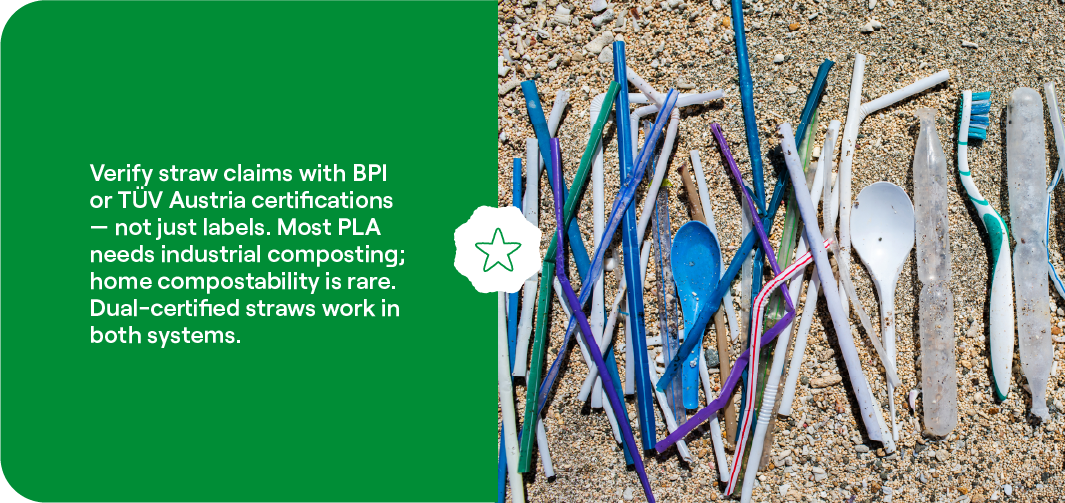
A straw isn’t compostable just because someone puts it on the label. It must meet testing standards and earn certification from bodies like BPI or TÜV Austria. The FTC Green Guides make clear that unqualified compostability claims without certification backing are potentially misleading.
Compostable straws are typically made from materials like PLA, PHA, agave fiber compounds, sugarcane bagasse, bamboo, or other plant fibers. Each material has different performance characteristics and composting requirements.
Why Compostable Straws Matter for Your Restaurant
Compostable straws help your restaurant stay ahead of plastic straw bans, meet customer expectations, and reduce compliance risk. States like California, New York, Washington, Vermont, and Massachusetts have enacted legislation restricting single-use plastics.
Your customers notice what you serve their drinks with. Offering a certified compostable straw signals that your sustainability commitment is real. That transparency builds trust and loyalty.
Using straws with recognized certifications also protects you from regulatory penalties. California’s AB 1201 prohibits “home compostable” labeling without OK Compost HOME certification, and products without verified certifications may not meet the legal definition of “compostable” in your market.
Plastic Straws vs. Compostable Straws vs. Paper Straws
Before exploring emerging materials, here’s how the three main straw categories compare on factors that matter to your operation.
| Factor | Plastic Straws | Paper Straws | Compostable Straws |
|---|---|---|---|
| Material source | Petroleum-based | Wood pulp | Plant-based bioplastics, agricultural fibers |
| End-of-life pathway | Landfill | Often landfill due to coatings | Composting (home or industrial) |
| Durability | Excellent | Poor | Good to excellent |
| Certifications | None | Rarely certified | BPI, TÜV Austria |
| PFAS risk | Low | High | Low when verified |
Plastic Straws
Plastic straws offer strong durability and work well in any beverage. However, they have no composting pathway. They persist in landfills for centuries, and regulatory bans in key markets are making them impractical for restaurant operators.
Paper Straws
Paper straws are the most common switch restaurants make. The well-known problem is sogginess. Paper straws lose structure quickly, especially in thick or hot beverages.
Many paper straws also use PFAS-based coatings to resist moisture. PFAS are synthetic chemicals linked to health concerns that compromise compostability claims.
Compostable Straws
Compostable straws solve paper’s performance problems while offering a verified end-of-life pathway. The critical distinction is that “compostable” must be backed by certification, not just a label claim.
Per FTC Green Guides, a straw marketed as compostable without recognized certification is making an unsubstantiated claim. Look for BPI or TÜV Austria seals before purchasing.
The Best Emerging Materials for Compostable Straws
Not all plant-based straw materials perform equally. Your choice affects durability, composting pathway, certification eligibility, and sourcing ethics. Here’s what you need to know about each option.
PLA (Polylactic Acid)
PLA is a plant-based plastic typically derived from corn starch. It’s the most widely used bioplastic in compostable straws. PLA straws offer solid durability in cold beverages and can earn BPI certification for industrial composting.
The limitation is that standard PLA requires high-temperature industrial composting facilities. It cannot achieve home compostability certification on its own. Without industrial composting access, a PLA straw may end up in landfill.
PHA (Polyhydroxyalkanoates)
PHA is a newer bioplastic produced through microbial fermentation. It can break down in a broader range of environments than PLA, including soil and marine conditions.
The trade-off is cost and availability. PHA is currently more expensive to produce, and fewer manufacturers offer PHA-based straws at commercial scale.
Agave Fiber
Agave fiber is a post-tequila agricultural waste product. Unlike bamboo or wheat straw, agave waste has no competing use. This makes it a pure waste-to-value material.
We use Upcycled Agave Fibers in our Green Dot Compostable Upcycled Agave Straws. What makes this material different is the enzyme technology we integrate during compounding. The enzyme masterbatch is integrated during compounding at 160–190°C. It catalyzes hydrolysis of PLA polymer chains, enabling full biodegradation at ambient temperatures (20–30°C). This is what enables TÜV Austria OK Compost HOME certification.
This is specifically what earned our straws TÜV Austria OK Compost HOME certification. They also carry BPI Commercial Compostability certification. Standard PLA without enzyme technology, like Greenprint’s Compostable Agave Cutlery, requires industrial composting at 55–60°C and cannot achieve HOME certification.
Sugarcane Bagasse
Sugarcane bagasse is the fibrous material left after sugarcane juice extraction. It’s widely used in foodservice products like plates and bowls. Straw applications are emerging but less common.
Bagasse products typically qualify for industrial compostability certification, not home compostability. If you already use bagasse foodware, bagasse straws could complement your composting program.
Bamboo Fiber
Bamboo grows quickly and regenerates without replanting. However, most bamboo is sourced from Asia and requires long-haul shipping. Compostability certifications for bamboo straw formats remain limited.
For operators prioritizing regional sourcing and verified certifications, alternatives like agave fiber offer a stronger profile.
Wheat and Reed
Wheat and reed straws are minimally processed natural options. They’re literally hollow plant stems used as drinking straws.
Wheat has a competing use as animal feed, which raises sourcing questions. Both materials have limited scalability and inconsistent performance for commercial foodservice.
Rice and Other Edible Straw Materials
Edible straws made from rice, pasta, or seaweed appeal to customers wanting a zero-waste experience. The practical challenge is durability.
Most edible straws soften quickly in both hot and cold beverages. Established compostability certifications for these formats are rare.
| Material | Composting Pathway | Durability | Sourcing Concern |
|---|---|---|---|
| PLA | Industrial only | Good (cold drinks) | Corn cropland use |
| PHA | Broader environments | Good | Higher cost |
| Agave fiber (enzyme-enhanced) | Home and industrial | Excellent | No competing use |
| Sugarcane bagasse | Industrial | Moderate | None significant |
| Bamboo | Limited | Moderate | Long-haul shipping |
| Wheat/Reed | Varies | Inconsistent | Animal feed competition |
| Rice/Edible | Not typically certified | Poor | None significant |
Common Challenges With Compostable Straws and How to Avoid Them
Restaurant owners evaluating compostable straws consistently raise three concerns: durability, chemical safety, and misleading marketing.
Durability and Sogginess
The top complaint with paper straws and some bioplastic straws is that they fall apart before customers finish their drink. Material composition determines how long a straw holds up.
Not all compostable straws perform the same in hot drinks, smoothies, or iced beverages. Always request samples and test them with your actual menu items before committing.
PFAS and Chemical Safety
PFAS are synthetic chemicals often used as moisture-resistant coatings in foodservice packaging. They don’t break down in the environment and are linked to health concerns.
Our Green Dot Compostable Upcycled Agave Straws are third-party verified PFAS-free through BPI certification, which requires testing below 100 ppm organic fluorine. When evaluating any straw, ask for third-party PFAS testing documentation rather than relying on self-declared claims.
Greenwashing and Misleading Labels
Labels like “plant-based” or “natural” don’t mean a straw is compostable; these are common greenwashing tactics. The FTC Green Guides require that compostability claims be backed by specific, verifiable evidence.
Here’s how to protect yourself:
- Check for certification seals. Look for BPI or TÜV Austria logos on packaging.
- Verify the listing. Confirm products on the certifying body’s website.
- Request documentation. If a supplier can’t provide certification proof, treat the claim with skepticism.
Home Compostable Straws vs. Industrial Compostable Straws
Most compostable straws require industrial composting. Home compostability is rare and requires specific material innovation. Understanding the difference between industrial and home composting helps you choose the right straw for your waste setup.
How Home Composting Works
Home composting happens at ambient temperatures in a backyard bin or pile. The TÜV Austria OK Compost HOME standard verifies that a product breaks down fully under these conditions.
Standard PLA fails at home compost temperatures. The enzyme technology we integrate catalyzes hydrolysis of PLA polymer chains at ambient temperatures (20–30°C), which is what makes our TÜV Austria OK Compost HOME certification possible. Our internal testing, documented in biodegradation study GP-BIO-001, confirmed full breakdown by Week 20 in home compost conditions (20–30°C), validated in triplicate. This data supports the certification findings.
How Industrial Composting Works
Industrial composting facilities maintain high temperatures and controlled conditions. BPI certification, tied to ASTM D6400, confirms a product will fully compost in these managed environments.
Most PLA-based compostable straws require this pathway. Without industrial composting access, they won’t break down in a backyard bin.
Which Compostable Path Fits Your Operation?
If your area has reliable industrial composting pickup, industrial-certified straws work for you. If industrial access is limited, home compostable straws are the practical choice.
Our dual-certified Green Dot straws work in either pathway, giving you flexibility regardless of your local waste system.
What Compostable Straw Certifications Actually Mean
Certifications protect you from greenwashing and regulatory risk. They’re your proof that a compostability claim is real.
BPI Certification
BPI certification is the U.S. standard for industrial compostability. It confirms a product meets ASTM D6400 requirements and will fully break down in a commercial composting facility. You can verify any product’s BPI listing on their website.
TÜV Austria OK Compost HOME and INDUSTRIAL
TÜV Austria offers two certification tiers:
- OK Compost INDUSTRIAL. Verifies breakdown in high-temperature facilities.
- OK Compost HOME. Verifies breakdown at ambient, backyard compost temperatures.
HOME certification, requiring a minimum of 12 months biodegradation testing, is significantly harder to achieve and remains rare in the straw category.
Why Dual Certification Matters
Dual certification means a straw is verified for both home and industrial composting. This gives your operation maximum flexibility.
Our Green Dot Compostable Upcycled Agave Straws carry both TÜV Austria OK Compost HOME and BPI certifications, making them the most versatile certified option available.
How to Choose the Right Compostable Straw for Your Business
Here’s a practical decision framework:
- Assess your local infrastructure. Does your waste hauler accept compostables? Is there an industrial facility nearby?
- Check for verified certifications. Look for BPI or TÜV Austria seals and confirm them online.
- Test performance with your menu. Order samples and try them in your hot drinks, smoothies, and cold beverages.
- Confirm PFAS-free status. Request third-party testing documentation.
If your operation doesn’t have composting access, consider our Blue Dot PCR Upcycled Agave Straws. They’re made with post-consumer recycled content and Upcycled Agave Fibers, offering a recycling-path alternative.
Make the Switch to Compostable Straws With Greenprint®
We built our straw line to solve the real problems restaurant owners face. Our Green Dot Compostable Upcycled Agave Straws use Upcycled Agave Fibers sourced as post-tequila waste with no competing use. They’re dual-certified by TÜV Austria OK Compost HOME and BPI, and verified PFAS-free through third-party testing.
Explore our full straw line at our store or contact our team for samples and pricing.
Frequently Asked Questions About Compostable Straws
How long do certified compostable straws take to break down?
Home compostable straws break down fully within the timeframes established by TÜV Austria OK Compost HOME standards at ambient temperatures. Industrial compostable straws break down in commercial facilities following BPI/ASTM D6400 timelines.
Are compostable straws tested for PFAS contamination?
Many paper and coated straws contain PFAS. Our Green Dot Compostable Upcycled Agave Straws are third-party verified PFAS-free through BPI certification.
Do agave-based compostable straws hold up in hot drinks and smoothies?
Performance depends on the material. Our agave-based straws maintain structural integrity in both hot and cold beverages where paper straws typically fail.
What is the difference between “compostable” and other environmental terms on packaging?
“Compostable” is a certified, verifiable claim tied to specific standards like BPI or TÜV Austria. Other commonly used terms like “recyclable” and “biodegradable” lack standardized definitions and are flagged by the FTC Green Guides as potentially misleading when used without qualification.

Nanoplastics vs. microplastics comes down to size. Learn how they differ, why researchers worry more about nanoplastics, and simple ways to reduce exposure.
Earth Day facts that show the scale of the environmental crisis, from plastic and landfill waste to CO2 and wildlife loss. See what the numbers mean for you.

Minnesota plastic ban rules for businesses, including city bag fees, Green To Go takeout packaging, PFAS limits, compostable labels, and EPR dates to plan for.