

Compostable Certifications: Emerging Standards in 2026



Content
- Key Takeaways
- What's Actually Changing in Compostable Standards in 2026
- Third-Party Certifications You Can Actually Trust
- Common Criticisms of Compostable Packaging and What's Actually True
- Compostable vs. Bio-Based vs. Oxo-Fragmentable: What Each Label Really Means
- How to Prepare Your Restaurant for the New Certification Landscape
- References
Compostable Certifications in 2026: What’s Changing and Why It Matters for Your Restaurant
The rules around compostable packaging are shifting fast, and the certifications you rely on today may not meet tomorrow’s legal requirements. This guide breaks down the emerging standards, the certifications that actually hold up to scrutiny, and the practical steps you can take right now to keep your restaurant compliant and your sustainability claims honest.
Key Takeaways
- New ASTM field-testing standards and state-level laws are redefining what “compostable” legally means for foodservice packaging, and restaurant owners need to verify their products meet updated requirements.
- Third-party certifications like BPI and TÜV Austria OK Compost HOME are the only reliable way to prove compostability claims under FTC Green Guides, while vague labels like “bio-based” carry no verifiable end-of-life guarantee.
- Preparing now by auditing your current packaging, confirming certifications, and partnering with transparent suppliers will protect your business from regulatory penalties and build trust with your customers.
What’s Actually Changing in Compostable Standards in 2026
Compostable packaging standards are moving from lab-controlled testing toward real-world performance verification. At the same time, state legislatures are writing stricter definitions of “compostable” into law.
For restaurant owners, this means the packaging you purchase today needs to meet higher bars for both scientific proof and legal compliance. These changes are driven by growing frustration with products labeled “compostable” that don’t actually break down in real composting systems.
The result is a tighter, more transparent certification landscape. Products that genuinely compost will be rewarded. Greenwashing will be penalized. Here’s what’s shifting and why it matters for your purchasing decisions.
New ASTM Field-Testing Standards for Compostable Products
ASTM International has introduced new field-testing methods that evaluate compostable products in actual composting facilities. These standards, known as D8618 and D8619, measure how products perform in the variable temperatures, moisture levels, and microbial conditions found at real industrial composting infrastructure sites.
This is a significant shift from older standards like ASTM D6400. Those older tests evaluate materials under optimized lab conditions, which don’t always reflect what happens at a working compost facility.
The new field-testing methods close that gap. They require products to demonstrate breakdown under the same conditions your waste hauler’s facility actually operates. This matters because a product that passes a lab test but fails in a real compost pile still ends up contaminating finished compost or heading to a landfill.
For your restaurant, this means looking for suppliers whose products are tested and certified against these updated benchmarks. At Greenprint®, we welcome this shift because our products are built to perform in real composting environments, not just pass a lab test.
State-Level Regulations From California to Colorado
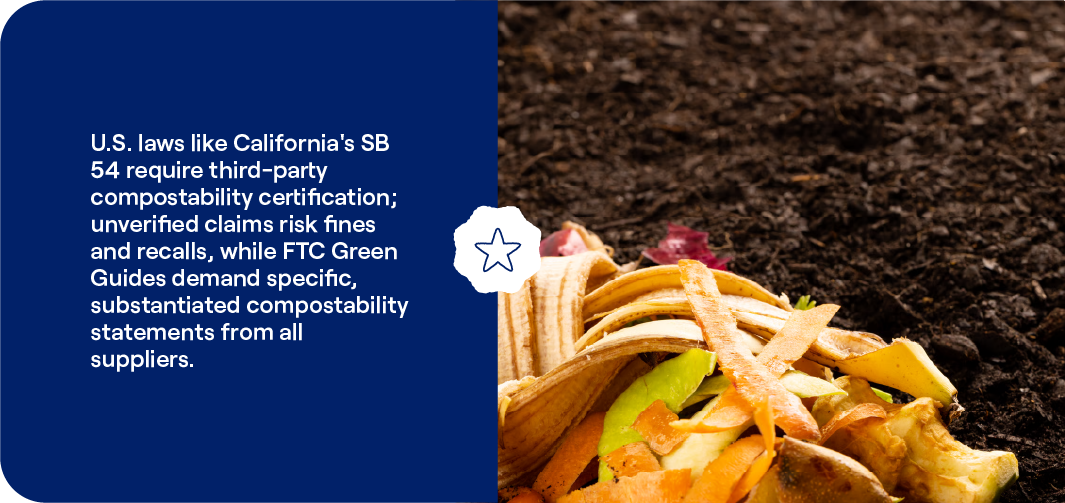
States across the U.S. are passing laws that restrict which products can legally be labeled or sold as “compostable.” California’s SB 54, along with legislation in Colorado, Washington, and other states, now requires compostable foodservice packaging to carry third-party certification from a recognized body.
Products with self-declared or unverified compostable claims can result in fines and forced product recalls. If your supplier can’t show you a valid certification from BPI or TÜV Austria, you could be the one facing a compliance issue during an inspection.
Many of these laws also introduce Extended Producer Responsibility policies — nearly a third of U.S. states have introduced or passed them. EPR is a framework that makes packaging manufacturers financially responsible for the end-of-life management of their products. This means the brands you buy from need to have their compliance documentation in order.
This patchwork of state regulations also affects FTC Green Guides claims. The FTC requires that any compostability claim be specific, substantiated, and qualified. Saying “compostable” without specifying whether a product requires home or industrial composting, or without holding a valid certification, is considered misleading under current guidelines.
Third-Party Certifications You Can Actually Trust
Third-party certification is the only reliable way to verify that a compostable product will actually break down as promised. Under FTC Green Guides, environmental seals and certifications must clearly convey the basis for the certification. A logo on a package means nothing if you can’t trace it back to a specific standard and a recognized certifying body.
The two certifications that matter most for foodservice operators in the U.S. are BPI and TÜV Austria. Understanding the difference between them helps you match the right product to your local waste infrastructure.
BPI Commercial Compostability
BPI certification is the U.S. gold standard for products designed to break down in industrial composting facilities. BPI stands for Biodegradable Products Institute. A BPI certified compostable product has been independently tested against ASTM D6400, which verifies that it will disintegrate and break down under the high-temperature conditions found at commercial compost sites.
Products must also pass ecotoxicity screening to confirm they won’t harm the finished compost or the soil it’s applied to, and must contain less than 100 ppm total organic fluorine. This is why BPI certification carries weight with composting facilities, waste haulers, and regulators.
Our Compostable Upcycled Agave Straws carry BPI Commercial Compostability certification. Our Compostable Upcycled Agave Cutlery also carries BPI Commercial Compostability certification. This means these products are accepted at participating industrial composting facilities across the country, giving you a clear, verifiable end-of-life pathway for your disposables.
TÜV Austria OK Compost HOME and Industrial
TÜV Austria offers two distinct compostability certifications that serve different purposes:
- OK Compost INDUSTRIAL: Verifies breakdown under the high temperatures of commercial facilities, similar to BPI.
- OK Compost HOME: A stricter standard that requires products to fully break down at the lower, ambient temperatures found in a backyard compost bin.
Achieving TÜV OK Compost HOME certification is rare for foodservice products. Standard PLA, which is a common plant-based plastic, requires high industrial temperatures to break down. Most PLA products simply cannot meet the HOME standard.
Our Compostable Upcycled Agave Straws carry TÜV Austria OK Compost HOME certification. They achieve this because they’re made with an enzyme masterbatch integrated during compounding at 160–190°C, which catalyzes hydrolysis of PLA polymer chains and enables full breakdown at ambient temperatures (20–30°C). Without this enzyme technology, standard PLA requires industrial composting at 55–60°C and cannot achieve HOME certification. That’s why our Compostable Upcycled Agave Cutlery carries BPI Commercial Compostability certification for industrial composting rather than TÜV HOME.
This distinction matters for your restaurant. If your customers take straws home and compost them in their backyard, our TÜV Austria OK Compost HOME certification means those straws will actually break down. If your cutlery goes into a commercial compost bin at your facility, BPI Commercial Compostability certification confirms it will be processed correctly there.
Common Criticisms of Compostable Packaging and What’s Actually True
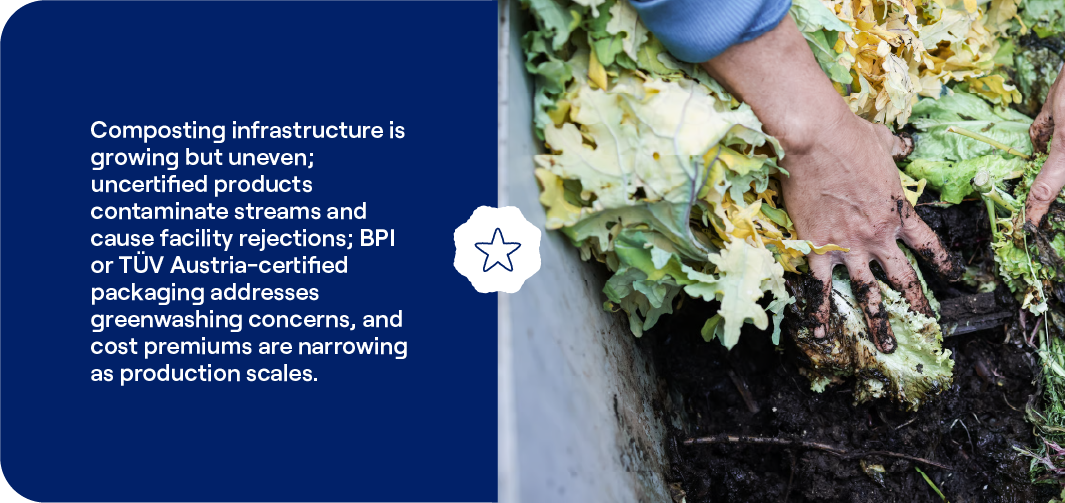
The most common criticism of compostable packaging is that it doesn’t break down because composting infrastructure doesn’t exist in most communities. This concern has some truth to it, but the picture is more nuanced than the criticism suggests.
Industrial composting infrastructure is growing from almost 5,000 facilities today. More municipalities are adding organics diversion programs, and state-level mandates are accelerating that buildout.
The real problem isn’t that compostable packaging can’t work. It’s that many products on the market carry vague or unverified claims. When uncertified products contaminate compost streams, facilities start rejecting all compostable packaging. This includes the certified products that would have broken down just fine.
Here’s how to separate legitimate concerns from outdated criticisms:
- Infrastructure gaps: Real but improving. Check whether your municipality or waste hauler accepts certified compostable products before purchasing.
- Contamination concerns: Valid when uncertified products enter the stream. Certified products with BPI or TÜV Austria credentials are designed to avoid this problem.
- Greenwashing accusations: Legitimate when applied to self-declared claims. Third-party certification exists specifically to address this issue.
- Cost premiums: True in most cases, but the gap is narrowing as production scales up.
On cost, compostable products do carry a premium over conventional plastic. But that cost needs to be weighed against the cost of non-compliance with new state laws, the brand value of genuine sustainability, and the growing number of customers who choose restaurants based on their environmental practices.
Circular economy waste management isn’t just an environmental strategy. It’s a business strategy that positions your restaurant for long-term success.
Compostable vs. Bio-Based vs. Oxo-Fragmentable: What Each Label Really Means
“Compostable,” “bio-based,” and “oxo-fragmentable” are not interchangeable terms, even though they’re often used as if they are. Only “compostable” carries a verifiable, certified end-of-life pathway when backed by third-party testing.
Here’s how these labels compare:
| Label | What It Means | Certification Required? | Verified End-of-Life? |
|---|---|---|---|
| Compostable | Breaks down into natural elements in a composting system within a defined time frame. | Yes (BPI, TÜV Austria). | Yes, when certified. |
| Bio-based | Made partly or fully from plant-derived materials. Says nothing about end-of-life. | No standard certification required. | No. |
| Oxo-fragmentable | Contains metal additives that fragment plastic into smaller pieces. Does not fully break down. | No recognized composting certification. | No. Banned in several jurisdictions. |
Under FTC Green Guides, claiming a product is "compostable" without specifying conditions and without holding a valid certification is misleading. Bio-based products may sound sustainable, but a bio-based cup that can’t be composted or recycled still ends up in a landfill.
This is also where PFAS-free food packaging enters the conversation. PFAS stands for per- and polyfluoroalkyl substances. These chemicals are sometimes used in food packaging for grease resistance, and they don’t break down in composting systems.
All of our verified Greenprint® product lines have undergone third-party PFAS testing. This isn’t a self-declared claim. When you’re evaluating packaging labels, look for both compostability certification and verified PFAS-free status to ensure you’re making a fully informed choice.
How to Prepare Your Restaurant for the New Certification Landscape
The best way to prepare for what’s changing is to act now rather than react later. Start with a straightforward audit of every disposable product in your operation.
Here’s a practical action plan:
- Audit your current packaging: List every disposable item you use, from cups and straws to clamshells and cutlery. Note the material, the brand, and whether it carries a third-party certification you can verify.
- Verify certifications directly: Look up your products on the BPI certified products database or check for TÜV Austria certification numbers. If a product claims to be compostable but doesn’t appear in a recognized certification directory, it may not meet legal requirements in your state.
- Match products to your local infrastructure: If your area has industrial composting pickup, BPI-certified products are a strong fit. If your customers compost at home, or if industrial access is limited, look for TÜV OK Compost HOME certified options.
- Update your waste systems: Add clearly labeled composting bins, train your staff on proper sorting, and coordinate with your waste hauler to confirm which certified products they accept.
- Partner with a transparent supplier: Work with a supplier that provides full certification documentation, maintains a traceable supply chain, and can tell you exactly what each product is made from and how it should be disposed of.
At Greenprint®, we build our entire product line around this kind of transparency. Our Compostable Upcycled Agave Straws and Compostable Upcycled Agave Cutlery are made with our proprietary agave compound and carry specific certifications for their intended composting pathways. Separately, our Fiberware™ clamshells, plates, and bowls are made from sugarcane fiber. Our Renewacups™ and Clearly Compostable™ cups are separate product lines with their own materials and certifications.
We don’t make blanket claims across our lineup because different products are designed for different end-of-life systems. You deserve to know exactly which is which.
If you’re ready to get ahead of the new certification landscape, contact our team to talk through your specific needs, or explore our products to see the full range of certified options available for your restaurant.
References


Agave Fiber Composition: What Makes Agave-Based Foodware Work Agave fiber gives compostable foodware its structural backbone. Understanding what’s inside this…

Beyond the Label: How to Verify Compostable Cup Claims Choosing compostable cups for your restaurant should be straightforward, but vague…
Straw Life Cycle Assessment: The True Environmental Impact Compared Life cycle assessment is the most reliable way to compare the…