

Material Durability Standards in Foodservice | Operator Guide


Content
- What Material Durability Standards Apply to Foodservice
- Food Grade vs Food Safe: What the Difference Means for Operators
- Common Foodservice Materials and Their Durability Ratings
- Key Certifications and Standards for Foodservice Packaging
- How to Evaluate Material Durability for Your Operation
- Real-World Durability Testing: What to Ask Your Supplier
- How Compostable Packaging Meets Durability Standards
- Frequently Asked Questions
Material Durability Standards in Foodservice: What Operators Need to Know
Every piece of packaging you put in a customer’s hands reflects your operation. When a container buckles under hot soup or a lid warps before it reaches the table, you lose product, time, and trust. Understanding material durability standards in foodservice helps you choose packaging that performs under real conditions, not just on a spec sheet. This guide breaks down the standards that matter, what they actually test, and how to apply them to your purchasing decisions.
What Material Durability Standards Apply to Foodservice
The standards landscape for food contact material standards covers three main areas: federal regulations, industry testing protocols, and voluntary certifications.
FDA food contact regulations (21 CFR) set the baseline. Title 21 of the Code of Federal Regulations defines which materials can safely contact food. Parts 174 through 186 list approved substances for packaging, coatings, and adhesives.
NSF/ANSI standards go further. NSF International develops performance standards that test how materials hold up under actual foodservice conditions. NSF/ANSI 51 covers food equipment materials, including disposable packaging. These standards evaluate whether a material maintains structural integrity through temperature changes, moisture exposure, and repeated food contact.
ASTM testing protocols provide the measurement framework. ASTM International publishes standardized test methods for tensile strength, heat deflection, moisture absorption, and grease resistance. When a supplier claims their product “passed durability testing,” they’re usually referencing ASTM methods.
For your day-to-day purchasing: FDA compliance is required. NSF/ANSI certification is voluntary but signals higher performance validation. ASTM test results give you the data to compare one material against another. For disposable packaging, confirm FDA food contact compliance at minimum. For reusable equipment, NSF/ANSI certification carries more weight with health inspectors.
Food Grade vs Food Safe: What the Difference Means for Operators
You’ll hear these two terms used interchangeably, but they mean different things. Knowing the difference between food grade vs food safe protects you from buying packaging that meets one standard but fails another.
Food grade means the material’s composition meets FDA standards for food contact. The raw materials, dyes, and coatings are approved under 21 CFR. A food grade designation tells you what the material is made of.
Food safe means the material won’t leach harmful substances, degrade, or lose structural integrity under the conditions it’s actually used in. A food safe designation tells you how the material performs.
A container can be food grade but not food safe for your operation. Picture a food grade paperboard container rated for cold items. The material itself is FDA-compliant. Fill it with hot chili, and it softens, leaks, and fails. The material was food grade. It wasn’t food safe for that application.
This distinction matters most when you’re evaluating packaging for high-heat items, greasy foods, or liquids. Always ask suppliers to specify the temperature range, grease resistance rating, and moisture tolerance for each product.

Common Foodservice Materials and Their Durability Ratings
Choosing the right food safe materials starts with understanding how each option handles your kitchen and serving line conditions. The table below compares traditional and compostable materials across the durability factors that matter most during service.
| Material | Heat Tolerance | Moisture Resistance | Grease Resistance | Certification Status |
|---|---|---|---|---|
| Stainless Steel | High (up to 500+ F) | Excellent | Excellent | NSF/ANSI 51 certified options available |
| Conventional Plastic (PP) | Moderate (up to 250 F) | Good | Good | FDA food contact compliant |
| Polystyrene (EPS Foam) | Low-Moderate (up to 200 F) | Good | Moderate | FDA food contact compliant |
| Bagasse (Sugarcane Fiber) | Moderate-High (up to 220 F) | Good with coating | Good | BPI Certified Compostable; FDA compliant |
| PLA (Polylactic Acid) | Low (up to 140 F) | Good | Low-Moderate | BPI Certified Compostable (industrial only) |
| CPLA (Crystallized PLA) | Moderate (up to 185 F) | Good | Moderate | BPI Certified Compostable (industrial only) |
| Agave-Bioplastic Compound | Moderate-High (up to 200 F) | Good | Good | TÜV Austria OK Compost HOME; BPI certified |
For disposable packaging, the gap between conventional and compostable options has narrowed significantly. Bagasse fiber products handle heat and grease well for most hot food applications. PLA has clear heat limitations, which is why it’s typically used for cold cups and containers. For a deeper look at PLA’s properties, see our guide on what PLA plastic is and how it performs in foodservice. For a broader comparison of plant-based options, our bioplastics comparison guide for foodware operators covers the full landscape.
The certification column matters because it tells you whether the material has been independently verified. Products with BPI or TÜV Austria certification have passed standardized testing for both safety and compostability.
Key Certifications and Standards for Foodservice Packaging
Not all certifications test for the same things. Here’s what each one covers and why it matters.
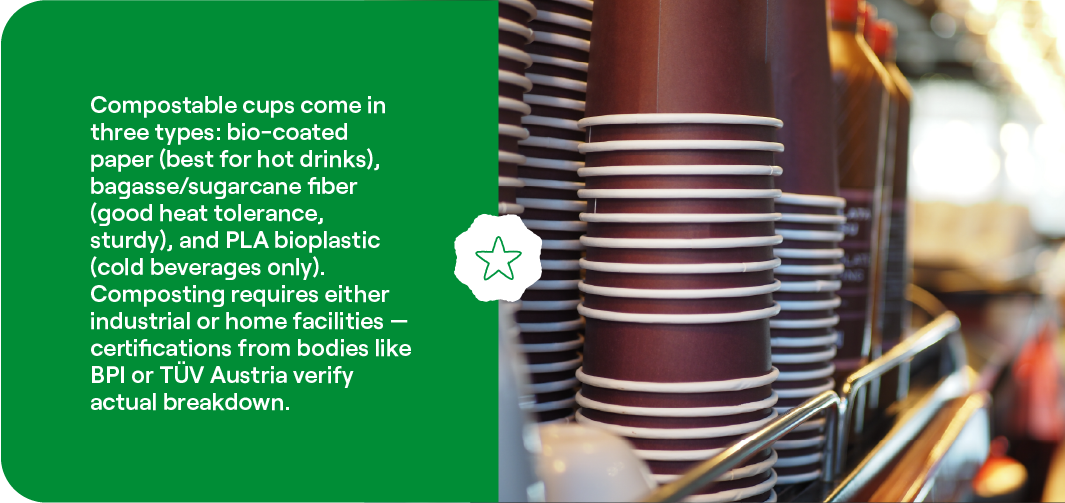
BPI Certified Compostable confirms that a product meets ASTM D6400 (for packaging) or ASTM D6868 (for coated products). BPI certification means the product will disintegrate and biodegrade in an industrial composting facility within a defined timeframe without leaving harmful residues. The testing process behind ASTM D6400 is detailed in our guide on ASTM D6400 compostability testing and verification.
TÜV Austria OK Compost HOME is a stricter standard. Products with this certification break down in home composting conditions, at lower temperatures and over longer timeframes than industrial composting requires.
TÜV Austria OK Compost INDUSTRIAL aligns with the European EN 13432 standard and confirms industrial compostability.
NSF/ANSI 51 evaluates food equipment materials for safety and durability. While primarily applied to permanent equipment, some disposable packaging suppliers reference NSF testing protocols.
FDA 21 CFR compliance is the baseline for all food contact materials in the U.S. It confirms safe chemical composition but does not test for structural durability under service conditions.
When reviewing supplier certifications, look for products that carry both FDA compliance and at least one third-party certification (BPI or TÜV Austria). The FTC Green Guides require that compostability claims specify whether the product is home compostable or industrially compostable, and name the certifying body. Our guide on FTC-compliant compostable product marketing explains these requirements in practice.
How to Evaluate Material Durability for Your Operation
Every operation is different. A taco truck has different demands for durable foodservice packaging than a catering company. Here’s a practical framework for matching material durability to your needs.
Start with your menu. List your highest-risk items: soups, sauces, fried foods, anything served above 180 F. These items stress packaging the most.
Test under real conditions. Request samples and run them through a full service cycle. Fill containers with your actual menu items. Let them sit for your typical delivery or catering hold time. Stack them. Transport them.
Evaluate these factors:
-
Heat hold time: does the container maintain integrity for 30, 60, and 90 minutes with hot food?
-
Grease resistance: does the material resist oil penetration without a separate liner?
-
Moisture resistance: does the container hold liquids without softening or leaking?
-
Stacking strength: can filled containers stack three or four high without crushing?
-
Transit durability: does the packaging survive a 20-minute delivery in a hot bag?
Match evaluation to your service model. Dine-in operations can tolerate lower transit durability. Delivery-heavy operations need containers that survive stacking, jostling, and temperature swings. Catering needs packaging that holds up over extended hold times.
Real-World Durability Testing: What to Ask Your Supplier
Supplier spec sheets are a starting point, but they don’t tell the full story. Before committing to a new product, bring these questions to your supplier.
Certification and compliance:
-
Can you provide the BPI or TÜV Austria certification number for this product?
-
Is this product certified for home composting, industrial composting, or both?
-
Does this product meet FDA 21 CFR food contact requirements?
-
Can you share ASTM test results for heat deflection and grease resistance?
Performance and durability:
-
What is the maximum recommended temperature?
-
How long can this product hold hot food (above 180 F) before structural degradation?
-
Has this product been tested with high-grease foods?
-
Can you provide third-party lab results, not just internal testing data?
Operational fit:
-
Do you offer samples for in-house testing before a case order?
-
What is the minimum order quantity?
-
What storage conditions does this product require?
If a supplier can’t answer these questions or provide documentation, that’s a signal. Reputable manufacturers stand behind their products with third-party test data and clear composting certification documentation and verification.
How Compostable Packaging Meets Durability Standards
There’s a persistent assumption that compostable means flimsy. Early plant-based packaging earned that reputation. Certified compostable materials have improved significantly. Bagasse fiber products, for instance, handle temperatures up to 220 F and resist grease, matching conventional PP containers for most hot food applications.
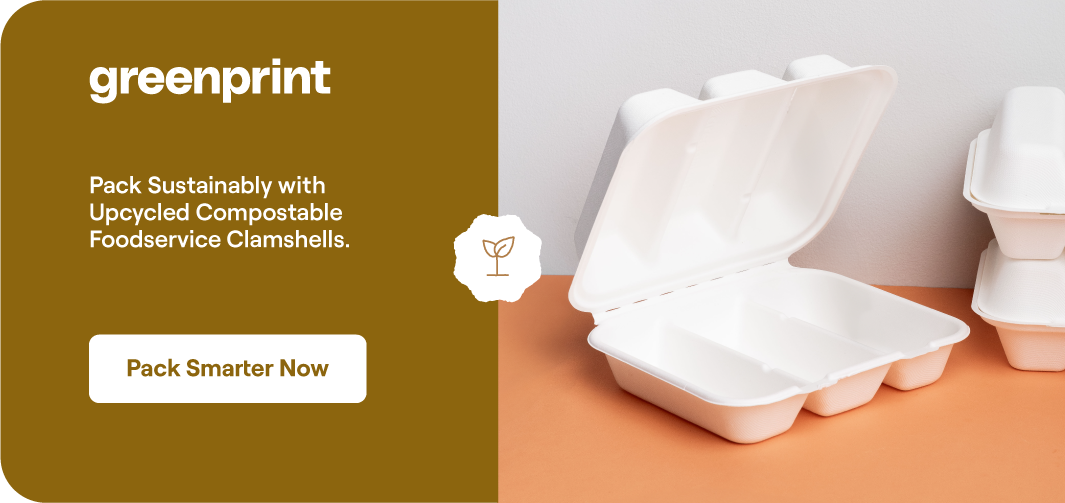
At Greenprint®, our Fiberware™ line of bagasse (sugarcane fiber) products uses the natural strength of pressed plant fiber to handle heat, grease, and moisture. The fiber structure provides rigidity comparable to molded pulp or polystyrene, with heat tolerance reaching 220 F. These products carry BPI Certified Compostable status, meaning they’ve passed ASTM D6400 testing for disintegration, biodegradation, and eco-toxicity in industrial composting facilities.
For home compostability, our enzyme-enhanced agave-bioplastic compound takes a different approach. The enzymatic breakdown mechanism allows the material to decompose in home composting conditions. It carries TÜV Austria OK Compost HOME certification and maintains structural performance throughout service. The material holds its shape, resists grease, and handles moderate heat throughout service, then breaks down after disposal.
The key point: compostable certification doesn’t come at the expense of durability. Products that carry BPI or TÜV Austria certification have been tested for performance under conditions that mirror real foodservice use. The difference is what happens after the product is discarded, not during service.
You can learn more about the distinction between composting pathways in our guide to home and industrial composting methods compared. For operators ready to explore certified options, contact our team today. We offer BPI-certified and TÜV Austria HOME-certified compostable packaging for plates, bowls, containers, cups, and cutlery.
Frequently Asked Questions
What Certifications Should Foodservice Packaging Meet?
At minimum, look for FDA 21 CFR food contact compliance. For compostable products, BPI Certified Compostable (for industrial composting) or TÜV Austria OK Compost HOME (for home composting) provide third-party verification of both safety and compostability.
How Do You Test Compostable Packaging for Durability?
Request samples and test with your actual menu items under real service conditions: heat hold time, grease resistance, stacking strength, and transit durability over 30 to 90 minutes.
Do Compostable Materials Hold Up to Hot Foods and Liquids?
Bagasse fiber products handle temperatures up to 220 F and resist grease and moisture effectively. PLA-based products have lower heat tolerance (around 140 F) and are better suited for cold food and beverages.
References
- https://www.ecfr.gov/current/title-21/chapter-I/subchapter-B/part-174
- https://www.nsf.org/nsf-standards/standards-portfolio/food-equipment-standards
- https://www.ftc.gov/legal-library/browse/federal-register-notices/guides-use-environmental-marketing-claims-green-guides
- https://www.gogreenprint.com/contact


Learn how the Colorado plastic ban and single-use plastic laws affect your business, from the bag fee and foam ban to local rules. Get compliant today.

See the Hawaii plastic ban and single-use plastic laws for Honolulu, Maui, Hawaii County, and Kauai, with dates, fines, and compliant foodware tips for 2026.

Nanoplastics vs. microplastics comes down to size. Learn how they differ, why researchers worry more about nanoplastics, and simple ways to reduce exposure.