

PLA Certification Standards for Restaurant Owners



Content
- Key Takeaways
- What Are PLA Certification Standards?
- What Makes a PLA Product Truly Compostable?
- Key PLA Certification Standards You Need to Know
- Industrial vs. Home Composting and How Certifications Apply
- PFAS-Free Certification and Food Contact Safety
- How PLA Certifications Apply to Restaurant Disposables
- How to Verify PLA Certifications When Choosing a Supplier
- Choose Certified Compostable Packaging With Greenprint®
PLA Certification Standards Every Restaurant Owner Should Know
PLA certification standards help you confirm that the compostable products you’re buying actually break down as promised, backed by independent testing rather than marketing claims alone. This guide walks you through the major certifications, what they require, and how to use them to make smarter purchasing decisions for your restaurant.
Key Takeaways
- PLA certification standards are third-party testing protocols that verify a product breaks down under specific composting conditions within a defined timeframe.
- Not all PLA products compost the same way, and the difference between industrial and home compostability certifications directly affects how your waste disposal setup needs to work.
- Checking for recognized certification logos and verified test reports is the most reliable way to avoid greenwashing and stay compliant with evolving regulations.
What Are PLA Certification Standards?
PLA certification standards are independent testing protocols that verify whether a PLA product fully breaks down under specific composting conditions within a set timeframe. These standards exist to protect you from unverified “compostable” claims that sound good on packaging but don’t hold up in practice. Evolving compostability requirements make it more important than ever to stay up to date on emerging certification standards.
PLA stands for polylactic acid, a plant-based plastic commonly used in foodservice disposables like cups, straws, and cutlery. Just because something is made from PLA doesn’t automatically mean it’s certified compostable. To earn that designation, the product must pass rigorous lab testing conducted by an accredited third-party organization.
Why does this matter for your restaurant? Certifications give you a verifiable way to confirm that the products you’re purchasing will actually break down in a composting system. Without them, you’re relying on a supplier’s word alone. That puts your business at risk of regulatory issues and can erode the trust your customers place in your sustainability efforts.
The FTC Green Guides make this clear: terms like “compostable” require competent and reliable scientific evidence. A certification seal from a recognized body like BPI or TÜV Austria provides that evidence. A generic “compostable” label without third-party verification does not.
What Makes a PLA Product Truly Compostable?
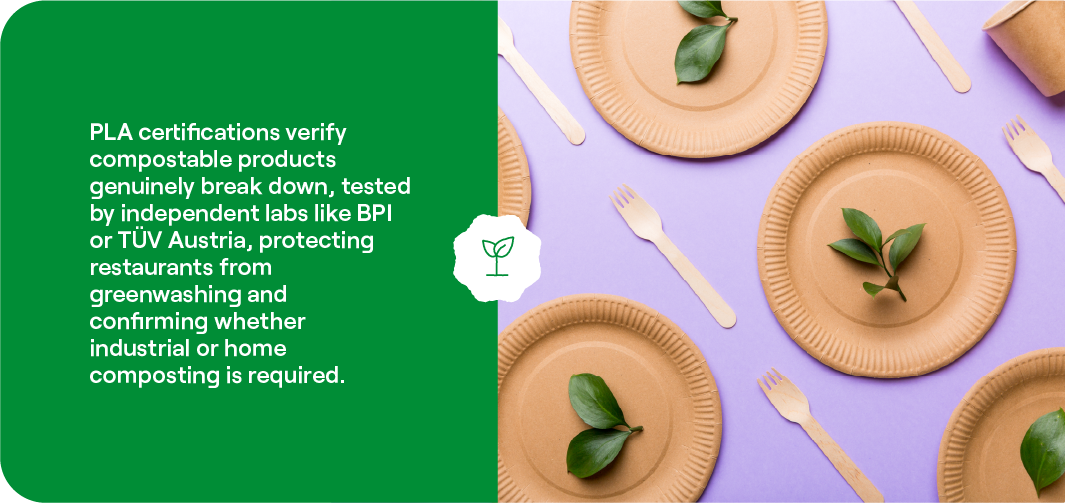
A PLA product is truly compostable only when it has been tested and certified by a recognized third party to fully break down under defined composting conditions within a specific timeframe. This means a “compostable” label without a certification seal behind it is just a marketing claim with nothing to back it up.
For a PLA product to earn certified compostable status, it must meet requirements across several areas:
- Composting conditions: The product must break down under controlled temperature and moisture levels, either in an industrial facility or a home compost setting, depending on the certification.
- Material formulation: The specific blend of materials in the product determines whether it can compost at all, and under which conditions.
- Third-party testing: An independent lab must verify that the product disintegrates and converts into compost within the required timeframe, leaving no harmful residues.
Here’s something important to understand: standard PLA typically requires the high heat (55–60°C) of an industrial composting facility to break down. It does not compost in a backyard bin under normal conditions.
However, some PLA formulations can achieve home compostability through enzyme technology. An enzyme masterbatch is integrated during compounding at 160–190°C. It catalyzes hydrolysis of PLA polymer chains, enabling full breakdown at ambient temperatures (20–30°C), which is what allows certain products to earn home compostability certification. This is not a general property of all PLA products. It’s a result of specific material engineering.
Our Greenprint® Upcycled Agave Straws use this enzyme-enhanced approach, which is why they carry TÜV Austria OK Compost HOME certification . Standard PLA without enzyme technology, like our Compostable Agave Cutlery, requires industrial composting at 55–60°C and cannot achieve HOME certification.
Key PLA Certification Standards You Need to Know
Several certification bodies and test standards govern compostable PLA products. As a restaurant owner evaluating suppliers, you’ll encounter these names on packaging, spec sheets, and product documentation. Understanding what each one means helps you make informed purchasing decisions.
BPI Certification (North America)
BPI (Biodegradable Products Institute) is the leading North American certifier, certifying over 51,000 products for commercial compostability. A product with the BPI seal has been independently tested and verified to break down in an industrial composting facility.
BPI certification criteria require that a product meet the ASTM testing standards (covered below), pass disintegration and safety screening, and demonstrate that the finished compost is free of harmful residues. BPI also maintains a publicly searchable database of every certified product, which makes verification straightforward for buyers like you.
What does the BPI seal mean in practice? It tells you the product has met North America’s most widely recognized compostability benchmark. Our Upcycled Agave Straws and our Compostable Agave Cutlery both carry BPI Commercial Compostability certification, verifiable in the BPI certified products database.
TÜV Austria OK Compost HOME and INDUSTRIAL
TÜV Austria, the world market leader in bioplastics certification, issues two distinct compostability certifications, and the difference between them is critical for your purchasing decisions.
- OK Compost INDUSTRIAL: Verifies that a product breaks down in a high-heat commercial composting facility.
- OK Compost HOME: Verifies breakdown at lower, ambient temperatures found in a typical backyard compost bin.
HOME certification is rare for PLA-based products because standard PLA requires industrial composting temperatures of 55–60°C to decompose. Achieving HOME certification requires a material formulation that enables breakdown without industrial heat. That’s what makes this certification a meaningful differentiator when you’re comparing suppliers.
Our Fiberware™ clamshells, plates, and bowls made from sugarcane bagasse carry TÜV Austria OK Compost INDUSTRIAL certification. Our Upcycled Agave Straws carry TÜV Austria OK Compost HOME certification (Cert ID: TA8012206793), as mentioned above.
ASTM D6400 and ASTM D6868
ASTM D6400 and ASTM D6868 are test methods, not certifications. This is an important distinction that often causes confusion.
ASTM D6400 defines the requirements for plastics designed to be composted in industrial facilities. ASTM D6868 covers compostable coatings and films applied to paper or other substrates. These standards set the scientific benchmarks that certifiers like BPI use to evaluate products.
When a supplier references ASTM D6400 compliance, they’re telling you the product was tested against this standard. But passing the test alone isn’t the same as holding a certification. Always look for the BPI or TÜV seal as confirmation that an independent body reviewed and verified the results.
EN 13432 (Europe)
EN 13432 is the European standard for industrial compostability. It functions as the European equivalent of ASTM D6400 and requires 4 distinct tests covering disintegration, chemical safety, and compost quality in industrial composting conditions.
This standard is relevant if you source products from European suppliers or if your operation serves international markets. Many globally distributed compostable products carry both BPI and EN 13432 certifications to cover compliance in multiple regions.
Industrial vs. Home Composting and How Certifications Apply
The distinction between industrial and home composting determines whether a certified compostable product will actually break down in your waste disposal setup. Choosing the wrong type means your “compostable” packaging could end up sitting in a landfill instead of returning to the earth.
Here’s how the two composting pathways compare:
| Factor | Industrial Composting | Home Composting |
|---|---|---|
| Temperature | High-heat, controlled facilities (55–60°C) | Ambient outdoor temperatures (20–30°C) |
| Timeframe | Faster breakdown | Longer breakdown period |
| Infrastructure | Requires access to a commercial facility | Works in a backyard compost bin |
| Applicable Certifications | BPI, TÜV Austria OK Compost INDUSTRIAL, ASTM D6400, EN 13432 | TÜV Austria OK Compost HOME |
| Standard PLA Compatibility | Yes | No (requires enzyme masterbatch technology) |
What does this mean for your restaurant? If your area has access to a commercial composting facility, products with BPI or TÜV Austria OK Compost INDUSTRIAL certification will work for your operation. If you or your customers rely on home composting, you need products specifically certified to TÜV Austria OK Compost HOME.
Buying industrially certified products and expecting them to break down in a home compost bin is a common and costly mistake. The product won’t decompose properly, and you’ll have wasted money on a sustainability claim that doesn’t deliver.
PFAS-Free Certification and Food Contact Safety
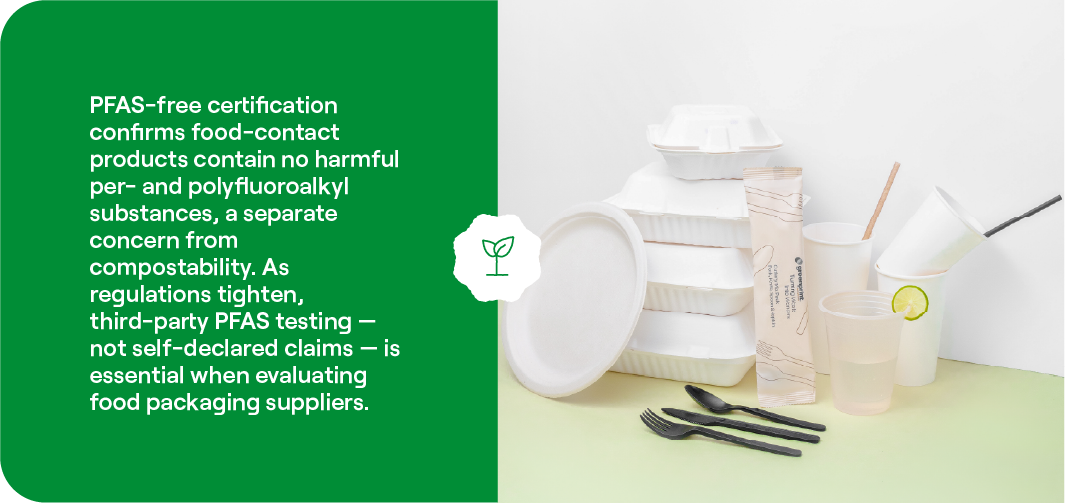
PFAS-free verification confirms that a food-contact product does not contain per- and polyfluoroalkyl substances. These are a class of chemicals linked to health concerns that have become a major focus of food packaging regulations. This is a separate issue from compostability and requires its own dedicated testing.
Here’s what you need to understand: compostability certifications verify that a product breaks down properly. They do not test for chemical safety in food-contact applications. That’s why PFAS-free verification matters as a distinct layer of product safety documentation, especially as more states pass legislation restricting PFAS in food packaging.
At Greenprint®, our verified product lines have undergone third-party PFAS testing through Intertek. These are not self-declared claims.
- Upcycled Agave Straws and Compostable Agave Cutlery: BPI certified with total organic fluorine testing.
- Renewacups™ paper cups: Intertek verified across a comprehensive panel of compounds using LC-MS/MS and GC-MS methods, with all compounds returning as not detected.
- Fiberware™ products: Intertek verified with all tested compounds returning as not detected.
When you’re evaluating suppliers, ask specifically about PFAS testing documentation. A compostability certification alone doesn’t tell you anything about food-contact safety.
How PLA Certifications Apply to Restaurant Disposables
Each product category in your restaurant carries different certification requirements based on its material and intended composting pathway. Understanding which certifications apply to which products helps you build a waste stream that actually works.
Here’s how certifications map to common disposable items in our product line:
- Straws: Our Upcycled Agave Straws hold both TÜV Austria OK Compost HOME (Cert ID: TA8012206793) and BPI certifications, making them suitable for both home and industrial composting pathways.
- Cutlery: Our Compostable Agave Cutlery carries BPI Commercial Compostability certification (verifiable at bpiworld.org). This line requires industrial composting at 55–60°C because it uses standard PLA without enzyme technology.
- Clamshells, plates, and bowls: Our Fiberware™ line carries TÜV Austria OK Compost INDUSTRIAL certification. These products are made from sugarcane bagasse, not PLA.
- Cups: Our Renewacups™ paper cups are designed for hot beverages with verified food-contact safety. Our Clearly Compostable™ cold cups are made from PLA-based materials, with BPI and TÜV Austria certifications currently pending.
Matching the right certification to the right product ensures your waste stream actually works the way you intend it to. Don’t assume all compostable products are interchangeable.
How to Verify PLA Certifications When Choosing a Supplier
The most reliable way to verify a compostability claim is to check for independent certification documentation rather than relying on packaging language alone. Here are the steps to follow before placing an order:
- Search the BPI certified product database: BPI maintains a free, public directory where you can look up any product by company name or product type.
- Ask for certificate numbers: A legitimate supplier will provide specific certification IDs from BPI, TÜV Austria, or other recognized bodies. If they can’t produce this documentation, that’s a red flag.
- Look for certification logos on packaging: The BPI seal and TÜV Austria OK Compost logos are standardized marks. Generic “compostable” text without a recognized logo is not the same as certification.
- Request third-party test reports: Ask for the actual lab reports behind the certification, including PFAS testing documentation if food-contact safety matters to your operation.
The FTC Green Guides are clear on this point: vague or self-declared compostability claims without substantiation are misleading. Certifications or seals must clearly convey the basis for the claim. If a supplier can’t provide that transparency, move on to one who can.
Watch out for these warning signs:
- Products labeled “compostable” with no certification logo.
- Suppliers who reference ASTM standards but can’t provide actual certification documentation.
- Claims of “home compostable” without TÜV Austria OK Compost HOME certification.
- Vague language like “plant-based” or “natural” used as substitutes for compostability claims.
Choose Certified Compostable Packaging With Greenprint®
We built our product lines around verified certifications because we believe restaurant owners deserve packaging they can trust without having to become material scientists. From our TÜV Austria OK Compost HOME certified Upcycled Agave Straws to our BPI certified Compostable Agave Cutlery and TÜV Austria OK Compost INDUSTRIAL certified Fiberware™ products, every claim we make is backed by independent testing and documented PFAS-free verification.
You can explore our products to find the right fit for your operation, or contact our team to get help matching certifications to your local waste infrastructure. We’re here to make the switch straightforward and keep your business on solid ground.


Compostable straws vs plastic straws: compare materials, breakdown, certifications, and cost to pick the right certified compostable straw for your business.

Compare the best salad bowls with lids for takeout and catering, from bagasse to plastic, and choose industrially compostable options that keep salads fresh.
Compare the best compostable food containers for restaurants, from bagasse clamshells to PLA deli boxes. Choose certified, PFAS-free packaging with confidence.