

Best Compostable Food Containers for Restaurants


Content
- What Makes a Food Container Compostable
- Compostable Container Materials Compared
- Best Compostable Food Containers for Every Menu
- How Certifications and PFAS Testing Protect You
- Are Compostable Food Containers Microwave Safe
- Home vs Industrial Composting for Food Containers
- How to Choose the Right Compostable Food Containers
- Frequently Asked Questions
Best Compostable Food Containers for Restaurants
The best compostable food containers are certified plant-fiber and PLA formats matched to your menu and your local composting access. For most restaurants, molded bagasse (sugarcane fiber) handles hot, greasy meals well, while PLA suits cold items. At Greenprint®, our Fiberware™ line is bagasse built for busy kitchens. This guide helps you pick the right format for every dish.
What Makes a Food Container Compostable
A certified compostable container gives you a verifiable, compliant claim you can stand behind. That matters when customers, city ordinances, or auditors ask what happens to your packaging after a meal.
“Compostable” is a testable standard, not a marketing word. It means the container meets a standard like ASTM D6400, breaking down through managed composting into safe organic matter under defined conditions and within a set timeframe. Certified compostable is different from recyclable: recyclable materials get reprocessed into new products, while compostable ones return to soil.
That distinction protects your business. A certified claim comes with lab reports and a real standard behind it. You can answer questions with documents instead of guesses.
We keep the full definitions in two guides. Learn what the label really requires in certified compostable products, and see the split in compostable vs. recyclable. The FTC Green Guide requires that any compostability claim be accurate and backed by evidence.
Compostable Container Materials Compared
The material you choose decides which foods it can hold and where it can be composted. It also affects heat tolerance, cost, and disposal. Here is how the three main options compare for foodservice.
Material | Best for | Heat tolerance | Composting pathway |
|---|---|---|---|
Bagasse (molded sugarcane fiber) | Hot, greasy entrees; clamshells, bowls, trays | High; handles hot food and reheating | Industrial (commercial) composting |
Molded plant fiber (bamboo, wheat straw) | Plates, bowls, dry and warm foods | Medium to high | Industrial composting; some home-certified formats |
PLA (plant-based bioplastic) | Cold cups, lids, cold deli items | Low; softens with heat | Industrial composting |
Bagasse is pulp left after pressing sugarcane, molded into rigid containers. It is the workhorse for hot foodservice because it stays firm under heat and grease. Our Fiberware™ bagasse containers cover clamshells, bowls, plates, and trays for that reason.
PLA is a plant-based plastic made from fermented plant sugars. It shines for cold cups, lids, and cold deli items, but it is not built for heat. For a deeper look at how these plant-based plastics work, see the basics of bioplastics.

Best Compostable Food Containers for Every Menu
Match the container to the food, then confirm the certification. The right format protects food quality, speeds up packing, and holds up through delivery. Here is how the common formats perform as compostable takeout containers, and where our Fiberware™ bagasse containers fit.
Clamshells for Hot Meals
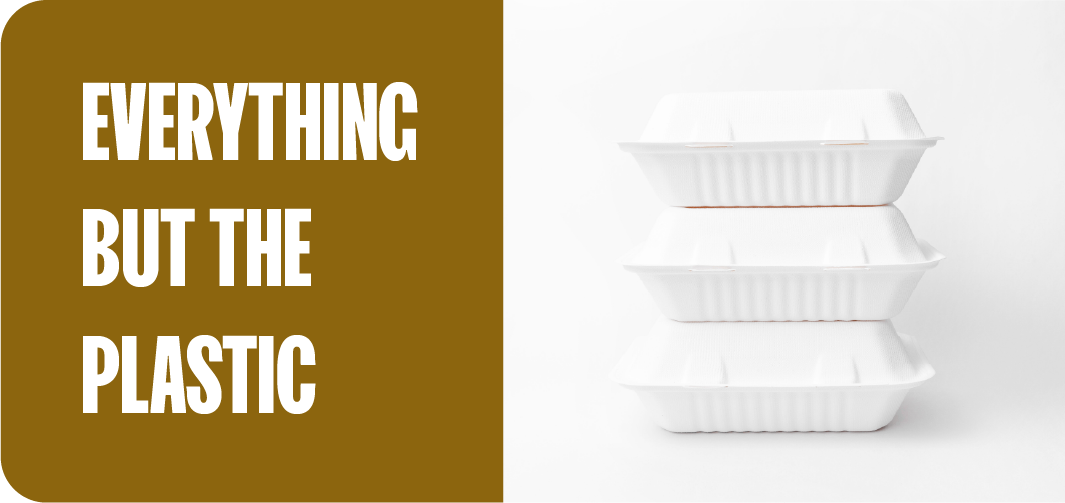
Hinged clamshells keep hot, greasy entrees contained through a delivery run. Bagasse clamshells resist grease and moisture without a plastic lining, so they hold burgers, fries, and saucy plates.
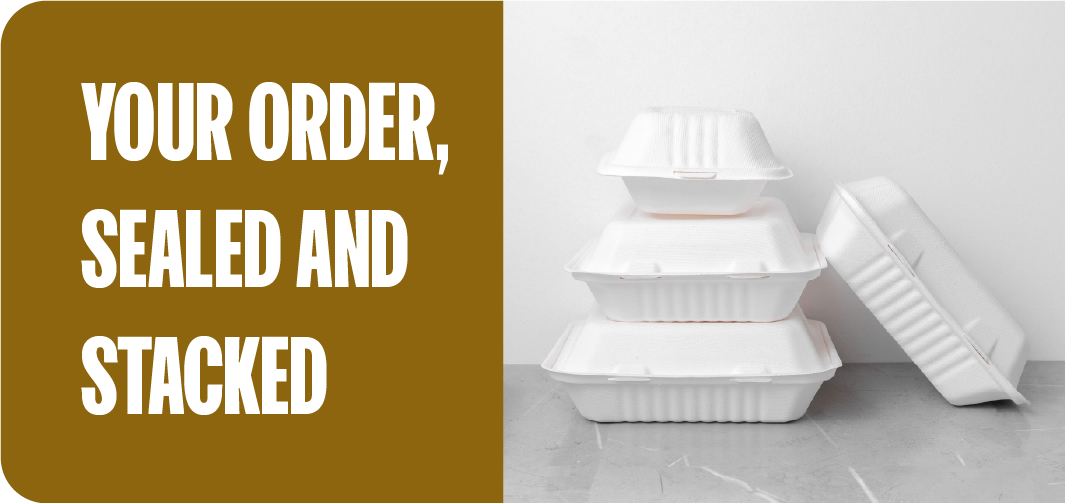
Our Fiberware™ compostable clamshell containers include hoagie boxes and taco boxes for high-volume service. They stack for storage and close with a snug hinge to limit leaks.
Clamshells also carry your brand cleanly on the lid or sleeve. For takeout and delivery, that visible sustainability choice reinforces the meal experience customers already expect.
Bowls for Soups and Salads
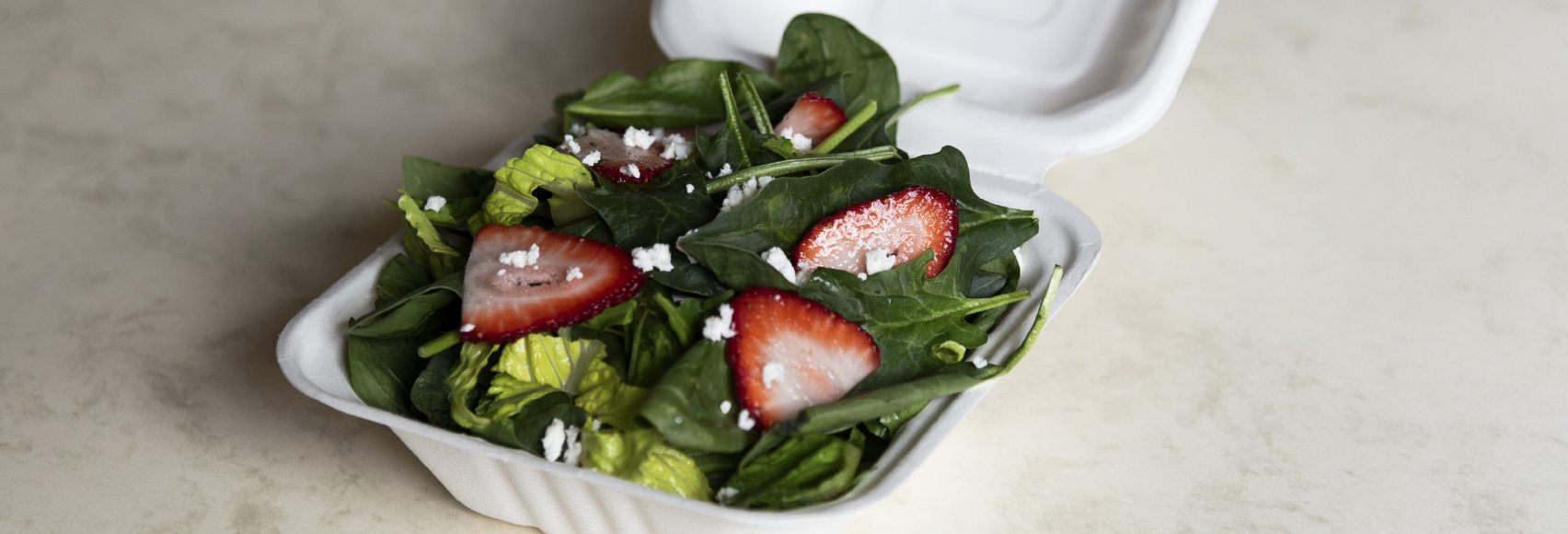
Molded-fiber bowls handle both hot and cold, which makes them flexible across the menu. They work for soups, grain bowls, and salads without going soft at the seams.
Our Fiberware™ compostable bowls come in sizes for sides and full entrees. Pair them with compatible lids for compostable to go containers that travel well.
Bowls also cut clutter on a prep line. One versatile shape can hold breakfast oats, lunch salads, and dinner grain bowls across a full service day.
Trays and Multi-Compartment Boxes
Trays and divided boxes keep components separate, so a combo plate arrives neat. The three-division layout suits catering, cafeteria lines, and meal programs.
Our Fiberware™ compostable food trays and multi-compartment boxes handle warm, portioned meals. Sturdy walls keep sauces and sides from mixing in transit.
These formats simplify large orders where consistency matters. One tray design can serve schools, hospitals, and event catering without switching materials.

Deli and Portion Containers
Deli and portion containers cover cold prep, dressings, and grab-and-go sales. Lidded options seal tight for a clean shelf display and easy stacking.
For cold items, compostable deli containers and small portion cups round out a prep station. Choose compostable containers with lids sized to your most common orders.
Consistent sizing speeds up service and cuts guesswork for staff. It also helps customers reheat or store leftovers, which keeps your brand in their kitchen longer.
How Certifications and PFAS Testing Protect You
Certifications and test reports turn a vague promise into audit-ready proof. They give you documentation to show inspectors, customers, and any city composting program.
This protection grows as more cities pass packaging and PFAS rules. A container with named certifications and lab results keeps you ready for the next ordinance.
Two marks matter most. BPI Commercial certifies products for commercial composting in North America. TÜV Austria OK Compost INDUSTRIAL confirms breakdown under industrial composting conditions. Our Fiberware™ containers carry TÜV Austria OK Compost INDUSTRIAL certification. For a full walkthrough, see our guide to composting certifications.
PFAS are added chemicals you do not want near food or compost. Our Fiberware™ was tested by Intertek across a 30-compound panel with a result of Not Detected. Learn why this testing matters in PFAS testing and compostable certifications. The FTC Green Guide expects these claims to be specific and supported. That is why we name the lab and the standard.
Are Compostable Food Containers Microwave Safe
Our Fiberware™ molded bagasse holds its shape under heat far better than PLA. That makes it a strong pick for to go containers for hot, saucy foods and short reheating. Always confirm the microwave-safe rating on the specific product spec sheet before you promise reheating to customers.
Standard PLA is different. It softens and deforms near 55 to 65 degrees C, at or above its heat distortion temperature. That range, documented in research published in Scientific Reports, means it is not suited to microwaving or hot fill.
When in doubt, match the material to the job: our Fiberware™ bagasse for hot foods, PLA for cold.
Home vs Industrial Composting for Food Containers
Matching your packaging to available infrastructure is what actually keeps it out of a landfill. Most foodservice fiber containers need industrial composting, which reaches higher, sustained temperatures than a backyard pile.
Home composting runs cooler and slower, so fewer products qualify for it. Our Fiberware™ containers are industrial compostable only under TÜV Austria OK Compost INDUSTRIAL, and they are not home compostable. Understand the split in our guide to industrial compostable products.
Knowing this upfront keeps your labeling honest under the FTC Green Guide. If your customers lack industrial composting access, tell them, and point them to the right disposal option.
How to Choose the Right Compostable Food Containers
Use a short checklist before you place a wholesale order. It keeps your sourcing accurate and your labeling honest. A few minutes of review now prevents costly swaps later.
-
Match the material to the menu: bagasse for hot and greasy, PLA for cold.
-
Confirm a named certification, such as BPI Commercial or TÜV Austria OK Compost.
-
Ask for PFAS test documentation with the lab, panel, and result.
-
Check whether your area has industrial or home composting access.
-
Verify lid compatibility and case counts for your order volume.
When you are ready to buy, our TÜV-certified industrial compostable Fiberware™ containers cover clamshells, bowls, trays, and deli formats with the documentation your buyers expect. Have a mixed menu or a wholesale volume in mind? Contact our team today, and we will match the right formats to your service.
Frequently Asked Questions
How long do compostable food containers take to break down?
Under BPI commercial compostability certification, based on ASTM D6400, certified packaging must disintegrate within about 84 days. It reaches at least 90% breakdown within six months, at the roughly 58 degrees C of an industrial composting facility.
Are compostable food containers more expensive than regular plastic?
Compostable containers generally cost a little more per unit than conventional plastic. Many operators find the difference manageable given stronger customer loyalty and easier compliance with packaging rules.
Can compostable food containers hold hot, greasy foods?
Yes, molded bagasse (sugarcane fiber) containers handle hot, greasy, and saucy foods well without a plastic lining. That is why bagasse clamshells and bowls are the workhorse choice for hot foodservice.
Can compostable food containers be recycled?
No, compostable containers belong in composting, not recycling. The EPA says food or food-soiled paper should never go in the bin, since it can contaminate the recycling stream. That material may be compostable instead.
References
- https://www.epa.gov/sustainable-management-food/approaches-composting
- https://www.ftc.gov/news-events/topics/truth-advertising/green-guides
- https://bpiworld.org/
- https://en.tuv.at/ok-compost-industrial/
- https://pmc.ncbi.nlm.nih.gov/articles/PMC12089350/
- https://www.epa.gov/sustainable-management-food/composting
- https://bpiworld.org/certification
- https://www.epa.gov/recycle/frequent-questions-recycling


Learn how the Colorado plastic ban and single-use plastic laws affect your business, from the bag fee and foam ban to local rules. Get compliant today.

See the Hawaii plastic ban and single-use plastic laws for Honolulu, Maui, Hawaii County, and Kauai, with dates, fines, and compliant foodware tips for 2026.
Nanoplastics vs. microplastics comes down to size. Learn how they differ, why researchers worry more about nanoplastics, and simple ways to reduce exposure.