

PFAS Testing in Compostable Certifications: Buyer’s Guide


PFAS Testing in Compostable Certifications: What Buyers Should Know
If you source compostable foodservice packaging, PFAS testing in compostable certifications is now a critical part of your procurement process. Per- and polyfluoroalkyl substances can contaminate finished compost and leach into groundwater, which is why every major certification program now screens for them. Understanding how PFAS testing in compostable certifications works helps you ask better questions, evaluate suppliers, and protect your brand from greenwashing risk.
What Are PFAS and Why Do Certifications Test for Them?
PFAS are a class of synthetic chemicals built around carbon-fluorine bonds. Manufacturers have used them for decades as grease and moisture barriers in compostable food packaging materials. The carbon-fluorine bond is one of the strongest in chemistry. That means PFAS do not break down in soil, water, or composting environments.
This persistence is exactly why certification bodies now test for them. When PFAS-containing packaging enters a composting facility, those chemicals end up in the finished compost. That compost then goes onto farms and gardens, spreading PFAS into soil and groundwater. The EPA provides a detailed overview of PFAS and their documented health and environmental effects.
Municipalities and composting facility operators pushed back. They did not want to accept packaging that would contaminate their end product. In response, BPI, CMA, and other certification programs added PFAS screening requirements starting in 2020. Today, PFAS testing is a standard part of earning a certified compostable label.
At Greenprint®, our Fiberware™ line (BPI Commercial certified for industrial composting) and Clearly Compostable™ line (TÜV Austria OK Compost INDUSTRIAL) are third-party verified PFAS-free. That commitment matters because PFAS in compost is not a theoretical risk. It is a documented contamination pathway that certification programs are actively working to close.
How Certification Programs Handle PFAS
Three major programs now include PFAS restrictions as part of their compostable packaging certification requirements. Each takes a slightly different approach. For a broader look at how these programs fit into the certification landscape, see our guide to emerging compostable certification standards.
BPI Certification
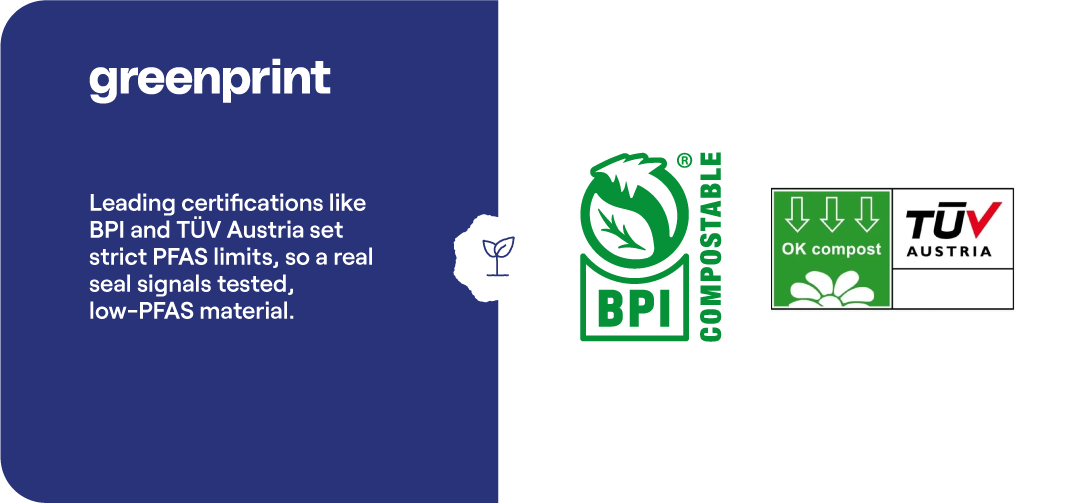
BPI (the Biodegradable Products Institute) added mandatory PFAS screening in January 2020. Their PFAS-free certification requirement has three parts. First, manufacturers must submit a Safety Data Sheet (SDS) showing no intentionally added PFAS. Second, the product must pass a lab test confirming total organic fluorine is below 100 parts per million (ppm). Third, the manufacturer must sign a formal declaration that no PFAS were intentionally added at any stage of production.
This three-part approach closes gaps that any single check might miss. BPI’s broader compostability testing covers ASTM D6400 compliance. You can learn more about that process in our article on how compostability testing validates packaging claims.
CMA Field Testing
The Compost Manufacturing Alliance (CMA) takes a different approach. CMA tests certified products in real commercial composting facilities under actual operating conditions, not just in labs. Their PFAS ban aligns with BPI’s January 2020 timeline.
Where BPI relies on lab screening, CMA verifies that products actually break down in commercial composting operations. Their field-testing approach adds a layer of real-world validation that lab results alone cannot provide.
NSF Verification
NSF International offers a compostability and PFAS-free verification program that operates independently from BPI and CMA. Their mark provides third-party verification through a separate testing and auditing process.
For buyers, the NSF mark is another credible signal. Having multiple independent verification programs means you can cross-reference claims and look for products that carry more than one mark.
How PFAS Testing Works in Practice
This is where procurement professionals need the clearest understanding. PFAS testing methods fall into two categories, and each has distinct strengths and trade-offs.
Total Fluorine Testing
Total fluorine testing is the standard screening method used by certification programs. The most common technique is combustion ion chromatography (CIC).
A sample of the packaging material is combusted at high temperature. This breaks down all organic compounds, including any PFAS present. The combustion releases fluoride ions. Those ions are then measured using ion chromatography.
The result is a single number: total fluorine in parts per million. BPI and other programs use 100 ppm as their pass/fail threshold. If the total fluorine reading comes in at or above 100 ppm, the product fails PFAS screening.
The advantage of total fluorine testing is its breadth. CIC catches every fluorinated compound in the sample, including PFAS compounds that targeted tests might miss. The limitation is that it cannot tell you which specific PFAS compounds are present, or whether the fluorine came from PFAS at all versus other fluorinated chemicals.
For certification screening, this trade-off is deliberate. A broad net is more protective than a targeted one.
Targeted PFAS Analysis
Targeted analysis uses chromatographic methods, most commonly liquid chromatography with tandem mass spectrometry (LC-MS/MS). These methods can identify and quantify individual PFAS compounds by name.
This approach has three significant barriers for packaging testing. First, PFAS can bind to natural fibers in compostable materials, making full extraction difficult. If the extraction step misses bound PFAS, the test underreports actual contamination. Second, the known catalog of PFAS compounds includes thousands of substances, but no single lab test covers all of them. Third, targeted analysis costs significantly more per sample than total fluorine screening.
For these reasons, certification programs use total fluorine testing as their primary screening tool. Targeted analysis plays a supporting role when manufacturers or regulators need to identify specific compounds after a total fluorine test flags a concern.
What PFAS-Free Certification Labels Tell You
When you see a BPI Compostable mark on packaging, it now means the product has passed PFAS screening at the 100 ppm total fluorine threshold. Products certified or recertified after January 2020 must meet this requirement. For tips on identifying genuine compostable packaging versus greenwashing, see our detailed guide.
There is an important distinction between “no intentionally added PFAS” and “PFAS-free.” The phrase “no intentionally added PFAS” means the manufacturer did not deliberately use PFAS in formulation. It does not guarantee zero PFAS presence, because trace contamination can occur through supply chain contact or raw material processing.
The 100 ppm total fluorine threshold is the measurable standard. Products below that line earn PFAS-free certification status. Products above it do not, regardless of whether the PFAS was intentionally added.
You can verify any product’s certification status directly. BPI maintains a searchable database of certified products. Each listing shows the product’s certification number, the manufacturer, and the date of certification or recertification.
How To Verify PFAS Testing for Your Packaging
Procurement professionals should build PFAS verification into their standard supplier evaluation process. Here are the steps that matter.
Request a certificate of analysis (COA). Ask your supplier for the most recent COA showing total fluorine test results. The COA should come from an accredited third-party lab, not from the manufacturer’s own testing.
Check the BPI certified product database. Search for the product by name, manufacturer, or certification number. Confirm the certification is current and was issued or renewed after January 2020 (when PFAS requirements took effect).
Ask about testing frequency. Certification is not a one-time event. Find out how often your supplier retests for PFAS and whether they test each production batch or on a periodic schedule.
Verify lab accreditation. The lab performing total fluorine testing should hold ISO 17025 accreditation or equivalent. This ensures standardized procedures and reliable results.
Watch for red flags. Self-declared “PFAS-free” claims without third-party testing are not equivalent to certification. If a supplier cannot produce a COA or point to a current third-party certification, treat the claim with skepticism. Our guide to marketing compostable certified products responsibly covers this distinction in depth.
Choose Packaging You Can Trust
Verifying PFAS testing results does not have to be complicated when you work with the right suppliers. At Greenprint, our Fiberware™ molded fiber plates and containers (BPI Commercial certified for industrial composting) and Clearly Compostable™ product lines (TÜV Austria OK Compost INDUSTRIAL) carry third-party verified PFAS-free status.
We provide full documentation on request, including certificates of analysis, certification numbers, and testing schedules. Our commitment to transparency means you can verify every claim we make through independent third-party records.
Explore our PFAS-free certified compostable cups and cold drink containers to find packaging that meets the strictest compostable packaging certification standards. Contact us to request samples and review our full certification documentation.
Frequently Asked Questions
Does Compostable Mean PFAS Free?
Not automatically. A product can meet compostability standards (like ASTM D6400) without passing PFAS testing. Only certifications issued after January 2020 by programs like BPI include PFAS screening at the 100 ppm total fluorine threshold.
What Is the 100 PPM Total Fluorine Threshold?
It is the maximum allowable level of total fluorine in compostable packaging under BPI and similar certification programs. Products at or above 100 parts per million fail PFAS screening and cannot earn PFAS-free certification status.
How Often Do Certification Bodies Retest Products for PFAS?
BPI requires retesting at each certification renewal cycle. Manufacturers may also be subject to spot checks. Ask your supplier for their most recent certificate of analysis to confirm testing is current.
Can PFAS Migrate Into Compost From Certified Packaging?
Certified packaging that passes the 100 ppm total fluorine threshold contains fluorine levels low enough to meet certification standards. The 100 ppm limit was set to minimize the risk of PFAS migration into finished compost.
References


Learn how to reduce carbon footprint at home with simple steps for energy, heating, food, and waste. Start with easy swaps your whole household can keep up.

Are styrofoam cups safe? See how styrene, heat, microwaving, and reuse change foam cup safety, and find foam-free cup options for hot and cold drinks.

The environmental impact of food waste runs from methane emissions to wasted water and land. See how it harms the planet and simple ways to cut it today.