

Colorado Plastic Ban: Bag, Foam & Single-Use Plastic Laws



Content
- What Is Colorado's Plastic Pollution Reduction Act?
- Colorado Plastic Bag Ban and Paper Bag Fee
- Colorado Polystyrene Foam Ban for Food Establishments
- Can Colorado Cities Pass Stricter Plastic Rules?
- Penalties for Breaking Colorado's Plastic Laws
- Other Colorado Laws That Affect Foodservice Packaging
- How Colorado Restaurants Can Switch to Compliant Packaging
- Frequently Asked Questions
Colorado Plastic Ban & Single-Use Plastic Laws
The Colorado plastic ban changed how stores and restaurants pack food and goods across the state. This guide explains Colorado’s single-use plastic laws as of October 2026. It covers the bag fee, bag ban, and foam ban. You’ll also learn what cities can add and how to switch your packaging.
This article is general information and is not legal advice.
What Is Colorado’s Plastic Pollution Reduction Act?
Colorado’s Plastic Pollution Reduction Act is the state law behind the Colorado plastic ban. It’s House Bill 21-1162 (HB21-1162), found at C.R.S. 25-17-501 and the sections that follow. Gov. Jared Polis signed it in July 2021, and the Colorado HB21-1162 bill page lists it as law.
The law phased in over two years. A 10-cent checkout bag fee started on January 1, 2023. Bans on single-use plastic carryout bags and polystyrene foam food containers followed on January 1, 2024.
Under the law, a single-use plastic carryout bag is a checkout bag made mostly of plastic. That plastic can come from natural gas, petroleum, or plant sources such as corn. Some bag types are excluded, which we cover below.
Date | What Changed | Who Must Comply |
|---|---|---|
January 1, 2023 | 10-cent minimum fee on paper and plastic carryout bags | Covered stores |
January 1, 2024 | Single-use plastic carryout bags banned; recycled paper bags still cost 10 cents | Covered stores, plus grocery and convenience stores |
January 1, 2024 | Polystyrene foam containers for ready-to-eat food banned | All retail food establishments |
June 1, 2024 | Last day to use up pre-2024 plastic bag inventory | Covered stores |
July 1, 2024 | Cities and counties may pass stricter rules | Local governments |
The table shows the main dates in order. Most of these rules are now settled law, so the focus for your business is daily compliance.
Colorado Plastic Bag Ban and Paper Bag Fee
Since January 1, 2024, covered stores can’t give customers single-use plastic carryout bags. Customers can bring a reusable bag or buy a recycled paper bag. That paper bag still costs at least 10 cents.
The fee came first. Starting January 1, 2023, stores charged at least 10 cents for each paper or plastic carryout bag. Cities and counties can set a higher Colorado bag fee if they choose.
Stores could use up plastic bags bought before 2024, but that window closed on June 1, 2024. The paper bag fee has no end date in the law. Recycled paper bags must use 100% recycled content.
Colorado is one of several states on our state plastic bag ban list. Operating in several states? Check that list before you set one bag policy.
Which Stores Must Follow the Bag Ban
The Colorado plastic bag law applies to “stores.” Small stores are exempt from both the fee and the ban. A small store must meet three tests under the law.
-
It operates only in Colorado.
-
It has three or fewer locations in the state.
-
It isn’t part of a franchise, corporation, or partnership with locations outside Colorado.
Restaurants are also exempt from the bag ban. The exemption covers places that serve individual portions for eating on or off site. Grocery stores and convenience stores don’t get this exemption.
Some cities, including Denver, may apply stricter rules, so check your city’s requirements.
Bags and Customers Exempt From the Fee
Some bags don’t count as carryout bags under the law. The fee and the ban don’t apply to these bags:
-
Pharmacy bags for prescription medication.
-
In-store bags for loose or bulk items, including produce.
-
In-store bags for frozen food, meat, or seafood.
-
In-store bags for unwrapped prepared food or bakery goods.
-
Laundry, dry cleaning, and garment bags.
Customers who show they take part in a federal or state food assistance program don’t pay the fee.
Plant-based plastic bags get no pass under the law. Reusable bags also can’t be made of bio-based polymers. The enrolled HB21-1162 bill text has the full exemption wording.
Colorado Polystyrene Foam Ban for Food Establishments
Since January 1, 2024, Colorado retail food establishments can’t hand out expanded polystyrene (EPS) foam containers for ready-to-eat food. The ban covers hinged takeout containers, plates, bowls, cups, and trays. Many people call this the Colorado styrofoam ban.
The Colorado polystyrene ban applies to all retail food establishments. There’s no small-business carve-out like the one in the bag rules. A single-location cafe must follow it, just like a national chain.
The law let businesses use up foam inventory bought before January 1, 2024. That use-up has no end date in the statute. It only covers stock purchased before 2024, so most of it is likely gone by now.
A few places fall outside the ban, according to Eco-Cycle’s polystyrene ban toolkit. Examples include farmers markets, roadside markets, and hospitals. Retailers that only resell prepackaged food in its original package are also exempt.
Other states handle foam differently, so compare Colorado with our Virginia foam ban guide. Molded fiber is a common foam replacement, and our molded fiber takeout clamshells come in several sizes.
Can Colorado Cities Pass Stricter Plastic Rules?
Yes. Since July 1, 2024, cities and counties can pass plastic rules as strict as or stricter than state law. Before that date, state law limited local plastic rules.
Denver is one example of a city with its own bag fee and takeout packaging rules. If you operate there, check Denver’s current city requirements directly.
Boulder is still deciding. The City of Boulder plastics project is exploring policies to reduce single-use plastics. Its project timeline lists community engagement in fall 2026 and implementation in late 2027, and that timeline may change.
Statewide action stalled in 2026. Gov. Polis vetoed SB26-146 on June 2, 2026. The bill would have made utensils, straws, condiments, and napkins available only on request.
In his veto letter, quoted in CPR’s SB26-146 veto coverage, Polis wrote that local governments should decide these policies. He pointed to Denver and Breckenridge as examples. Check your city and county rules before you order packaging.
Penalties for Breaking Colorado’s Plastic Laws
Under HB21-1162, local governments enforce Colorado’s plastic laws. The statute lets each city or county enforce violations in the manner it chooses. Each retail transaction with a violation counts as one violation.
State law sets fine caps only for counties, in unincorporated areas. A county can fine up to $500 for a second violation. It can fine up to $1,000 for a third or later violation.
The law sets no statewide fine for a first violation. Cities set their own penalties, so check with your local government. Counties may also ask a court to order a business to stop a violation.
Schools get one exception. Local governments can’t enforce these rules against a retail food establishment located inside a school.
Plastic rules are only one part of packaging compliance. Our plastic regulation compliance guide helps you catch labeling, sourcing, and local rules too.
Other Colorado Laws That Affect Foodservice Packaging
Several other Colorado laws touch your packaging choices. Each one has a different scope and timeline.
Since January 1, 2024, Colorado has banned intentionally added PFAS in certain food packaging, per CDPHE’s PFAS laws page. Our PFAS testing for compostables guide explains how testing works.
The Compostables Labeling Act also matters. Since July 1, 2024, SB23-253 requires compostable labels to be certified and clear, per CDPHE compostable product standards. They must meet ASTM D6400 or D6868 standards, which our compostable certifications explained guide covers.
Colorado’s producer responsibility law, HB22-1355, charges recycling program costs to packaging and paper producers, not restaurants by default. Ask the program whether your business counts as a producer, or see our EPR laws for plastics overview.
The vetoed SB26-146 is not law. The state has no request-only rule for utensils or straws.
How Colorado Restaurants Can Switch to Compliant Packaging
Switching works best in steps. Start with the items you use most, then check your local rules.
-
Audit your stock for foam clamshells, cups, plates, bowls, and trays.
-
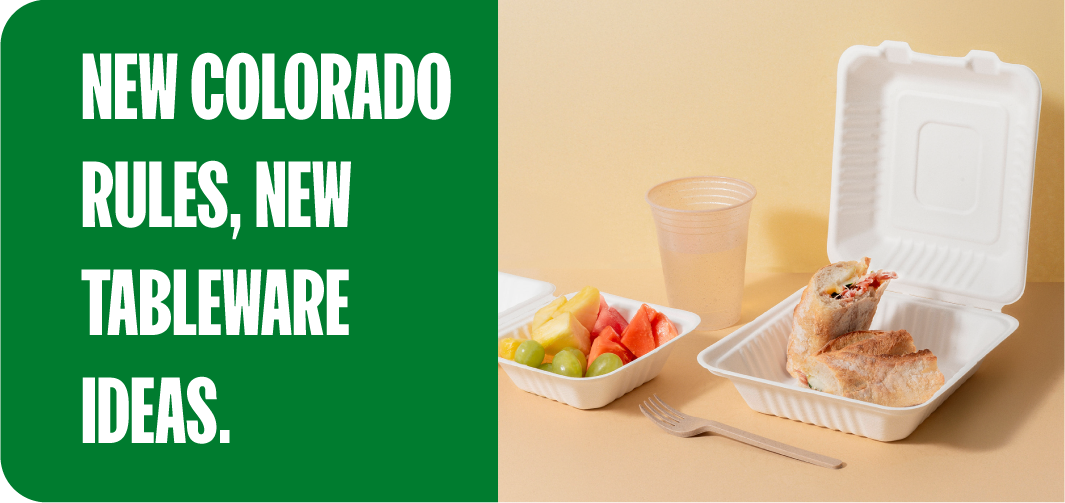
Replace foam takeout containers with molded fiber clamshells sized to your menu.
-
Swap foam plates, bowls, and cups for fiber or paper options.
-
Confirm that any product labeled compostable carries a recognized certification.
-
Ask your hauler whether local composting accepts compostable packaging.
-
Review your city’s rules for bags, foam, and utensils.
Composting access matters in Colorado. Front Range processor A1 Organics has refused compostable packaging since April 1, 2023, per CPR’s compost processor report.
Check with your hauler for current guidelines, since this policy could change. Even without local composting, fiber products still help you meet the foam ban. Our guide covers packaging without composting access.
Greenprint® offers certified compostable foodservice packaging for this switch. Our Fiberware™ clamshells, plates, and bowls are made from bagasse, a sugarcane fiber. They carry TÜV Austria OK Compost INDUSTRIAL certification, so they need an industrial composting facility.
For drinks, our Renewacups™ paper cups handle hot beverages. Our Clearly Compostable™ cups handle cold beverages and carry BPI and TÜV Austria OK Compost INDUSTRIAL certifications.
You can browse our foam-free fiber clamshells and plates and order for your Colorado locations. If you’re unsure which sizes fit your menu, our team can help you compare options.
Frequently Asked Questions
Does Colorado Ban Plastic Straws?
No. As of fall 2026, Colorado has no statewide straw ban. Gov. Polis vetoed a 2026 bill that would have made straws available only on request. For an alternative, see our Upcycled Agave straws.
Can Restaurants in Colorado Use Plastic Bags?
Yes, in most cases, because restaurants serving individual portions are exempt from the state bag ban. Grocery stores, convenience stores, and stricter cities are exceptions.
Are Compostable Bags Allowed Under Colorado’s Bag Ban?
No. Colorado’s law counts bags made mostly of plastic from corn or other plants as single-use plastic carryout bags.
Where Does Colorado’s 10-Cent Bag Fee Go?
Under HB21-1162, the store keeps 40% of each fee and sends 60% to its city or county each quarter. Local governments use their share for enforcement, recycling, composting, waste diversion, and education.
References
- https://www.leg.colorado.gov/bills/hb21-1162
- https://content.leg.colorado.gov/sites/default/files/documents/2021A/bills/2021a_1162_enr.pdf
- https://ecocycle.org/our-programs/zero-waste-colorado/plastic-pollution-reduction-act-overview/2024-ppra-guide-for-businesses/2024-polystyrene-ban-business-toolkit/
- https://bouldercolorado.gov/projects/reducing-single-use-plastics-boulder
- https://www.cpr.org/2026/06/03/polis-vetoes-progressive-bills/
- https://cdphe.colorado.gov/pfas-laws
- https://cdphe.colorado.gov/hm/standards-compostable-products
- https://www.cpr.org/2023/03/01/put-that-pizza-box-in-the-trash-colorados-largest-compost-processor-will-no-longer-accept-packaging-and-paper-products/


See the Hawaii plastic ban and single-use plastic laws for Honolulu, Maui, Hawaii County, and Kauai, with dates, fines, and compliant foodware tips for 2026.

Nanoplastics vs. microplastics comes down to size. Learn how they differ, why researchers worry more about nanoplastics, and simple ways to reduce exposure.

Earth Day facts that show the scale of the environmental crisis, from plastic and landfill waste to CO2 and wildlife loss. See what the numbers mean for you.