

How Does Commercial Composting Work? A Full Guide


Content
- Key Takeaways
- What Is Commercial Composting?
- How Does the Commercial Composting Process Work?
- Three Main Methods of Commercial Composting
- What Is the Difference Between Commercial and Home Composting?
- Common Challenges in Commercial Composting
- How Certified Compostable Packaging Works With Commercial Composting
- How to Set Up Commercial Composting for Your Restaurant
- Choose the Right Compostable Products for Your Business
How Does Commercial Composting Work? A Complete Guide
Commercial composting is the system that makes certified compostable foodservice packaging actually break down as intended. This guide explains how the process works, what certifications matter, and how to choose the right products for your restaurant’s waste infrastructure.
Key Takeaways
- Commercial composting uses controlled high temperatures, moisture, and oxygen to break down organic waste and certified compostable packaging into finished compost.
- Not all compostable products work in every composting system, so matching your packaging to your local facility’s capabilities is essential for proper disposal.
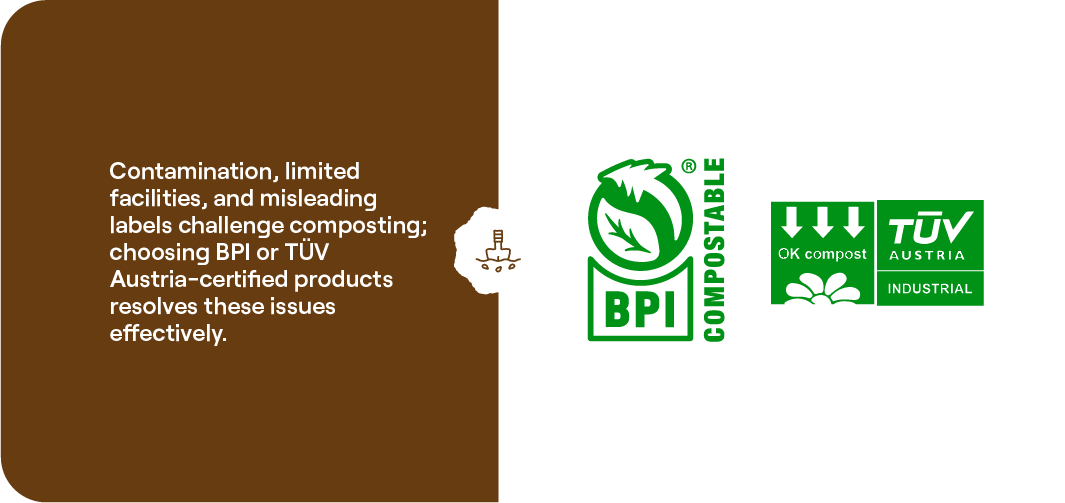
- Choosing certified compostable products with recognized seals like BPI or TÜV Austria protects the composting stream and keeps your business compliant with regulations.
What Is Commercial Composting?
Commercial composting is a large-scale process that breaks down organic waste at high temperatures under controlled conditions. This means a professional facility manages the heat, moisture, and airflow to turn food scraps, yard waste, and certified compostable packaging into finished compost.
A commercial composting facility operates very differently from a backyard compost pile. These facilities use specialized equipment to maintain the precise conditions needed for rapid decomposition. They can process thousands of pounds of material at a time, accepting everything from restaurant food waste to certified compostable takeout containers.
This infrastructure is what allows certified compostable foodservice packaging to work as intended. Products carrying BPI or TÜV Austria OK Compost INDUSTRIAL certification are specifically designed and tested to break down under these controlled, high-temperature conditions. Without access to a commercial facility, these products won’t decompose properly.
For restaurant owners, understanding commercial composting helps you make better purchasing decisions. When you know what your local facility can accept, you can choose products that will actually break down rather than contaminate the composting stream.
How Does the Commercial Composting Process Work?
The commercial composting process transforms organic waste into stable compost through a series of managed stages. Each stage is carefully controlled to ensure certified compostable materials fully break down.
The process begins with collection. Organic waste and compostable packaging are gathered from restaurants, businesses, and municipal programs, then transported to the facility. Once materials arrive, facility operators prepare the feedstock by sorting out contaminants, shredding larger items, and mixing materials to create a balanced blend.
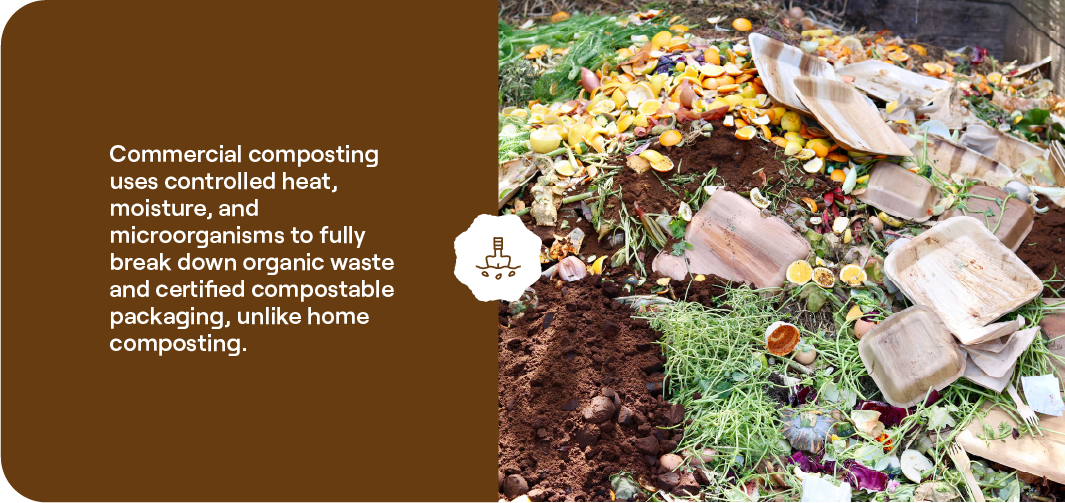
The active composting phase is where the real work happens. Microorganisms rapidly consume organic matter while facility operators manage temperature, moisture, and oxygen levels. This high-heat environment is what enables certified compostable packaging to decompose completely. The controlled conditions are far more intense than anything a backyard pile can achieve.
After the active phase, the compost enters a curing stage. The material sits at lower temperatures, allowing it to stabilize and any remaining pathogens to die off. Finally, the finished compost is screened to remove debris, producing a clean product ready for use in gardens, farms, and landscaping.
The key difference between commercial and home composting comes down to control. Facility operators actively monitor and adjust conditions throughout the process, which is why products certified for industrial composting require this infrastructure to perform as labeled.
Three Main Methods of Commercial Composting
Commercial composting facilities use different methods depending on their available space, the type of waste they handle, and how much volume they process. Your local facility’s method can affect which certified compostable products it accepts.
Windrow Composting
Windrow composting is the most common large-scale method. Facilities arrange organic waste into long, narrow rows called windrows, then use mechanical equipment to turn them regularly.
The turning process introduces oxygen and distributes heat evenly throughout the pile. This method works well for high volumes of yard waste, food scraps, and compostable packaging. However, windrow composting requires significant land area and depends on weather conditions, which can slow the process during cold or rainy periods.
Aerated Static Pile Composting
Aerated static pile composting keeps organic material in place while blowers push air through the pile from below. This means the piles don’t need to be turned, which speeds up the process.
The consistent airflow supports the high temperatures needed to break down certified compostable materials efficiently. This method is particularly well suited for food-soiled packaging and other compostable foodservice products because it maintains steady conditions throughout the decomposition cycle.
In-Vessel Composting
In-vessel composting processes organic waste inside enclosed containers or reactors. These systems tightly control temperature, airflow, and moisture, breaking down materials faster than other methods.
In-vessel systems are common in urban areas where space is limited. The enclosed design also reduces odor and allows facilities to accept a wider range of organic waste. For foodservice operators, this often means in-vessel facilities can handle more types of certified compostable packaging.
What Is the Difference Between Commercial and Home Composting?
Commercial composting and home composting both break down organic materials, but they operate at very different scales and temperatures. The composting pathway you have access to determines which certified compostable products will actually work for your operation.
| Factor | Commercial Composting | Home Composting |
|---|---|---|
| Temperature range | High, sustained heat maintained by facility operators | Lower, ambient temperatures dependent on climate |
| Timeline | Faster breakdown due to controlled conditions | Slower, can take several months or longer |
| Accepted materials | Broader range including certified compostable packaging | Limited to food scraps, yard waste, and HOME-certified products |
| Certifications | BPI, TÜV Austria OK Compost INDUSTRIAL | TÜV Austria OK Compost HOME |
| Infrastructure | Requires a commercial facility or hauler | Backyard bin or pile managed by the individual |
This distinction explains why we design different product lines for different composting pathways. Our Fiberware™ clamshells, plates, and bowls carry TÜV Austria OK Compost INDUSTRIAL certification and require commercial composting infrastructure. Our Compostable Upcycled Agave Cutlery carries BPI Commercial Compostability certification and also requires industrial composting facilities because, unlike our straws, the cutlery’s PLA/PBAT/Agave Fibers blend does not include the enzyme masterbatch and requires industrial composting temperatures of 55–60°C to fully break down.
Our Green Dot Compostable Upcycled Agave Straws are different. They carry TÜV Austria OK Compost HOME certification, which means they break down at the lower temperatures found in a backyard compost bin. This is possible because an enzyme masterbatch integrated during compounding at 160–190°C catalyzes hydrolysis of PLA polymer chains, enabling full biodegradation at ambient temperatures (20–30°C) where standard compostable plastics cannot break down. Internal biodegradation study GP-BIO-001 corroborates this certification, documenting full breakdown by Week 20 in home compost conditions (20–30°C), validated in triplicate.
Per FTC Green Guides, compostability claims must specify whether a product needs industrial or home composting infrastructure. Matching the right product to the right pathway isn’t just good practice. It’s a compliance requirement.
Common Challenges in Commercial Composting
The compost industry faces several challenges that directly affect foodservice operators trying to divert waste responsibly. Understanding these obstacles helps you avoid common pitfalls.
- Contamination from non-compostable items: When conventional plastics or uncertified packaging enter the composting stream, they can ruin entire batches of compost. According to BPI, this contamination comes from non-compostable materials; not certified compostable products; and is the main reason many facilities restrict what they accept.
- Limited facility access: Commercial composting infrastructure isn’t available everywhere. Many regions lack a nearby facility, which means even properly certified compostable products may end up in landfills; the third-largest contributor of methane in the U.S. without a collection program.
- Labeling confusion: Products labeled “compostable” without a recognized certification seal create uncertainty for consumers, restaurant staff, and facility operators alike. This type of greenwashing undermines trust across the composting supply chain. Per FTC Green Guides, compostability claims must be specific and substantiated.
Choosing products with clear BPI or TÜV Austria certifications addresses all three challenges. Certified products give facility operators confidence that materials will break down as expected. This helps maintain composting program access for everyone and keeps your business compliant with regulations.
How Certified Compostable Packaging Works With Commercial Composting
Certification standards create the bridge between compostable packaging and the facilities that process it. Without a recognized certification, a product labeled “compostable” may not be accepted by your local facility, and the claim itself may not hold up under regulatory scrutiny.
The relationship works like this: certification bodies test products under standardized conditions that replicate commercial composting environments. Products that pass earn a certification seal, which signals to facility operators that the material will break down completely without leaving harmful residues.
What “Commercially Compostable” Means on a Label
A “commercially compostable” or “industrially compostable” label means the product has been tested and verified to break down fully under the high-temperature conditions of a commercial composting facility. In the U.S., BPI certification verifies compliance with ASTM D6400 standards and requires products to test below 100 ppm total organic fluorine. Internationally, TÜV Austria OK Compost INDUSTRIAL verifies compliance with EN 13432 standards.
Our Fiberware™ plates, bowls, clamshells, and containers made from sugarcane bagasse carry TÜV Austria OK Compost INDUSTRIAL certification. Our Compostable Upcycled Agave Cutlery made with Upcycled Agave Fibers carries BPI Commercial Compostability certification. Both product lines require commercial composting infrastructure and should be labeled accordingly.
When you see these certification seals, you know the product has been independently tested. This matters for compliance and gives composting facilities confidence to accept your waste.
What “Home Compostable” Means on a Label
A “home compostable” label means the product has been certified to break down at the lower temperatures found in a backyard compost bin. TÜV Austria OK Compost HOME is the recognized standard for this claim.
Home compostability certification is rare for foodservice products because most compostable materials need industrial heat to decompose. Our Green Dot Compostable Upcycled Agave Straws are an exception. They carry TÜV Austria OK Compost HOME certification because an enzyme masterbatch, integrated during compounding at 160–190°C, catalyzes hydrolysis of PLA polymer chains, enabling full biodegradation at ambient temperatures (20–30°C) where standard compostable plastics fail.
For operators in areas without commercial composting access, or in states with organics diversion mandates, our home-compostable straws; enabled by enzyme technology that catalyzes PLA hydrolysis at ambient temperatures; offer a practical disposal pathway that doesn’t depend on industrial infrastructure.
How to Set Up Commercial Composting for Your Restaurant
Setting up a composting program for your restaurant is straightforward when you break it into clear steps. The goal is to create a system that’s easy for your staff to follow and actually gets your compostable waste to the right place.
Start by auditing your current waste. Look at every type of disposable you use, from cups and containers to cutlery and straws. Note which items currently go to landfill and which could be replaced with certified compostable alternatives. This gives you a baseline for improvement.
Next, find a local composting hauler or facility. Contact your municipality’s waste management office or use online directories to locate commercial composting services in your area. Ask what materials they accept and what certifications they require. This information guides your product choices.
Once you know your options, choose certified compostable products that match your local facility’s capabilities. If your area lacks commercial composting, consider home-compostable options for items like straws. Select products with BPI or TÜV Austria certification to ensure they’ll be accepted.
Set up your collection system with clearly labeled bins in your kitchen and dining areas. Use simple signage that shows staff and customers exactly what goes where. Color coding and pictures help prevent contamination.
Train every team member on the program. A quick training session covering which items are compostable, which are recyclable, and which go to trash prevents mistakes and keeps your composting stream clean. Make this part of onboarding for new hires.
Finally, communicate with your customers. Let guests know about your composting program through signage, menu notes, or brief explanations from staff. This builds trust and shows that your sustainability efforts are real.
Choose the Right Compostable Products for Your Business
The right compostable product depends on your local waste infrastructure, and we build our product lines to give you options that match real-world conditions.
Our Green Dot Compostable Upcycled Agave Straws with TÜV Austria OK Compost HOME certification offer a home-compostable pathway for operators without commercial composting access. Our Fiberware™ clamshells, plates, and bowls with TÜV Austria OK Compost INDUSTRIAL certification and our Compostable Upcycled Agave Cutlery with BPI Commercial Compostability certification are designed for commercial composting. Our Upcycled Agave (PCR) straws and cutlery provide a recycled-content option for operations where composting infrastructure isn’t available at all.
Every verified Greenprint® product line has undergone third-party PFAS testing, giving procurement teams the documentation they need for ESG reporting and compliance with emerging state legislation. We don’t make broad claims. We provide specific, auditable test results that hold up to scrutiny.
Explore our products to find the right fit for your operation, or contact our team for guidance on matching certified compostable packaging to your local composting infrastructure.


Are styrofoam cups safe? See how styrene, heat, microwaving, and reuse change foam cup safety, and find foam-free cup options for hot and cold drinks.

The environmental impact of food waste runs from methane emissions to wasted water and land. See how it harms the planet and simple ways to cut it today.

New Jersey plastic bans and regulations cover bags, foam, straws, and utensils. Learn what is banned, who must comply, and compliant compostable swaps.