

EPR for Plastics: How New Laws Reshape Packaging



Content
- Key Takeaways
- What Is Extended Producer Responsibility for Packaging?
- How Do EPR Laws Improve Plastics Recycling and Composting?
- Key Elements of EPR Packaging Laws
- Which U.S. States Have EPR for Packaging Laws?
- What EPR Packaging Laws Mean for Restaurant Owners
- How Compostable and Recycled Packaging Helps You Stay Ahead of EPR Requirements
- Frequently Asked Questions About EPR Packaging Laws
- Choose Packaging That's Built for the Future with Greenprint
EPR for Plastics: How New Laws Are Reshaping Packaging Choices
Extended Producer Responsibility laws are changing who pays for packaging waste in the United States. These laws directly affect the products you stock in your restaurant, and understanding them helps you make smarter purchasing decisions before regulations reach your market.
Key Takeaways
- Extended Producer Responsibility laws make packaging producers, not cities or taxpayers, financially responsible for managing packaging waste at end of life.
- Several U.S. states have already enacted EPR packaging laws, and many more are considering them, making this a growing compliance factor for foodservice operators.
- Choosing packaging with verified compostability certifications or recycled content can position your business favorably as EPR fee structures reward materials with proven end-of-life pathways.
What Is Extended Producer Responsibility for Packaging?
Extended Producer Responsibility is a policy that shifts the cost of managing packaging waste from local governments to the companies that produce or sell the packaging. This means the brands and manufacturers behind your cups, containers, and cutlery now fund the systems that collect, sort, recycle, or compost those materials after you use them.
For restaurant owners, this matters even if you’re not manufacturing packaging yourself. Your suppliers will face new financial obligations under EPR laws. Those costs can influence what you pay for packaging and which products remain available.
Here’s the core idea: EPR treats packaging like a product with a full lifecycle. The company that profits from putting packaging into the market also takes responsibility for what happens after it’s used. That’s different from the current system, where municipal waste programs funded by local taxes handle most of that burden.
When your distributor’s costs change because of EPR fees, those changes eventually show up in your invoices. Understanding this connection helps you anticipate shifts and choose packaging that performs well under the new rules.
How Do EPR Laws Improve Plastics Recycling and Composting?
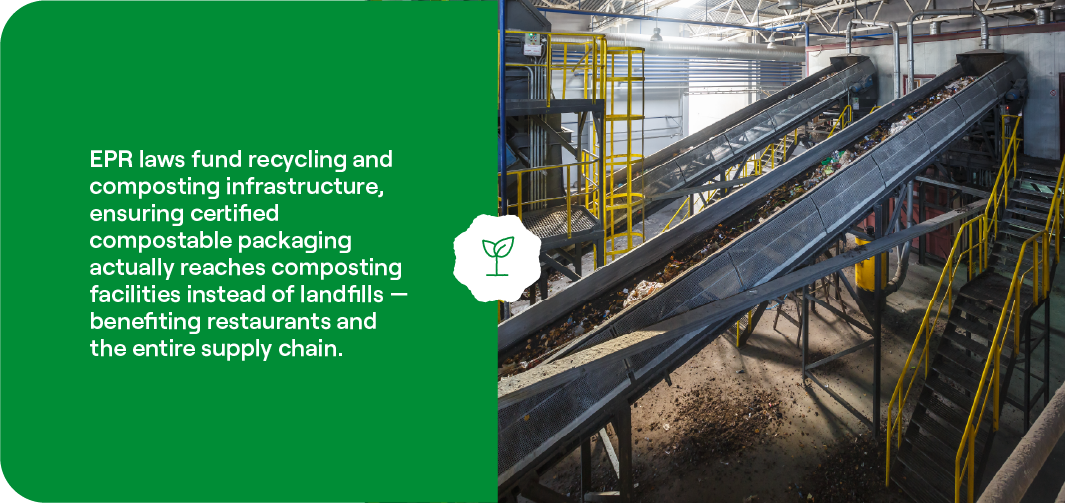
EPR laws generate dedicated funding that expands and improves recycling and composting infrastructure. When producers pay into EPR systems, that money goes toward building new collection programs, upgrading sorting facilities, and supporting composting operations.
This is good news for your restaurant. Better infrastructure means your compostable cups, plates, and cutlery are more likely to reach a composting facility instead of a landfill. It also means recycled-content products become more practical as the supply of clean, sorted recyclable material increases.
Consider what happens without adequate infrastructure. The majority of 4,000+ U.S. compost facilities process only yard trimmings, so even certified compostable straws can end up in the trash if your area lacks a composting program that accepts them. EPR funding helps close that gap by building the systems that make composting and recycling actually work.
The practical result is that packaging designed with a clear end-of-life pathway becomes more valuable. Products with recognized certifications contribute to meeting the recycling and composting targets that EPR laws require, which benefits everyone in the supply chain.
Key Elements of EPR Packaging Laws
EPR packaging laws share several building blocks that determine how the system works, who pays, and what packaging is affected. Understanding these elements helps you see how your suppliers’ obligations may eventually show up in your costs and product options.
Covered Products and Materials
EPR mandates typically cover a broad range of packaging materials used in foodservice. This includes single-use plastic items, paper packaging, containers, and compostable or plant-based alternatives.
The key point for restaurant owners is that compostable packaging is generally included in the scope of these laws. Whether you’re using traditional plastic takeout containers or certified compostable clamshells, the packaging you purchase likely falls under EPR requirements for your suppliers.
Inclusion in EPR doesn’t mean compostable products are treated the same as hard-to-recycle plastics. As we’ll cover below, packaging with verified end-of-life pathways often receives favorable treatment within EPR fee structures.
Producer Responsibility Organizations (PROs)
A Producer Responsibility Organization is a third-party organization that producers pay into to collectively manage their packaging waste obligations. Instead of each producer building its own collection and recycling program, a PRO pools funding from many producers and coordinates the work.
PROs handle the operational side of EPR systems:
- Collection coordination: They contract with haulers to pick up packaging waste from communities.
- Sorting and processing: They fund facilities that sort materials and prepare them for recycling or composting.
- Composting partnerships: They work with composting facilities to ensure certified compostable packaging gets processed correctly.
For restaurant owners, PROs are behind-the-scenes players. But their effectiveness directly determines whether the compostable or recyclable packaging you choose actually reaches the right facility.
Fee Structures and Eco-Modulation
Producers pay fees to PROs based on the type and amount of packaging they put on the market. Eco-modulation is the mechanism that adjusts those fees up or down depending on how easy the packaging is to recycle or compost.
Here’s how it works in practice:
- Higher fees: Packaging made from hard-to-recycle materials or mixed materials that contaminate recycling streams.
- Lower fees: Packaging with certified compostability or high recycled content that has a verified end-of-life pathway.
This fee adjustment creates a built-in incentive for producers to design better packaging. Over time, eco-modulation can make certified compostable and recycled-content products more cost-competitive because their producers pay less into the system.
That cost advantage can eventually flow through to the prices you see from your distributor. Choosing packaging that qualifies for lower fees positions you ahead of suppliers still using materials that face higher EPR costs.
Recycling and Composting Targets
EPR laws set mandatory targets for the percentage of packaging that must be recycled or composted within specific timeframes. These aren’t suggestions. They’re enforceable requirements that push the entire supply chain toward packaging with verified end-of-life pathways.
For foodservice operators, these targets create growing demand for packaging that can actually meet them. Products carrying recognized certifications like BPI Commercial Compostability, which certifies over 51,000 products, or TÜV Austria OK Compost HOME or INDUSTRIAL become more valuable in the marketplace because they contribute to meeting mandatory rates.
Packaging without a clear composting or recycling pathway becomes a liability for the producers selling it. That dynamic affects what products remain available and at what price points as EPR systems mature.
Which U.S. States Have EPR for Packaging Laws?
EPR packaging legislation is advancing across the United States. Several states have already signed laws, and more are considering bills. Your compliance exposure depends on where you operate, so this section gives you the most actionable information.
States with Active EPR Packaging Laws
The following states have enacted EPR packaging legislation that affects foodservice packaging:
| State | Key Law | Notable Provisions for Foodservice |
|---|---|---|
| California | SB 54 | Covers single-use packaging and foodservice ware, requires source reduction, sets composting and recycling targets. |
| Colorado | HB 22-1355 | Establishes a PRO system, covers paper and plastic packaging, includes eco-modulation. |
| Oregon | SB 582 | Requires a PRO for packaging, sets recycling targets, covers foodservice packaging. |
| Maine | LD 1541 | First U.S. state to pass EPR for packaging, producer-funded system for managing packaging waste. |
California’s SB 54 is particularly significant for foodservice operators. It explicitly covers single-use foodservice packaging and sets aggressive timelines for source reduction and recycling or composting. If you operate in California, your packaging choices are already subject to these requirements.
States with EPR Bills Under Consideration
Nearly a third of U.S. states have introduced or passed EPR packaging legislation, including New York, Washington, Massachusetts, Illinois, and several others. The trend is clear: EPR for packaging is expanding, not contracting.
Restaurant owners in these states should treat EPR as a “when, not if” reality. Evaluating your packaging choices now means you won’t need to scramble when legislation passes. The states already implementing EPR provide a roadmap for what’s coming to other markets.
What EPR Packaging Laws Mean for Restaurant Owners
EPR laws primarily obligate packaging producers and brand owners, not the restaurants that buy their products. However, the financial impact flows downstream to you.
As your packaging suppliers face new EPR fees, those costs may show up in your prices. Packaging that carries higher eco-modulation fees because it’s hard to recycle or compost could become more expensive. Packaging with verified end-of-life pathways may hold steady or even become more affordable by comparison.
New labeling requirements are also part of many EPR laws. You may start seeing updated labels on packaging that clearly indicate whether a product is recyclable, compostable, or neither. These labels help your staff and customers sort waste correctly, which supports your own waste management efforts.
The practical takeaway is straightforward:
- Your costs may shift: Suppliers paying higher EPR fees may pass those costs to you.
- Product availability may change: Materials that face steep fees could become harder to source.
- Labeling will improve: Clearer labels help everyone dispose of packaging correctly.
The packaging you choose today determines your compliance position tomorrow. Switching to certified compostable or recycled-content products now means you won’t need to overhaul your supply chain when EPR regulations tighten in your state.
How Compostable and Recycled Packaging Helps You Stay Ahead of EPR Requirements
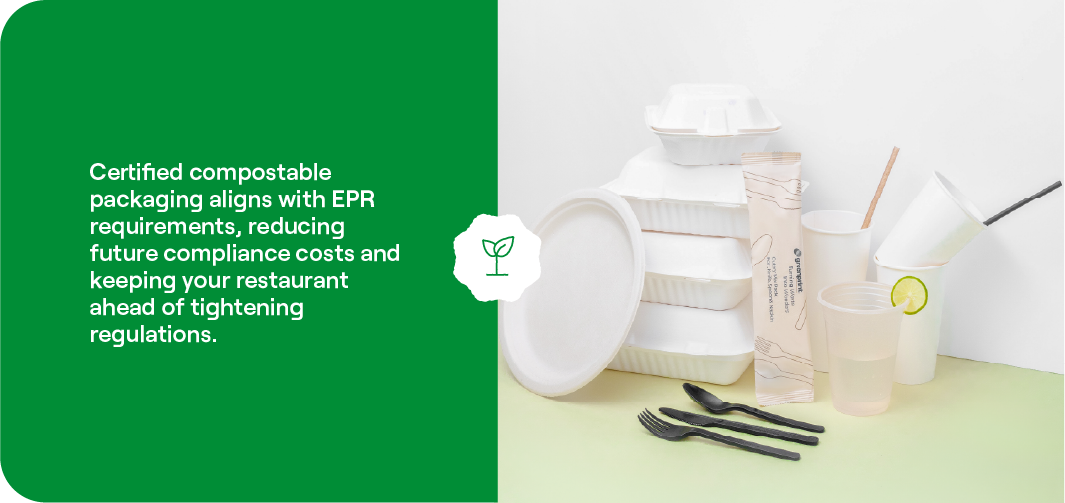
Packaging with verified compostability certifications and documented recycled content aligns directly with the eco-modulation incentives and composting targets that EPR laws establish. Choosing these products now positions your business ahead of tightening mandates rather than reacting to them after the fact.
At Greenprint®, we design our products with verified end-of-life pathways built in. Our Compostable Upcycled Agave straws carry both TÜV Austria OK Compost HOME certification and BPI Commercial Compostability certification. The straws achieve home compostability through an enzyme masterbatch integrated during compounding at 160–190°C, which catalyzes hydrolysis of PLA polymer chains and enables full biodegradation at ambient temperatures (20–30°C). This enzyme technology is what makes TÜV Austria OK Compost HOME certification possible. Our Compostable Upcycled Agave cutlery holds BPI Commercial Compostability certification for industrial composting, requiring the higher temperatures (55–60°C) of industrial composting facilities.
Our Fiberware™ clamshells, plates, and bowls are made from sugarcane bagasse and carry TÜV Austria OK Compost INDUSTRIAL certification. Our Renewacups™ hot cups are verified PFAS-free and carry Flustix plastic-free certification.
Each of these product lines gives you packaging that can contribute to the recycling and composting targets EPR laws require. When your suppliers use materials with recognized certifications, they’re positioned for lower eco-modulation fees. That cost structure benefits you as their customer.
Here’s what this means for your operation:
- Lower supplier costs over time: Products qualifying for reduced EPR fees may become more price-competitive.
- Compliance readiness: Certified products meet the standards that EPR systems reward.
- Customer confidence: Packaging with clear certifications supports transparent sustainability claims under FTC Green Guides.
You can explore our products to find the right fit for your operation, or contact our team to discuss which solutions match your local waste infrastructure and compliance needs.
Frequently Asked Questions About EPR Packaging Laws
Do Restaurant Owners Need to Register with a PRO Under EPR Laws?
Most EPR laws define the “producer” as the brand owner or first importer of the packaging, not the restaurant that purchases it. You typically won’t need to register with a PRO, but your suppliers’ EPR fees may influence the prices you pay for packaging.
Does EPR Apply to Certified Compostable and Plant-Based Packaging?
Compostable and plant-based packaging is generally covered under EPR mandates. However, it often qualifies for reduced fees through eco-modulation when it carries recognized certifications like BPI Commercial Compostability or TÜV Austria OK Compost HOME or INDUSTRIAL.
Can Eco-Modulation Reduce the Cost of Certified Compostable Packaging Over Time?
Eco-modulation is specifically designed to reward packaging with better end-of-life outcomes. This can translate to lower EPR fees for certified compostable or high-recycled-content products, potentially lowering costs passed through to buyers as the system matures.
Choose Packaging That’s Built for the Future with Greenprint
EPR laws are accelerating across the United States. Every new mandate reinforces the same principle: packaging with a verified end-of-life pathway is the future. Certified compostable products and recycled-content alternatives meet the standards that EPR systems reward.
We build every Greenprint® product around that reality. From our Compostable Upcycled Agave straws with TÜV Austria OK Compost HOME and BPI certifications to our Fiberware™ line with TÜV Austria OK Compost INDUSTRIAL certification and our PFAS-free Renewacups™, each product is designed to meet the standards that EPR systems reward.
That means you’re not just buying packaging. You’re investing in compliance readiness and long-term cost stability.
Explore our full range to find products that fit your operation, or contact us today to talk through the best options for your market and waste infrastructure.
References

What Are Eco-Labels? A Guide for Foodservice Buyers Eco-labels help foodservice buyers identify products that meet verified environmental standards, but…

Compare PLA, CPLA, bagasse, and PHA bioplastics for food service. Learn which material fits your menu, budget, and local composting infrastructure.

A plastic regulation guide for businesses covering state bans, EPR packaging laws, penalties, and compliant alternatives to keep your operations on the right side of the law.