

Is Industrial Composting Lower Carbon Than Landfill?



Is Industrial Composting Lower Carbon Than Landfill?
Yes, industrial composting is lower carbon than landfill. The difference isn’t marginal. When organic waste breaks down in a landfill, it produces methane, a greenhouse gas far more potent than CO2. Industrial composting breaks down the same material with oxygen, releasing CO2 instead. That single distinction makes composting the lower-carbon path for managing food waste and compostable packaging.
Why Landfills Produce So Much Methane
When food scraps, paper, and other organic materials end up in a landfill, they get buried under layers of trash. Oxygen can’t reach them. Without oxygen, bacteria break the material down through anaerobic decomposition, and the primary byproduct is methane.
Methane traps roughly 80 times more heat in the atmosphere than CO2 over a 20-year period. Landfill methane emissions are one of the largest human-related sources of this gas in the United States, according to the EPA.
Food waste is the worst offender in a landfill. It has high moisture content and plenty of carbon for bacteria to feed on. That combination accelerates methane production faster than dry materials like paper or wood.
Even landfills equipped with gas capture systems don’t catch everything. The EPA estimates that collection systems typically capture around 75% of generated landfill gas. The remaining portion escapes directly into the atmosphere. For a large facility processing thousands of tons of organic waste each year, that uncaptured fraction adds up quickly.
Yard trimmings and paper also produce methane in landfills, but food waste generates it at a higher rate. The labile carbon in food breaks down faster than cellulose-heavy materials, producing methane more rapidly once anaerobic conditions set in.
How Industrial Composting Works
Industrial composting uses controlled aerobic conditions to break down organic material. Facilities manage temperature, moisture, and airflow so oxygen stays available throughout the process.
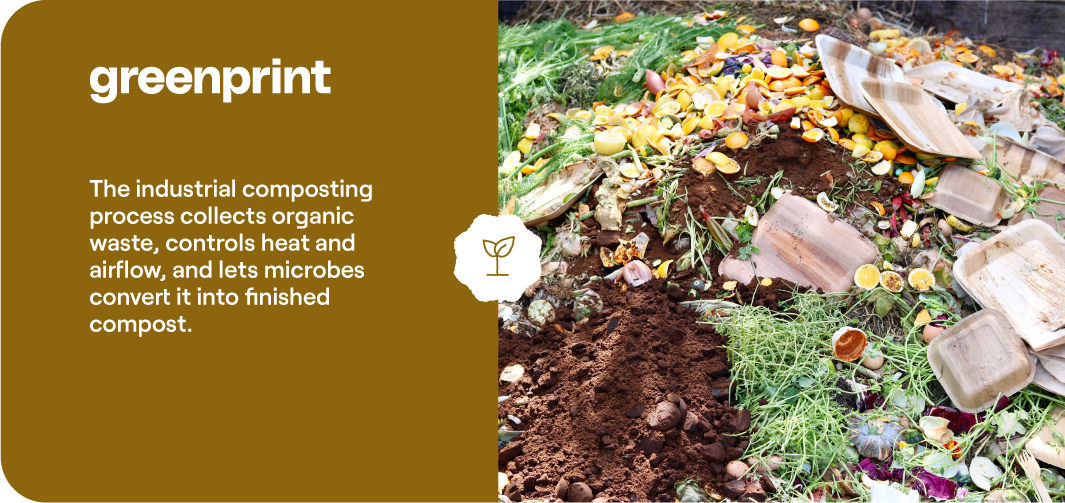
These facilities aren’t backyard compost bins. They reach temperatures between 55 and 70°C, which speeds decomposition and kills pathogens. The process also handles materials that home composting can’t manage, including certified compostable foodservice packaging.
For a full comparison of how industrial composting differs from home methods, see our guide on home vs. industrial composting key differences.
How Composting Emissions Compare to Landfill
This is where the carbon math gets clear. Aerobic decomposition, the kind that happens in a composting facility, produces carbon dioxide instead of methane. Since CO2 has a fraction of methane’s warming potential, the total climate impact drops dramatically.
Composting isn’t zero-emission. Small anaerobic pockets can form inside a compost pile, producing trace amounts of methane. The process also generates some nitrous oxide (N2O), another greenhouse gas. But these emissions are minor compared to what a landfill produces from the same material.
The comparison favors composting because of one fact: in a landfill, nearly all the carbon in organic waste converts to methane under anaerobic conditions. In a composting facility, nearly all that carbon converts to CO2 under aerobic conditions. The warming impact of methane is so much greater that even imperfect composting conditions produce far lower total greenhouse gas emissions than landfill disposal.
Well-managed commercial composting facilities also control their process to minimize anaerobic pockets. Turning the material regularly, monitoring moisture levels, and maintaining consistent airflow all reduce the chance of methane forming. The result is a process where the dominant emission is biogenic CO2. Biogenic CO2 is part of the natural carbon cycle. It comes from recently living material, not from releasing fossil carbon for the first time.
Nitrous oxide is the other emission worth understanding. It forms when nitrogen-rich materials (like food scraps) break down under alternating aerobic and anaerobic conditions. Composting facilities manage this by maintaining consistent oxygen levels and avoiding over-wetting the pile. Even with some N2O, total composting greenhouse gas emissions remain well below landfill levels.
What Happens to Carbon After Composting
The story doesn’t end when the composting process finishes. The finished compost itself becomes a carbon storage tool.
When compost is applied to soil, a portion of the carbon in that material becomes stable organic matter. This is sometimes called a “carbon sink” because the carbon stays in the ground rather than entering the atmosphere. Landfills can’t replicate this effect. Organic waste in a landfill doesn’t return carbon to productive soil. It sits buried, generating methane for decades.
Compost-amended soil holds water better, supports healthier root systems, and promotes microbial activity. These aren’t just agricultural benefits. They also reduce the need for synthetic fertilizers. Manufacturing synthetic fertilizers is energy-intensive and generates its own greenhouse gas emissions. By replacing some of that synthetic input with compost, you avoid an additional carbon source.
The composting carbon footprint, when you account for these downstream benefits, looks even better compared to landfill disposal. The soil application phase effectively creates a net carbon benefit that landfilling organic waste can never match.
Researchers have also found that compost-amended soil increases soil’s ability to resist erosion and retain nutrients. Healthier soil stores more organic carbon over time. Each application of compost builds on the previous one, compounding the climate benefit across growing seasons. For agricultural operations that receive finished compost from local facilities, the connection between food waste composting and soil health creates a closed-loop system. Food waste from restaurants becomes compost, compost feeds farms, and farms grow the food that restaurants serve.
How Researchers Measure the Difference
Quantifying the greenhouse gas difference between composting and landfill requires standardized tools. The EPA’s WARM (Waste Reduction Model) is one of the most widely used. It calculates the greenhouse gas implications of different waste management practices, including composting, landfilling, recycling, and source reduction.
WARM accounts for several factors: the methane generated in landfills, the carbon stored in compost-amended soil, the avoided emissions from displacing synthetic fertilizers, and the energy used to operate composting facilities. The model consistently shows composting as the lower-emission option for organic waste management.
Life cycle assessment (LCA) is another method researchers use. LCA tracks environmental impacts from raw material extraction through end-of-life disposal. For a deeper look at how LCA methodology works, read our explanation of cradle-to-gate vs. cradle-to-grave LCA boundaries.
If you’re new to how carbon emissions are tracked and reported, our overview of carbon footprint measurement methods covers the basics.
What This Means for Foodservice Businesses
If you run a restaurant, catering company, or any food-related operation, your waste stream matters for your carbon footprint. Food waste and packaging make up a large share of what foodservice businesses discard every day. Choosing what happens to that waste after it leaves your kitchen is a decision that directly affects your operation’s greenhouse gas output.
Switching to certified compostable products is one concrete step toward a lower-carbon waste stream. Look for certifications like BPI (for commercial composting in the U.S.) or TÜV Austria (for home or industrial composting). These certifications verify that a product will fully break down in a composting facility within a defined timeframe. For more on what those certifications require, read about the science behind compostability testing standards.
Diverting food waste and compostable packaging from landfills to composting facilities reduces your operation’s methane contribution. It also supports the creation of finished compost that benefits local agriculture and landscaping.
Food waste composting programs are expanding across the U.S. Many municipalities now offer commercial composting pickup for restaurants and food producers. Partnering with a local composting facility, and ensuring your packaging is accepted there, closes the loop on your waste.
Understanding your local composting infrastructure is the first step. Check whether nearby facilities accept food waste and certified compostable packaging. Many facilities have specific acceptance criteria, so matching your packaging to their requirements avoids contamination issues and rejected loads.
At Greenprint®, we design our foodservice packaging to work within this composting infrastructure. Our products, from certified compostable agave straws to fiber-based plates and bowls, carry BPI or TÜV Austria certifications. That means when your customers finish eating, the packaging can follow the food scraps into the compost bin instead of a landfill. Explore our full line of BPI-certified compostable foodservice packaging to find the right fit for your operation.
Frequently Asked Questions
Does Composting Eliminate All Greenhouse Gas Emissions?
No. Composting produces CO2, and small amounts of methane and nitrous oxide can form during the process. But the total warming impact is far lower than what the same material would produce in a landfill.
Can Compostable Packaging Go in an Industrial Composting Facility?
Yes, if the packaging carries a recognized certification like BPI or TÜV Austria. These certifications confirm the product meets standards for breakdown in industrial composting conditions. Learn more about compostability testing and certification requirements.
How Long Does Industrial Composting Take?
Most industrial composting facilities process material in 8 to 12 weeks, though timelines vary by facility and feedstock type. For a full comparison of timelines and conditions, see our guide on home vs. industrial composting differences.


Earth Day facts that show the scale of the environmental crisis, from plastic and landfill waste to CO2 and wildlife loss. See what the numbers mean for you.

Minnesota plastic ban rules for businesses, including city bag fees, Green To Go takeout packaging, PFAS limits, compostable labels, and EPR dates to plan for.
Reduce reuse recycle explained in plain terms. Learn what each of the 3 Rs means, why the order matters, and how compost completes the set as the 4th R.