

Minnesota Plastic Ban and Single-Use Plastic Laws Explained



Content
- Does Minnesota Have a Statewide Plastic Ban?
- Why Minnesota Cities Cannot Ban Plastic Bags
- Which Minnesota Cities Charge a Bag Fee?
- What Minneapolis and Saint Paul Require for Takeout Packaging
- How Minnesota Regulates PFAS in Food Packaging
- What Minnesota's Compostable Labeling Law Requires
- How the Packaging Waste and Cost Reduction Act Affects Businesses
- How to Choose Compliant Packaging in Minnesota
- FAQ
Minnesota Plastic Ban & Single-Use Plastic Laws: A Business Guide
If you run a food business, the Minnesota plastic ban question has a twist. Minnesota has no single statewide ban, so your rules come from your city and from statewide packaging laws. This guide to Minnesota Plastic Ban & Single-Use Plastic Laws covers what applies as of October 2026.
Does Minnesota Have a Statewide Plastic Ban?
No. As of October 2026, we found no statewide Minnesota ban on plastic bags, straws, foam containers, or bottles. Your obligations come from two layers instead: local ordinances and statewide product laws.
Local rules set which takeout packaging you can hand customers in cities like Minneapolis and Saint Paul. Statewide laws cover PFAS in food packaging, compostable labels, and a coming producer-funded packaging program. So the Minnesota plastic ban you hear about is really a mix of local and state rules.
If you’re comparing what states have banned plastic bags, our state-by-state bag ban overview tracks where statewide laws exist. In Minnesota, the answer depends on where you operate.
Why Minnesota Cities Cannot Ban Plastic Bags
State law blocks local bag bans. Minnesota Statutes section 471.9998 says no city or county may ban paper, plastic, or reusable bags. It has been in effect since May 31, 2017.
This plastic bag ban preemption hit Minneapolis first. The city passed a bag ban in 2016, but the 2017 state law invalidated it a day before it took effect.
Lawmakers have tried to undo the preemption. A 2024 repeal bill, HF3345, never became law. The statute still stands as of October 2026.
The law limits bans only. It says nothing about fees, which is why several cities charge for bags instead. Our national plastic regulation guide shows how other states handle the same question.
Which Minnesota Cities Charge a Bag Fee?
Because cities can’t ban bags, some charge for them. These local fees are the closest thing to a Minnesota plastic bag ban. The table below covers Minneapolis, Duluth, and Edina, but other cities may have their own rules.
City | Fee | Start Date | Restaurants |
|---|---|---|---|
Minneapolis | At least 5 cents per plastic, paper, or reusable carryout bag | 2020 | Restaurant carryout bags exempt |
Duluth | 5 cents per plastic bag | October 15, 2021 | Not confirmed; ask the city |
Edina | 5 cents per carryout bag | July 1, 2024 | Licensed food establishments exempt |
In Minneapolis and Edina, the business keeps the fee. Minneapolis rules are on the city’s Bring Your Own Bag page. Edina’s exemption covers restaurants and food trucks, according to the city’s bag fee FAQ. Duluth’s plastic bag fee started October 15, 2021, per the City of Duluth announcement.
Keep the scope straight. Bag fees are retail rules, while Green To Go ordinances cover food packaging. Check your city’s current ordinance, since city rules can change.
What Minneapolis and Saint Paul Require for Takeout Packaging
For most foodservice operators, the Green To Go ordinances matter more than any bag rule. “Green To Go” is the name both cities use for their takeout food and drink packaging rules. Each requires to-go packaging to be reusable, recyclable, or compostable.
Neither ordinance works as a single-use plastic bag ban. Saint Paul’s rules exclude bags by name. If you’re replacing banned items, our list of restaurant plastic alternatives can help you plan.
Rule | Minneapolis | Saint Paul |
|---|---|---|
Effective date | April 22, 2015 | January 1, 2022 |
Allowed packaging | Reusable, recyclable (#1, #2, #5 plastic), or BPI-certified compostable | Reusable or returnable, recyclable under city contracts, or BPI or city-approved compostable |
Not allowed | Foam, #6 polystyrene, PE-lined paper cups and plates, black plastic | Packaging outside the three allowed categories |
Bags | Not addressed on city page | Not covered |
Key exemptions | Manufacturer-prepackaged food (2015 city overview) | Hospitals, nursing homes, prepackaged food; hardship requests |
Extra requirement | Collection bins for each material you use | Applies to restaurants, delis, food trucks, and temporary vendors |
Minneapolis Green To Go Rules
Minneapolis’s ordinance has applied since April 22, 2015, per the city’s 2015 ordinance overview. It covers food and drinks prepared for immediate consumption or to go. Your containers must be reusable, recyclable, or compostable, per the Minneapolis Green To Go page.
Recyclable means #1, #2, or #5 plastic. Compostable plastics must be BPI certified. The city doesn’t allow expanded polystyrene foam, #6 rigid polystyrene, PE-lined paper cups and plates, or black plastic.
You also need collection bins for each type of material you use. Our commercial composting guide explains where collected compostables go. The city also warns that vague breakdown claims on packaging may not meet its rules.
If you’re replacing foam containers, compare the certification listed for our Fiberware™ bagasse clamshells against what Minneapolis accepts, since the city names BPI.
Saint Paul Green To Go Rules
Saint Paul’s rules took effect January 1, 2022, under Chapter 236 of city code. They cover food and drinks prepared for immediate consumption and carried out. Restaurants, delis, food trucks, and seasonal or temporary vendors all fall under them.
Packaging must be compostable, recyclable under city contracts, or returnable and reusable. Compostable means certified by BPI or another certifier the city approves, per the Saint Paul Green To Go page.
Hospitals, nursing homes, and manufacturer-prepackaged food are exempt. You can request a hardship exemption from the Department of Safety and Inspections with cost records.
Bags aren’t covered. The city page was last edited in 2022, so check for later amendments.
How Minnesota Regulates PFAS in Food Packaging
Since January 1, 2024, Minnesota statute 325F.075 has banned intentionally added PFAS in food packaging. The broader Amara’s Law timeline bans currently avoidable PFAS uses in 2032. Our PFAS testing breakdown covers the details.
What Minnesota’s Compostable Labeling Law Requires
If you sell products labeled compostable in Minnesota, certification is now required. Under Minnesota Statutes section 325E.046, those products must be certified as of January 1, 2026. They must meet one of two standards: ASTM D6400 or ASTM D6868.
The law covers bags, packaging, plates, bowls, cups, lids, trays, straws, utensils, and hinged or lidded containers. Products made only of wood or paper, with no coatings or additives, are exempt.
The certifier must be a nonprofit third party focused on composting. The MPCA labeling guidance names BPI as one example. Labels must show the ASTM standard, and a certifier’s mark works.
Labels must also say the item is meant for industrial or commercial composting. The law bars terms like “decomposable” unless an ASTM standard exists for the term and the product is certified. It doesn’t decide what compost sites accept, and complaints go to MPCA.
Pair these rules with the FTC Green Guides, which require environmental claims to be supported by a reasonable basis. Our guide to compostable certification standards covers how BPI and TÜV Austria certifications work.
How the Packaging Waste and Cost Reduction Act Affects Businesses
If you’re watching for a plastic bag ban 2026 update, Minnesota’s bigger change is packaging extended producer responsibility (EPR). The Packaging Waste and Cost Reduction Act was signed into law in early 2024, per MPCA’s packaging EPR overview. It makes producers fund a growing share of packaging recycling and composting costs.
Producers are generally brand owners, manufacturers, or importers. They must join a producer responsibility organization (PRO). MPCA confirmed Circular Action Alliance as that PRO on February 18, 2025.
Check whether you act as a producer for any packaging you sell. The statute’s definitions decide that, so review them with your supplier or legal counsel.
Key dates to track:
-
Per MPCA’s program timeline, producers form the PRO and MPCA runs needs assessments in 2025-2026.
-
Public comments on the draft 2026 needs assessment are open through November 13, 2026.
-
The PRO submits its first stewardship plan in 2027-2028.
-
From 2029, the PRO begins covering costs, phased in to at least 90% by 2031.
-
By 2032, packaging must be refillable, reusable, recyclable, or compostable.
MPCA opened rulemaking in 2026, and no final rules exist yet. Our extended producer responsibility explainer covers how EPR for packaging works across states.
How to Choose Compliant Packaging in Minnesota
A short checklist keeps you covered under both city and state rules. Work through it before your next packaging order.
-
Audit every to-go item you use, including cups, lids, clamshells, cutlery, and straws.
-
Check your city’s current ordinance for allowed materials, exemptions, and bin rules.
-
Choose packaging certified to ASTM D6400 or D6868 by a qualifying certifier like BPI.
-
Confirm each label shows the standard and says it’s meant for industrial or commercial composting.
-
Train staff to sort used packaging into the right bins.
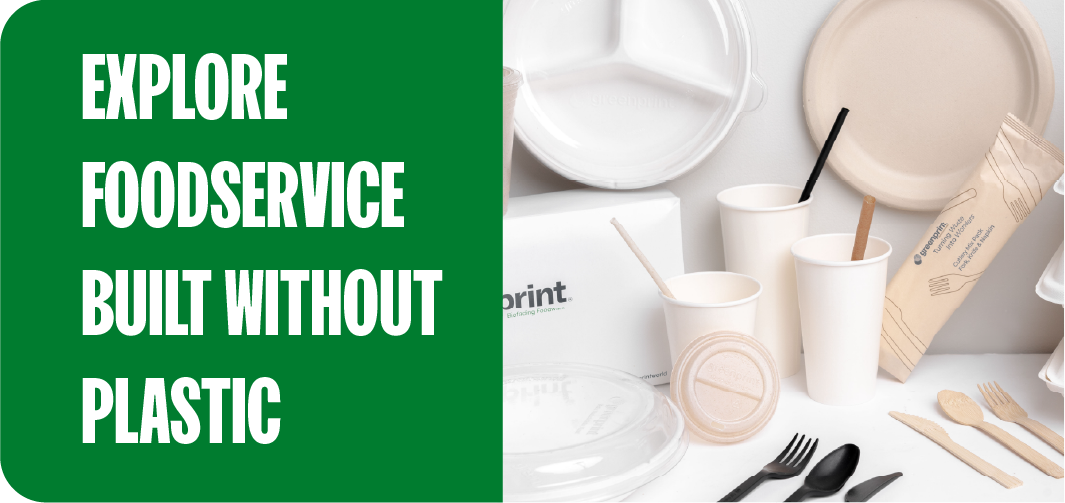
Greenprint® builds products with these rules in mind. Our Compostable Agave cutlery and compostable agave straws cover common to-go items. For cold drinks, we also offer Clearly Compostable™ cups.
Each product page lists its certifications, so you can match them to your city’s rules.
When you’re ready to switch, browse our certified compostable takeout packaging and match each item to your city’s rules.
FAQ
Are Plastic Straws Banned in Minnesota?
We found no statewide plastic straw ban in Minnesota as of October 2026. City Green To Go rules focus on to-go containers, so check your city’s current ordinance for straw rules.
Is Styrofoam Banned in Minnesota?
We found no statewide foam ban as of October 2026, but Minneapolis bans expanded polystyrene foam in to-go packaging. Saint Paul limits to-go packaging to compostable, recyclable, or reusable options.
Do Minnesota Restaurants Have to Charge for Bags?
Usually not, since Minneapolis exempts restaurant carryout bags and Edina exempts licensed food establishments. Other cities may differ, so check your city’s current ordinance.
When Does Minnesota’s Packaging EPR Program Start?
Producers began forming the program in 2025, and cost coverage starts in 2029. By 2032, packaging must be refillable, reusable, recyclable, or compostable.
References
- https://www.revisor.mn.gov/statutes/cite/471.9998
- https://www.house.mn.gov/SessionDaily/Story/13749
- https://www.house.mn.gov/sessiondaily/Story/18318
- https://www.minneapolismn.gov/business-services/licenses-permits-inspections/business-licenses/bring-your-own-bag
- https://www.edinamn.gov/m/faq?cat=107#question-1112
- https://duluthmn.gov/web-subscriptions/View-press-release/?prid=6577
- https://s3.amazonaws.com/meet-minneapolis/craft/cms/eap_ordinance.pdf?mtime=20171207170412
- https://minneapolismn.gov/business-services/business-assistance/run/food-business-rules/green-to-go/
- https://www.stpaul.gov/departments/safety-inspections/open-operate-expand-business/ongoing-requirements/amending-chapter-236-plastic-packaging
- https://www.revisor.mn.gov/statutes/cite/325F.075
- https://www.pca.state.mn.us/air-water-land-climate/pfas-use-prohibitions-and-reporting
- https://www.revisor.mn.gov/statutes/cite/325E.046
- https://www.pca.state.mn.us/business-with-us/compostable-product-labeling
- https://www.ecfr.gov/current/title-16/chapter-I/subchapter-B/part-260
- https://www.pca.state.mn.us/air-water-land-climate/extended-producer-responsibility-for-packaging
- https://www.pca.state.mn.us/news-and-stories/mpca-confirms-registration-of-minnesotas-initial-packaging-producer-responsibility-organization
- https://www.pca.state.mn.us/get-engaged/packaging-waste-and-cost-reduction-act

Reduce reuse recycle explained in plain terms. Learn what each of the 3 Rs means, why the order matters, and how compost completes the set as the 4th R.
Worm composting turns kitchen scraps into rich castings. Learn which worms to buy, how to set up a bin, what to feed them, and how to harvest compost.

Illinois plastic bans and regulations explained: hotel bottle law, Chicago bag tax and foodware rules, local bans, and pending bills. Plan your compliance now.