

How to Choose the Right Disposable Cutlery for Foodservice


Content
- Key Factors to Consider When Choosing Disposable Cutlery
- Types of Disposable Silverware
- Matching Cutlery to Your Menu: Heat, Durability, and Weight
- How to Verify a Compostable Claim: Certifications That Matter
- Tips for Buying Disposable Cutlery in Bulk
- Frequently Asked Questions
- Choose the Best Disposable Cutlery for Foodservice
How to Choose the Right Disposable Cutlery for Foodservice
Disposable cutlery is convenient and hygienic. The utensils are designed to be used once and then thrown away. This concept eliminates the need for washing and storage, so it is commonly used for takeout, food delivery, quick-service restaurants, and cafeterias.
Disposable cutlery can be made from various materials, so there are many things to consider when choosing the best kind for your business and consumers.
Manufacturing and resource consumption have long-term impacts on the planet. When you choose renewable plant-based products, you contribute toward a positive environmental impact. Greenprint® develops high-quality, sustainable cutlery products that follow worldwide composting and recycling regulations.
Key Factors to Consider When Choosing Disposable Cutlery
There are many types of disposable cutlery for your consumers to eat from. It must be practical to use and safe for food contact. To determine the right kind of flatware, consider the material makeup, its intended use, and any environmental drawbacks.
Material
Disposable flatware can be made of plastic, PLA, agave, wood, bamboo, and other materials. These materials may require some or no oil-based plastic components. We encourage you to consider whether the material of choice comes from a renewable resource.
Traditional plastic utensils are suitable for lightweight tasks but are flimsy and less sustainable than alternative cutlery made of strong, renewable materials. Sustainable utensils provide the convenience of plastic silverware but reduce your environmental footprint.
Intended Use
Using disposable utensils is practical for foodservice companies. Consider the temperature and density of the food.
Compostable bioplastics and wood are durable enough to handle hot and cold foods. They won’t melt when encountering heat or bend against hard-textured food. While lightweight plastic is an option for cold foods, avoid heating plastic because it can cause chemicals to leach into the food.
Prior to use, store the utensils somewhere clean and dry to prevent contamination and bacteria growth. Keep them sealed until they are needed.
Environmental Considerations
Due to the throwaway nature of disposable cutlery, it is not meant to be used repeatedly. Compostable and recyclable alternatives have risen in popularity to combat the environmental impact of disposable cutlery and single-use plastic waste. Using them can enhance your brand’s reputation, especially among environmentally aware consumers.
Find specific information on the product label or manufacturer’s website to discover the correct disposal method for your chosen flatware. Sustainable alternatives fit into at least one of the following end-of-life disposal classifications:
- Compostable (Home): Breaks down in a backyard compost system, verified by a certification such as TÜV Austria OK Compost HOME.
- Compostable (Industrial): Breaks down only in a commercial facility at 55 to 60°C, verified by BPI Commercial Compostability or TÜV Austria OK Compost INDUSTRIAL.
- Recyclable: Discarded resources, such as metal, plastic, and paper, that can be repurposed into new materials at a recycling facility.
A credible compostable claim always names a certifier, such as BPI or TÜV Austria. If a product only says "compostable" with no certification, treat that claim with caution.
Types of Disposable Silverware
If you want to use disposable forks, spoons, and knives, there are many types of flatware materials to choose from. Below, we break down popular options and their primary considerations.
| Disposable Cutlery Materials at a Glance | ||||
|---|---|---|---|---|
| Material | Best For | Heat Tolerance | End-of-Life / Certification | Relative Cost |
| Plastic (PP/PS) | Cold foods, tight budgets | Low, avoid hot food | Limited recycling, not compostable | Low |
| PLA | Cold and warm foods | Low to medium | Industrial composting (BPI, ASTM D6400) | Medium |
| CPLA | Hot foods and beverages | High | Industrial composting (BPI) | Medium |
| Compostable Agave (Green Dot) | Cold or lukewarm foods | Low, not above 40°C | Industrial composting (BPI Commercial Compostability) | Medium to high |
| Wood (birch) | Hot and cold foods | High | Compostable, decomposes naturally | Medium |
| Bamboo | Hot and cold foods | High | Compostable at a facility | Medium |
| Bagasse (sugarcane fiber) | Hot and cold foods | High | Industrial composting (TÜV Austria OK Compost INDUSTRIAL) | Medium |
Plastic Utensils
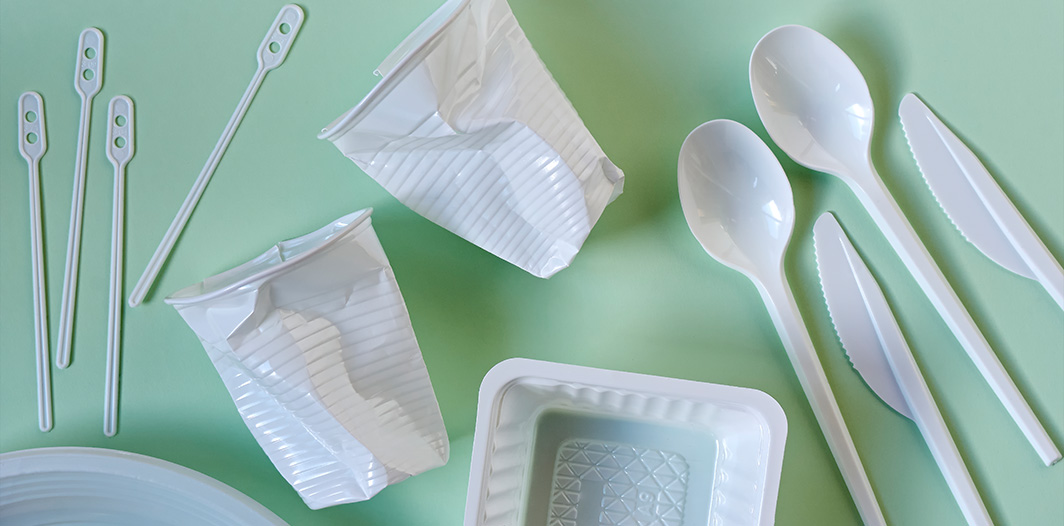
Disposable plastic cutlery is typically made of polypropylene (PP) or polystyrene (PS). Although plastic is commonly used for cutlery and other consumer products in everyday life, it has harmful environmental impacts.
It requires fossil fuels for production, which are nonrenewable resources that contribute to climate change and greenhouse gas emissions. When plastic comes into contact with food, notably hot food, there is a risk of microplastics and chemical leaching.
Not all forms of plastic can be recycled. Plastic waste resists breakdown in landfills and cannot be incinerated due to its toxic chemicals.
Many states are implementing plastic bans to reduce pollution and landfill waste. These bans focus on single-use plastic bags, bottles, straws, and utensils.
PLA Utensils
Polylactic acid (PLA) offers advantages over regular plastic. It is a bioplastic derived from organic matter, such as cornstarch, sugarcane, and cassava. When correctly disposed of, it can be composted through industrial composting programs.
Proper PLA utensil disposal can be inaccessible. Not all bioplastics are compostable, and there currently aren’t waste infrastructures that handle PLA recycling. This restriction means disposable PLA flatware must be disposed of at an industrial composting facility. Sent to a landfill instead, PLA can still pollute the earth and oceans.
Standard PLA suits cold and warm foods but turns brittle and can soften under heat, so it relies on industrial composting. CPLA is crystallized PLA with added heat tolerance, which makes it a better fit for hot foods and beverages. In both cases, a certification such as BPI Commercial Compostability is what makes a compostable claim credible.
Agave Utensils
Agave is a plant native to arid American environments. Its fibers are strong and versatile for various applications, such as disposables, brushes, and paper pulp.
Our Green Dot Compostable Upcycled Agave Cutlery is made from a proprietary three-component compound of Agave Fibers, a PLA polymer blend, and an enzyme masterbatch. We compound and injection mold it in-house in Santa Catarina, Nuevo León, on a line that runs on 40% wind power. You can read more about how our agave products are made.
This cutlery holds BPI Commercial Compostability certification, which requires an industrial composting facility operating at 55 to 60°C. It does not carry TÜV Austria OK Compost HOME certification, so it will not break down in a backyard compost bin. It is also third-party verified PFAS-free.
Because the compound is PLA-based, our Compostable Agave cutlery is best for cold or lukewarm foods and should not be used above 40°C (104°F). For operators without access to industrial composting, our Blue Dot PCR Upcycled Agave Cutlery uses 50% post-consumer recycled content. Note that the Blue Dot line is not compostable.
These two lines give you a clear choice based on your waste systems. Choose Green Dot where a commercial composter is available and you want a certified compostable claim. Choose Blue Dot where composting is not an option and a documented recycled-content story fits your goals.
Disposable Wooden Utensils
The birch wood used to create disposable wooden utensils is sourced sustainably to avoid fueling deforestation. It is cut and sanded into the desired fork, spoon, and knife shapes. They are sturdy, gentle on cookware, and suitable for many foods, making them one of the best plant-based, compostable cutlery options.
This disposable flatware doesn’t require fossil fuels and naturally decomposes much faster than plastic. Although composting is the ideal end-of-life method, wood will eventually decompose in a landfill.
Disposable Bamboo Utensils
Naturally sourced, plant-based bamboo forks, spoons, and knives are another plastic-free choice. Like wood, bamboo is cut and sanded into utensil shapes, which requires zero plastic components. Bamboo flatware is suitable for hot and cold dishes and is one of the cleanest materials for cutlery because bamboo is naturally antibacterial.
These sustainable utensils take one to six months to fully decompose at a composting facility, freeing up space in overcrowded landfills.
Other Plant-Based Disposable Utensils
Go green with your foodservice disposable silverware. Along with the options above, you can find bioplastic utensils made from bagasse (sugarcane fiber), plant-starch material (PSM), and cornstarch.
Bagasse is the fiber left after sugarcane is pressed for juice, so it reuses a food-processing byproduct. Plant-starch material, often labeled PSM, blends starch with other polymers and can vary widely in composition. Because the pathway differs by product, the certification on the label is your most reliable guide.
These are typically compostable, though the pathway varies by material. Always check the packaging label for information about the material and how to correctly dispose of it.
Matching Cutlery to Your Menu: Heat, Durability, and Weight
The right match protects both the meal and your margins. A utensil that fails mid-bite frustrates customers and drives up replacement orders. Choosing by service type keeps performance high and waste low.
Match your cutlery to how your food is served. For hot or oily dishes, choose CPLA, wood, or bamboo, which hold up under heat. For cold or lukewarm service, standard PLA and our Compostable Agave cutlery perform well and keep costs reasonable.
Cutlery weight also matters for the experience. Medium-weight utensils suit light meals, salads, and pastries. Heavy-weight utensils handle dense, saucy, or fibrous foods like steak, barbecue, and root vegetables without bending.
Oily and saucy dishes add a second test. A utensil that softens in heat will also weaken when it sits in warm grease or sauce. For those menus, a heavy-weight wood, bamboo, or CPLA utensil holds up better than a thin plastic or standard PLA option.
Remember that agave and PLA cutlery suit cold or lukewarm foods, so keep them off hot plates above 40°C (104°F). For hot service, CPLA, wood, or bamboo are the safer match.
How to Verify a Compostable Claim: Certifications That Matter
Not every "compostable" label means the same thing. Before you buy, look for a named certification that tells you where and how a product breaks down. Here are the certifications that matter most for disposable cutlery:
- BPI Commercial Compostability: Confirms a product composts in an industrial facility, verified against the ASTM D6400 standard.
- ASTM D6400: The U.S. standard for compostability in industrial facilities that BPI certification relies on.
- TÜV Austria OK Compost INDUSTRIAL: Confirms industrial composting at 55 to 60°C, the European equivalent benchmark.
- TÜV Austria OK Compost HOME: Confirms a product breaks down in a backyard compost system at ambient temperatures.
Before you buy, check that the certification appears on the product or its packaging, not just in marketing copy. A real certification names the standard, the certifying body, and often a license or certificate number you can verify. If a claim only says "compostable" with no certifier, treat it as unproven per FTC Green Guide.
Certification tells you a product can compost, but your local facility decides whether it will. Some composters accept certified foodservice items, and others screen them out. Confirm acceptance with your hauler or composter before you commit to a large order.
Our Green Dot Compostable Upcycled Agave Cutlery carries BPI Commercial Compostability certification, so it composts in an industrial facility. If you compost at home instead, the EPA offers guidance on what backyard systems can and cannot handle.
Tips for Buying Disposable Cutlery in Bulk
There are many avenues to purchase disposable flatware for your foodservice business or event. Consider the following tips as you select the best disposable silverware:
- Consider the ideal material and durability to suit your intended usage.
- Know how to compost or recycle the used utensils based on your local waste systems.
- Determine how many utensils you need to avoid under- or over-ordering.
- Find a vendor that complies with U.S. environmental standards, such as BPI Commercial Compostability certification.
- Some companies give discounts and offers on bulk orders.
Frequently Asked Questions
Is Compostable Cutlery Really Compostable?
Yes, when it carries a certification such as BPI Commercial Compostability or TÜV Austria OK Compost. Most compostable cutlery needs an industrial composting facility, not a backyard bin.
Can Compostable Cutlery Handle Hot Foods?
CPLA, wood, and bamboo handle heat well. Standard PLA and our Compostable Agave cutlery are best for cold or lukewarm foods below 40°C (104°F).
How Long Does Compostable Cutlery Take to Break Down?
In an industrial composting facility, certified compostable cutlery typically breaks down within 45 to 180 days. Home compostable products certified to TÜV Austria OK Compost HOME can take longer at ambient temperatures.
What Is the Most Sustainable Disposable Silverware?
There is no single winner. Match a certified material to your food temperatures and your local composting or recycling access.
What Certifications Should I Look For?
Look for BPI Commercial Compostability, ASTM D6400, and TÜV Austria OK Compost, which distinguishes HOME from INDUSTRIAL composting.
Choose the Best Disposable Cutlery for Foodservice
When choosing the right disposable cutlery for foodservice, consider what the various types of utensils are made of. Also think about what will happen to them after use. Single-use plastic is notorious for polluting the environment and never fully breaking down in landfills.
Many sustainable options, such as agave and wooden silverware, have become popular alternatives in the foodservice industry. When utensils are better for the planet, they tend to also be safer for consumers.
Greenprint specializes in plant-based cutlery and building a sustainable circular economy, which includes locally sourcing raw materials and using zero-waste packaging for all our products. Explore our plant-based products and collections of sustainable solutions for everyday use. Contact our team today to find the right fit for your menu.


See the Hawaii plastic ban and single-use plastic laws for Honolulu, Maui, Hawaii County, and Kauai, with dates, fines, and compliant foodware tips for 2026.

Nanoplastics vs. microplastics comes down to size. Learn how they differ, why researchers worry more about nanoplastics, and simple ways to reduce exposure.

Earth Day facts that show the scale of the environmental crisis, from plastic and landfill waste to CO2 and wildlife loss. See what the numbers mean for you.