

Plan Sustainable Corporate Events: 7 Steps to Cut Waste



Sustainable Corporate Events: 7 Steps to Cut Event Waste
Sustainable corporate events cut waste, travel, and resource use without making the day worse for attendees. Much of an event’s waste comes from a few places: catering, foodware, printed materials, and travel. This guide walks you through seven steps to plan around each one and report your results honestly.
What Is a Sustainable Corporate Event?
A sustainable corporate event is a meeting, conference, or company gathering planned to use less and waste less. Sustainable events also cut travel where they can and source food and supplies with care.
The last piece is honest reporting. You track what happened, share it plainly, and fix what didn’t work next time. For a formal approach, the ISO 20121 event standard sets requirements for an event sustainability management system.
Why Sustainable Corporate Events Matter for Your Business
Your event is a public version of your company’s values. If your ESG or CSR report promises less waste, a conference full of plastic forks undercuts it. Clients, investors, and staff notice that gap.
You may hear questions from clients and staff about how your event compares across the sustainability in events industry. Clients may ask how your vendors handle waste, and staff may expect events to match your commitments. PCMA reports that planners see rising attendee sustainability expectations, including visible measures at events.
When an event contradicts those commitments, people read it as greenwashing. The psychology behind greenwashing shows how fast that mismatch erodes trust. Procurement leads can close the gap by writing sustainability requirements into RFPs and vendor contracts.
Supplier accountability is the other piece. Your company is judged by the caterers, venues, and suppliers you hire. Asking them for written proof protects your brand and gives your procurement team clear standards to buy against.

How to Plan a Sustainable Corporate Event
Sustainable event planning works best in order, because your venue choice shapes every decision after it.
Step 1: Set Measurable Sustainability Goals
Start with goals you can track and check after the event. “Be more sustainable” is too vague to guide a decision or prove a result. Vague goals also lead to vague claims later.
Good goals name a waste stream, a product, or a behavior. Write them into your sustainable event guidelines and share them with every vendor. For example:
-
Keep food scraps and certified compostable foodware out of landfill.
-
Serve no single-use plastic at catering.
-
Replace bottled water with refill stations.
-
Offer a transit or shuttle option to every attendee.
Use a past event as your baseline if you have the records. That gives you something real to measure against. Then name one owner for each goal to track vendor progress and collect data afterward.
Step 2: Choose a Venue With Verified Sustainability Credentials
Your venue decides what’s possible for waste, energy, and travel. Get answers before you sign the contract. Ask each venue to confirm, in writing:
-
Whether they have commercial composting and what their hauler accepts.
-
Which materials their recycling stream takes.
-
Where their energy comes from.
-
How close they are to public transit.
-
Whether they hold credentials such as LEED or Green Key.
The USGBC LEED rating system rates the building itself, so still ask about daily waste practices. Composting access matters most, because it decides which foodware you buy in Step 5.
Ask for the hauler’s name and its accepted-materials list. Accepted materials vary by facility and must exclude contaminants like non-compostable packaging, per EPA composting guidance. Confirm whether your hauler accepts foodware.
Step 3: Cut Travel and Printed Materials
Attendee travel adds to your event’s emissions, so make transit the easy option. Pick a venue near public transit and share routes in the invite. Run shuttles from hotels and transit hubs, and offer hybrid attendance for short sessions.
Every avoided trip lowers emissions, but counting them takes its own method. Our guide to planning a net-zero event covers carbon accounting and offsets.
Next, cut paper. Put the agenda in your event app or behind a QR code at check-in. Use reusable badge holders and collect them at the exit.
If you must print signage, skip dates and session details. That way, the same signs can work at your next event.

Step 4: Plan Low-Waste Catering
Catering is where good intentions most often turn into trash. These sustainable events ideas cut waste before it reaches the bin:
-
Confirm headcounts close to the date and order to match.
-
Build menus around local, seasonal, and plant-forward dishes.
-
Serve water from bulk dispensers instead of single-serve bottles.
-
Skip individually wrapped snacks and condiments.
-
Set up food donation for safe, untouched leftovers before the event.
The EPA Wasted Food Scale ranks preventing waste and feeding people above composting. Donate first, then compost what’s left. Line up the donation partner, pickup time, and food-safe containers well before the event.
Vet your caterer before you sign. Ask them to explain:
-
How they size orders to a confirmed headcount.
-
Which dishes they can source locally.
-
Whether they work with a food donation partner.
-
What foodware they bring and which certifications it carries.
-
How they separate kitchen scraps from service waste.
Step 5: Replace Single-Use Plastic With Certified Foodware
Your foodware should match the venue’s waste setup. Compostable items only pay off when a composting stream accepts them. Check your Step 2 answers before you order.
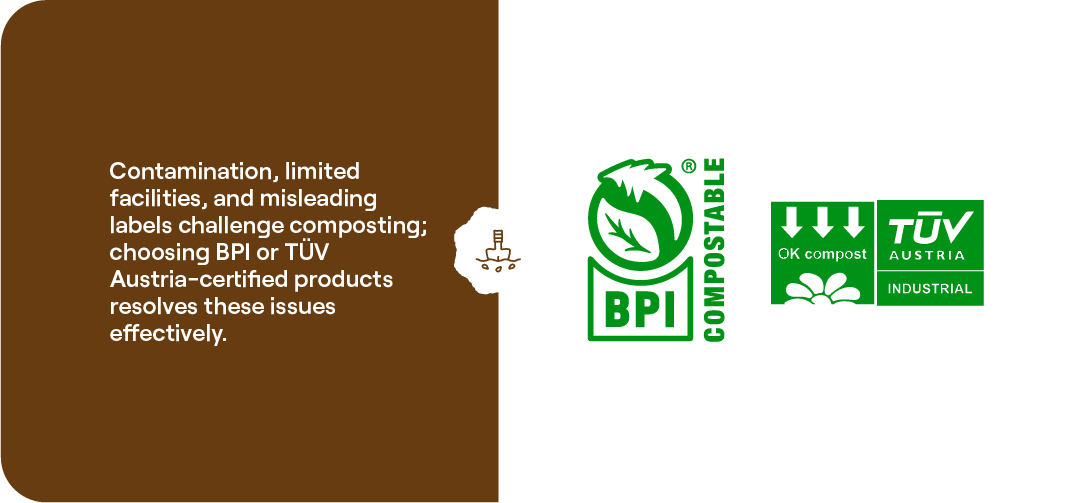
Certification is how you verify a compostable claim. BPI’s commercial compostability certification uses ASTM D6400 as its base standard. TÜV Austria bases its OK Compost INDUSTRIAL label on the EN 13432 standard.
Our guide on how compost labels differ explains what each one covers.
Venue composting access | What to choose |
|---|---|
Commercial composting that accepts foodware | Items certified by BPI or TÜV Austria OK Compost INDUSTRIAL. |
Home or on-site composting only | Items certified TÜV Austria OK Compost HOME. |
No composting access | Reusables where possible, and fewer single-use items overall. |
Our Greenprint® foodware covers each part of a catered event:
-
Upcycled Agave Straws are certified TÜV Austria OK Compost HOME and BPI.
-
Compostable Agave Cutlery is BPI Commercial certified for industrial composting facilities.
-
Fiberware™ plates, bowls, and clamshells are made from bagasse (sugarcane fiber) and certified TÜV Austria OK Compost INDUSTRIAL.
-
Renewacups™ paper hot cups are PFAS tested by Intertek.
-
Clearly Compostable™ cold cups are made from PLA and certified by BPI and TÜV Austria OK Compost INDUSTRIAL.
Our straws use an enzyme-enhanced agave compound, which is what earns the HOME certification. Our cups are paper and PLA, and Fiberware™ is bagasse, so none of them use agave.
Step 6: Set Up Clearly Labeled Waste Stations
The right foodware still ends up in landfill if guests sort it wrong. Group compost, recycling, and landfill bins together at every station. Don’t leave a lone trash can, because it becomes the default.
Label each bin with photos of the actual items you’re serving. A picture of your cup is easier to follow than a one-word sign. Staff the busiest stations during meals to guide people.
Brief your staff and volunteers before doors open. Show them each item on the menu and the bin it belongs in.
Contamination is the risk to watch. Facility contracts may let a facility reject a load if contamination is too high. An EPA plastic contamination report describes these terms.
Ask your hauler how it handles contaminated loads. A mixed-up bin could undo careful planning.
Compost and recycling are separate streams with different rules, as Boulder County’s composting FAQ explains. Our breakdown of compostable vs. recyclable packaging covers the difference.

Step 7: Measure and Report Your Results
Measure against the goals you set in Step 1. Ask your hauler for weights or volumes by stream: compost, recycling, and landfill. Ask each vendor to confirm they followed your guidelines.
Add attendee feedback. A short survey can ask whether the stations were clear and the transit options worked.
Report honestly, including what didn’t work. The best sustainable events examples share real gaps, like a contaminated bin or a vendor who brought plastic. That candor builds more trust than a polished success story.
Share the report with your vendors, too. It sets the bar for your next contract.
For emissions, use the carbon accounting method in the net-zero event guide from Step 3.
How to Keep Your Event Sustainability Claims Accurate
After the event, you’ll want to share results. Keep every claim specific and backed by records. “A zero-impact event” says nothing you can prove.
A stronger claim reads like this: “We sent food scraps and certified compostable foodware to a commercial composter.” Name the certification whenever you mention compostable items. Anyone can confirm a product’s listing through BPI’s certified product search.
The FTC Green Guide warns against broad environmental claims and calls for clear qualifiers. Our post on misleading eco certifications shows which seals tell buyers very little.
Stock Your Next Corporate Event With Certified Foodware
Many of these steps end at the catering table. Once you know your venue’s composting access, you can choose foodware that matches it.
Explore our sustainable solutions, starting with our certified compostable event foodware. If you’re replacing plastic forks, browse our Compostable Agave Cutlery or compare agave and plastic silverware. For event quantities, contact the Greenprint team with your headcount, menu, and venue composting access.

Frequently Asked Questions
Are Compostable Plates and Cups Worth It for Corporate Events?
Yes, if your venue can compost them and each item has a named certification. Ask for third-party PFAS test results too, and learn how products earn compostable status.
Can a Hybrid Event Be More Sustainable Than an In-Person Event?
Often, yes, because remote attendees skip the trip entirely. A hybrid format also lowers catering and foodware needs, since fewer people attend in person.
What Should You Ask a Caterer About Sustainability?
Ask how they size orders, source food, donate leftovers, separate scraps, and certify their foodware. Get the answers in writing before you sign.
What Happens to Compostable Foodware if the Venue Has No Composting?
It won’t get the composting conditions it was certified for, so confirm composting access before you buy. Our guide on why PLA needs industrial composting explains those conditions.
References
- https://www.iso.org/standard/86389.html
- https://www.pcma.org/sustainability-expectations-rising/
- https://cdn.airops.com/rails/active_storage/blobs/proxy/eyJfcmFpbHMiOnsiZGF0YSI6NTU1NzMzNjk2LCJwdXIiOiJibG9iX2lkIn19--a6be70fea19ad91b8ccfccf7d162fb81ed8088f1/67_Planning%20a%20Net-Zero%20Event_1.png
- https://www.usgbc.org/leed
- https://www.epa.gov/sustainable-management-food/composting
- https://www.epa.gov/sustainable-management-food/wasted-food-scale
- https://bpiworld.org/compostability-certification
- https://en.tuv.at/ok-compost-industrial-en/
- https://www.epa.gov/system/files/documents/2021-08/emerging-issues-in-food-waste-management-plastic-contamination.pdf
- https://bouldercounty.gov/environment/composting/composting-changes-faqs/
- https://products.bpiworld.org/
- https://www.ftc.gov/business-guidance/resources/environmental-claims-summary-green-guides


The Connecticut plastic ban covers thin checkout bags, and foam and straw bills keep returning. Learn the rules, exemptions, and steps to prepare your business.

Run a zero waste coffee shop with this operator playbook. Audit your bins, put reusable cups first, pick certified compostables, and train staff to sort right.

Regenerative vs organic farming compared, covering USDA organic rules, regenerative goals, and ROC labels. See what each label proves before you source food.