

Compostable Forks: Materials, Certifications, and Guide



Content
- Key Takeaways
- What Makes a Compostable Fork Actually Compostable?
- Compostable Fork Materials Compared
- Certifications That Verify Compostable Fork Claims
- How to Match Compostable Forks to Your Restaurant's Needs
- Composting Pathways for Compostable Forks
- Find the Right Compostable Forks for Your Operation
- Frequently Asked Questions About Compostable Forks
Compostable Forks for Restaurants: Materials, Certifications, and What to Look For
Choosing the right compostable fork for your restaurant means understanding what materials actually break down, which certifications verify those claims, and whether your local waste system can process the product. In this guide, we cover materials, certifications, composting pathways, and practical recommendations so you can make purchasing decisions that serve both your sustainability goals and your business.
Key Takeaways
- A fork can only be called “compostable” if it carries third-party certification from a recognized body like BPI or TÜV Austria, not just because it’s made from plant-based materials.
- Different compostable fork materials have different composting requirements, temperature limits, and durability profiles, so the right choice depends on your menu, service style, and local waste infrastructure.
- If your operation doesn’t have access to commercial composting, a recycled-content fork is a more honest choice than a compostable fork that will end up in a landfill.
What Makes a Compostable Fork Actually Compostable?
A compostable fork is a utensil that has been tested and certified by an independent third party to break down fully in a composting environment within a defined time frame. This means the fork will return to organic matter without leaving toxic residue behind, but only when processed in the right conditions.
The word “compostable” is a regulated claim under FTC Green Guides. You can’t just call something compostable because it’s made from plants. The claim requires specific, verifiable proof from an accredited testing organization.
In the United States, ASTM D6400 is the standard that defines what qualifies as compostable in an industrial composting facility. Products meeting this standard can earn certification from the Biodegradable Products Institute (BPI), whose certification program has been operating for over 25 years and is required by every U.S. state with regulatory language around compostability. TÜV Austria offers additional certifications, including OK Compost HOME for products that break down at lower temperatures and OK Compost INDUSTRIAL for those requiring commercial facilities.
Many products use terms like “plant-based” or “natural” without carrying any third-party compostability certification. Under FTC Green Guides, these vague claims can mislead customers and expose your business to regulatory risk. The simplest way to protect yourself is to ask your supplier for certification documentation before you buy.
Compostable Fork Materials Compared
Not all compostable forks are made from the same materials. The material determines everything from how the fork performs during a meal to how it breaks down afterward. Here’s how the most common compostable fork options compare:
| Material | Source | Composting Pathway | Durability | Temperature Limit | Common Certifications |
|---|---|---|---|---|---|
| Cornstarch / PLA | Corn, sugarcane | Industrial only | Moderate | Low | BPI Commercial Compostability |
| Bamboo / Wood | Bamboo, birch | Home or industrial (verify certifications with supplier) | Low to moderate | High | Varies by supplier |
| Agave-based bioplastic | Post-tequila agave waste | Industrial | Heavy-weight | Low to moderate | BPI Commercial Compostability (for Cutlery), PFAS verified |
Cornstarch and PLA Forks
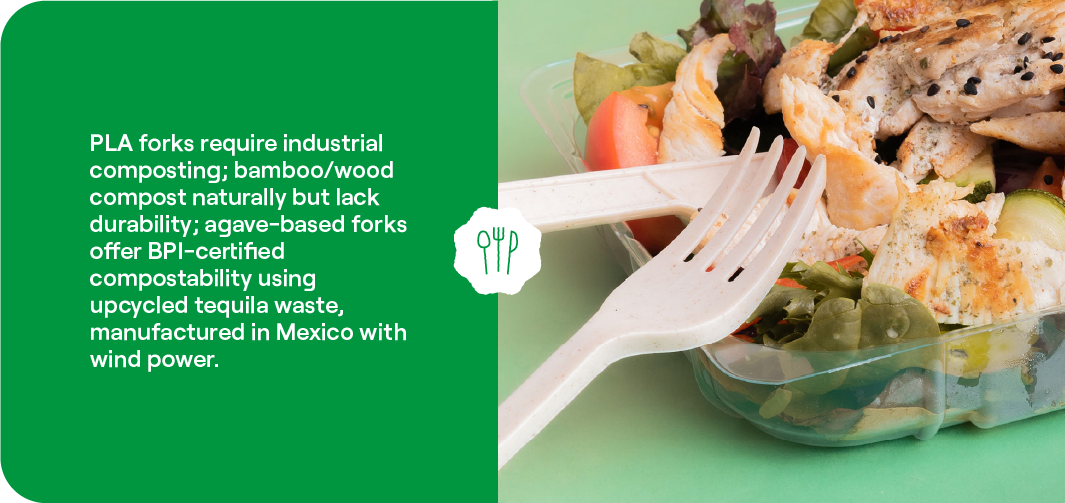
PLA (polylactic acid) forks are made from plant starches like corn or sugarcane. They require industrial composting facilities operating at high temperatures to break down. This means they cannot be composted in a backyard bin.
This is a key limitation that many suppliers don’t make clear. PLA performs well for cold applications like salads and desserts, but it softens under heat. If your composting hauler doesn’t accept PLA, these forks will likely end up in a landfill where they won’t break down in any meaningful time frame.
Bamboo and Wood Forks
Bamboo and wood forks are naturally compostable. They can break down in both home and industrial composting environments. They also handle heat better than PLA-based options, making them suitable for a wider range of foods.
The trade-offs are practical:
- Shipping footprint: Bamboo is typically shipped long distances from Asia, which adds to the product’s overall environmental impact.
- Texture: Wood and bamboo forks can feel rough or splintery during use.
- Strength: They lack the structural strength needed for heavier or denser foods.
For lighter fare, they work fine. For a full meal with dense proteins or grains, they may not hold up.
Agave-Based Bioplastic Forks
Our Greenprint® Green Dot Compostable Upcycled Agave Cutlery (CF1000) is made with Upcycled Agave Fibers. The agave comes from post-tequila agricultural waste sourced from farming families in Jalisco, Mexico. This raw material has no competing use, making it a genuine waste-to-value story rather than a crop diverted from food or animal feed.
We manufacture this cutlery at our facility in Mexico, which runs partially on wind power. We control the material from raw fiber to finished fork. This vertical integration gives us full quality control and a product that can’t be easily replicated by competitors who purchase pre-made compounds. It’s also what sets agave cutlery apart from plastic silverware across performance and sustainability metrics.
For operations that don’t have access to composting infrastructure, we also offer Blue Dot Upcycled Agave (PCR) Cutlery. This line combines Upcycled Agave Fibers with post-consumer recycled plastic. It is not compostable and does not carry BPI or ASTM D6400 certification. Its value is in diverting waste on the front end by using reclaimed material streams. We’ll cover when this option makes sense later in this guide.
Certifications That Verify Compostable Fork Claims
Third-party certifications are the only reliable way to verify that a compostable fork will actually break down as claimed. As a restaurant operator, you should require documentation of these certifications from any supplier before making a purchase.
Here are the certifications that matter:
- BPI Commercial Compostability (for Cutlery): This U.S.-based certification confirms that a product meets ASTM D6400 and will fully break down in an industrial composting facility. Our Green Dot Compostable Upcycled Agave Cutlery carries BPI Commercial Compostability certification (for Cutlery).
- TÜV Austria OK Compost HOME: This certification verifies that a product breaks down at lower, ambient temperatures found in a home compost bin. Our agave straws carry TÜV Austria OK Compost HOME certification. Our cutlery does not currently carry TÜV HOME certification and requires industrial composting.
- TÜV Austria OK Compost INDUSTRIAL: This certification confirms breakdown in a commercial composting facility operating at higher temperatures.
- Third-party PFAS verification: PFAS (per- and polyfluoroalkyl substances) are synthetic chemicals that have raised health concerns. Our cutlery line is third-party verified PFAS-free through BPI Commercial Compostability certification (for Cutlery). Third-party testing is more reliable than self-declared claims because it involves independent laboratory analysis.
Under FTC Green Guides, certifications and seals must clearly convey the basis for the certification. A generic “green” seal without explanation of what it certifies can be misleading. Always ask what standard a certification is based on and who issued it.
How to Match Compostable Forks to Your Restaurant’s Needs
The right compostable fork depends on three things: what you’re serving, how you’re serving it, and what happens to the fork after the meal. Getting this match right saves you money and ensures your sustainability claims hold up to scrutiny.
Cold and Lukewarm Service
Our Green Dot Compostable Upcycled Agave Cutlery is designed for cold and lukewarm meals. Because the material is PLA-based, it’s not built for high-heat applications.
This makes it ideal for:
- Salads and grain bowls.
- Chilled desserts.
- Room-temperature catering spreads.
- Deli counters and grab-and-go service.
These forks are heavy-weight and sturdy enough to handle dense foods without snapping or flexing. They carry BPI Commercial Compostability certification (for Cutlery), so you can back up your sustainability claims with documentation.
High-Volume Catering and Events
For catering operations and large events, consistency matters as much as sustainability. Every fork needs to perform the same way across hundreds of servings.
Our cutlery is produced at our facility in Mexico, which runs partially on wind power. The manufacturing process delivers uniform heavy-weight forks that hold up under real service conditions. Bulk ordering is straightforward, and the consistent quality means fewer complaints and less waste from broken utensils.
Operations Without Composting Access
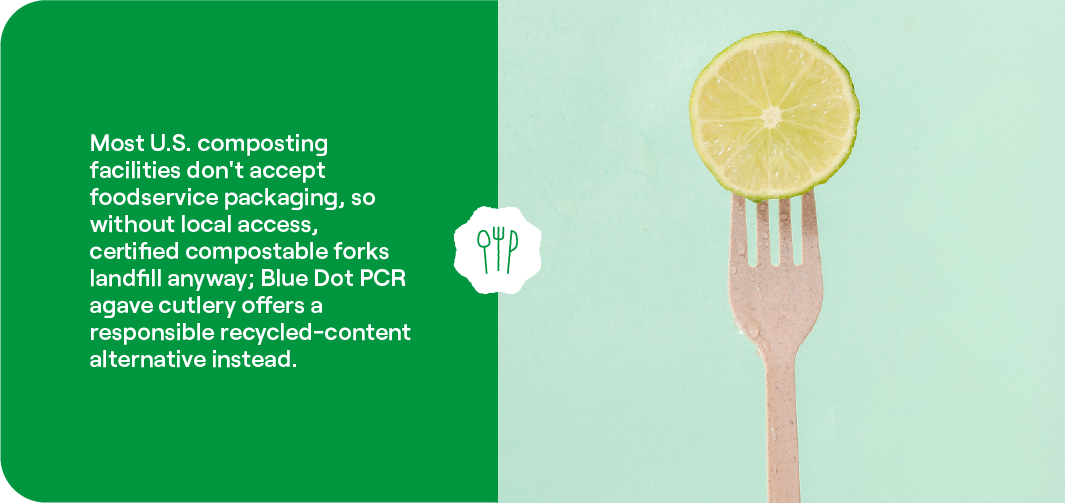
The majority of the 4,000+ compost facilities in the U.S. are set up to process only yard trimmings, not food scraps or compostable packaging. If your area doesn’t have a commercial composting facility that accepts certified products, a certified compostable fork will most likely end up in a landfill.
In a landfill, it won’t break down as designed because landfills lack the oxygen, moisture, and microbial activity that composting requires. This is the same problem that makes plastic utensils so persistent in the environment.
In that situation, the honest choice is a fork made from recycled content rather than one marketed as compostable. Our Blue Dot Upcycled Agave (PCR) Cutlery combines Upcycled Agave Fibers with post-consumer recycled plastic.
Here’s what you need to know about Blue Dot:
- Not compostable: It does not carry BPI or ASTM D6400 certification. Per FTC Green Guides, we do not market it as compostable.
- Recycled content: Its sustainability story is about what goes into the product, not what happens at end of life.
- PFAS-free: It carries third-party verified PFAS-free status.
If you can’t compost, don’t buy compostable. Blue Dot gives you a responsible alternative.
Composting Pathways for Compostable Forks
Certified compostable forks require specific conditions to break down fully. Understanding these pathways helps you set up the right waste management system for your operation.
Industrial composting facilities maintain the heat, moisture, and microbial activity needed to break down PLA-based materials within the certified time frame. BPI Commercial Compostability certified cutlery (for Cutlery), including our Green Dot Compostable Upcycled Agave Cutlery, requires this type of facility.
Home composting operates at lower, ambient temperatures. Most compostable cutlery cannot break down in a backyard bin. Our agave straws achieve home compostability because they include an enzyme masterbatch integrated during compounding at 160–190°C. This enzyme catalyzes hydrolysis of PLA polymer chains, enabling full breakdown at ambient temperatures (20–30°C). This is what enables TÜV Austria OK Compost HOME certification. Our cutlery line does not include enzyme technology and therefore requires industrial composting at 55–60°C. Without the enzyme masterbatch, standard PLA cannot achieve HOME certification.
If you’re setting up a composting program at your restaurant, here are the practical steps:
- Partner with a local composting hauler: Confirm they accept BPI Commercial Compostability certified products and process them at an industrial facility.
- Label your bins clearly: Use signage that shows staff and customers which items go in the compost bin versus trash or recycling.
- Train your team: Make sure everyone on staff understands which products are compostable and how to sort them correctly.
- Communicate with customers: Let diners know their utensils are compostable and show them where to dispose of them properly.
Directing compostable forks to the right facility is the only way to deliver on the sustainability promise printed on the packaging.
Find the Right Compostable Forks for Your Operation
Choosing compostable forks comes down to three decisions: the material that fits your menu, the certification that backs up your claims, and the composting infrastructure available in your area.
If you have access to commercial composting, our Green Dot Compostable Upcycled Agave Cutlery gives you a BPI Commercial Compostability certified (for Cutlery), PFAS-verified, heavy-weight fork made from upcycled agricultural waste. If composting isn’t available, our Blue Dot Upcycled Agave (PCR) Cutlery offers a recycled-content alternative without making end-of-life claims your operation can’t support.
At Greenprint®, we built our supply chain for transparency. We source our own Agave Fibers, control our own materials, and manufacture our own products. Every claim we make is backed by third-party verification.
You can explore our cutlery to see the full lineup, or contact our team to get samples and documentation for your next purchasing decision.
Frequently Asked Questions About Compostable Forks
Are PLA-based compostable forks safe for hot foods?
PLA-based compostable forks, including our Green Dot Compostable Upcycled Agave Cutlery, are designed for cold and lukewarm foods. They may soften or warp with hot meals.
What is the legal difference between “biodegradable” and compostable claims?
“Compostable” requires third-party certification to a specific standard like ASTM D6400, while the term “biodegradable” has no enforceable legal definition under FTC Green Guides and can apply to almost any material over an undefined time frame. We avoid this term because it is vague and potentially misleading.
How can I verify if compostable forks are PFAS-free?
Ask your supplier for third-party PFAS testing documentation. Our Greenprint® cutlery is third-party verified PFAS-free through BPI Commercial Compostability certification (for Cutlery), which first banned PFAS in 2017 and requires independent laboratory testing rather than self-declared claims.
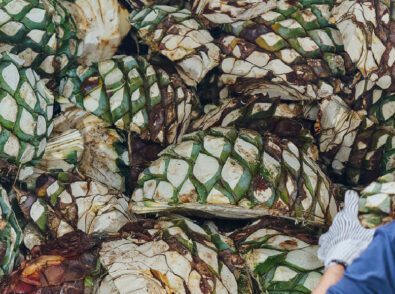

What happens to agave waste after tequila production? Learn how agave bagasse becomes biofuel, compost, construction material, and compostable food packaging.
Industrial composting produces far lower carbon emissions than landfill. Learn how aerobic decomposition reduces methane and why it matters for your business.
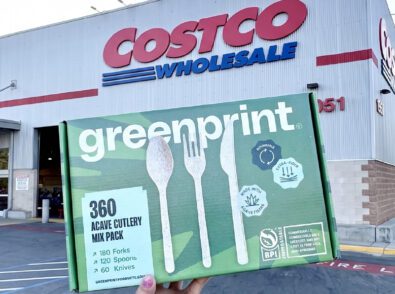
Greenprint compostable cutlery mix pack at Costco: 360 BPI-certified agave forks, spoons, and knives. Heavy-weight, industrial compostable, and built for events.