

Agave Fiber Composition: The Science Behind Agave Foodware



Content
- Key Takeaways
- Where Agave Fiber Comes From and Why It Matters
- What Agave Fiber Is Made Of
- Physical and Mechanical Properties That Make Agave Fiber Work in Foodware
- How Agave Fiber Becomes a Compostable Foodware Product
- How Agave Fiber Compares to Bamboo, Wheat Straw, and Conventional Plastic
- Build Your Menu Around Agave-Based Foodware
Agave Fiber Composition: What Makes Agave-Based Foodware Work
Agave fiber gives compostable foodware its structural backbone. Understanding what’s inside this plant material helps you choose products that actually perform during service. This article breaks down the science of agave fiber composition, from its chemical building blocks to how we turn it into certified compostable straws and cutlery.
Key Takeaways
- Agave Fiber’s natural combination of cellulose, hemicellulose, and lignin gives it the rigidity and moisture resistance needed to reinforce compostable foodware.
- Our Upcycled Agave Fibers come from post-tequila agricultural waste with no competing use, making them a true waste-to-value material that supports farming families in Jalisco, Mexico.
- Vertical integration allows us to control quality and formulation in ways competitors who buy pre-made compounds cannot match.
Where Agave Fiber Comes From and Why It Matters
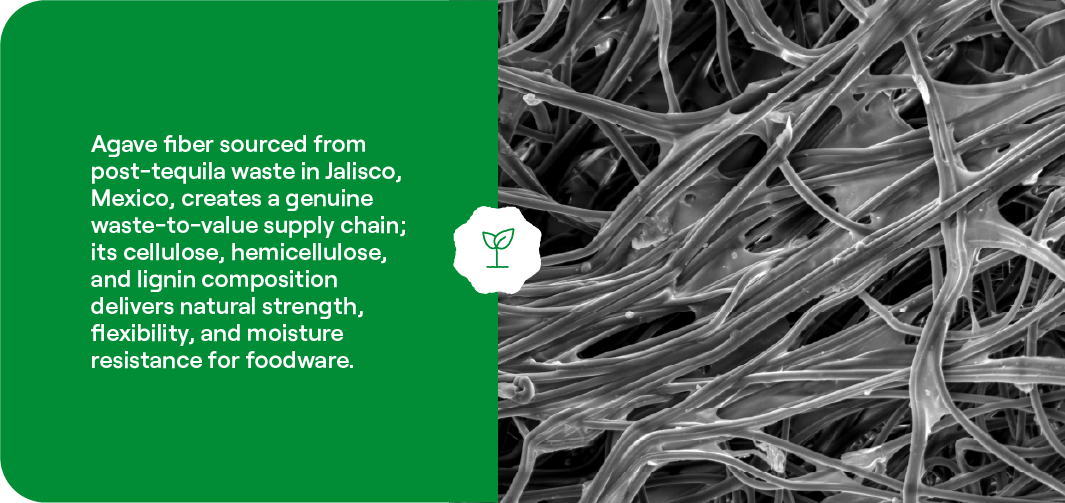
Agave Fibers used in foodware come from the leftover plant material generated after tequila production. This is agricultural waste that would otherwise sit unused.
Farming families in Jalisco, Mexico, harvest agave plants for their piñas. The piña is the starchy core used to make tequila. The remaining husks and bagasse are typically discarded as waste. At Greenprint®, we source this post-tequila material and transform it into a functional raw material for compostable foodware.
This sourcing model matters because agave waste has no competing use. Consider the alternatives:
- Bamboo: Requires long-haul shipping from Asia and competes with construction and textile markets.
- Wheat straw: Diverts material from animal feed supply chains.
- Agave waste: Abundant, regional to our manufacturing operations, and nobody else needs it.
That makes our supply chain a genuine waste-to-value model. We turn a zero-value byproduct into high-performance foodware while creating direct revenue for the farming families who grow the agave. You get a product with a clean sourcing story you can actually explain to your customers.
What Agave Fiber Is Made Of
The performance of any natural fiber comes down to its chemical composition. Agave fiber contains three primary structural components and several secondary compounds. Together, these explain why it works so well in foodware applications.
Cellulose, Hemicellulose, and Lignin
Agave fiber gets its strength and structure from three plant polymers. They work together like a natural composite material.
Cellulose is the main structural component of plant cell walls. Think of it as the load-bearing framework. It forms long, strong chains that give the fiber its tensile strength and rigidity. When you pick up a straw and it doesn’t collapse, cellulose is doing much of that work.
Hemicellulose acts as a binding agent between cellulose fibers. It’s shorter and more flexible than cellulose. This helps the overall structure absorb stress without cracking. It’s the reason a fork can flex slightly under pressure without snapping in half.
Lignin is the natural “waterproofing” compound in plant walls. It fills the gaps between cellulose and hemicellulose, adding stiffness and providing resistance to moisture and microbial attack. When your straw sits in a drink for an hour without getting soggy, lignin plays a key role.
The balance of these three components is what makes agave fiber particularly well suited for foodware. Agave’s lignin content gives it natural moisture resistance that many other plant fibers lack. That’s exactly what you need in a straw or fork that’s going to sit in a drink or touch wet food.
| Component | What It Does | Why It Matters for Foodware |
|---|---|---|
| Cellulose | Provides structural strength. | Keeps straws and cutlery rigid during use. |
| Hemicellulose | Binds cellulose fibers together. | Adds flexibility so products resist snapping. |
| Lignin | Waterproofs and stiffens cell walls. | Helps products hold up against moisture and liquids. |
Bioactive Compounds and Functional Properties
Beyond its structural components, agave fiber contains secondary compounds like saponins and fructans.
Saponins are naturally occurring plant chemicals. They contribute to the fiber’s resistance to microbial growth. Fructans are carbohydrate chains that influence how the fiber interacts with other materials during processing.
These compounds don’t define the fiber’s primary performance. But they do contribute to its overall durability profile. In practical terms, they help explain why agave fiber maintains its integrity when blended into a compound and formed into a finished product.
Physical and Mechanical Properties That Make Agave Fiber Work in Foodware
Agave Fiber reinforces compostable foodware so it holds up during real-world restaurant service. From the moment a customer picks up a straw to the last bite of a to-go meal, the fiber’s physical properties translate directly into the durability and reliability you need.
Tensile Strength and Durability
Tensile strength measures how much pulling force a material can handle before it breaks. Agave fiber has naturally high tensile strength. This means it resists stretching and snapping under load.
Why does this matter for your operation? When a customer bites down on a straw or uses a fork to cut through food, the product needs to hold its shape. It can’t bend, split, or fall apart mid-meal. That’s a service failure you can’t afford.
Our Compostable Upcycled Agave Straws and Compostable Upcycled Agave Cutlery both rely on Agave Fiber’s tensile strength. They deliver the kind of sturdy, reliable performance that foodservice operators expect from conventional plastic, without the conventional plastic.
Thermal Stability and Heat Resistance
Agave fiber itself tolerates moderate heat well. It maintains its structural properties across a range of temperatures relevant to food service. However, the overall heat tolerance of a finished product depends on the full material system, not just the fiber.
For accuracy per FTC Green Guides: our Compostable Upcycled Agave Cutlery is designed for cold and lukewarm meals. The compound is not engineered for high-heat applications. Our Compostable Upcycled Agave Straws perform well in both cold and room-temperature beverages.
If your operation serves primarily hot foods that require heat-resistant utensils, this is an important distinction. We’re direct about what our products do and don’t do because you need that information to make the right purchasing decision.
How Agave Fiber Becomes a Compostable Foodware Product
We control every step of the manufacturing process at our vertically integrated facility in Mexico. This level of control is a key differentiator. Most competitors purchase pre-made compounds from outside suppliers. We formulate and compound our own proprietary material in-house.
What does that mean for you? Full control over quality, consistency, and the sustainability profile of every product we ship.
Fiber Extraction and Preparation
The journey starts with post-tequila agave waste arriving from Jalisco. The raw plant material goes through processing steps that clean, dry, and reduce it into usable fiber suitable for compounding.
This preparation stage converts bulky agricultural byproduct into a consistent input. That consistency matters because it allows us to maintain the same performance characteristics from batch to batch. You get reliable products every time you reorder.
Compounding Agave Fiber With Bioplastics
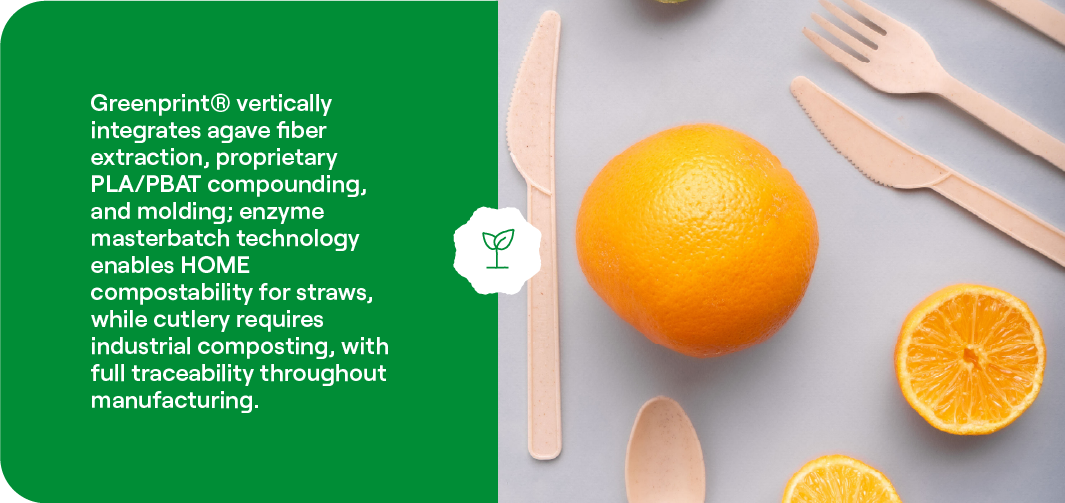
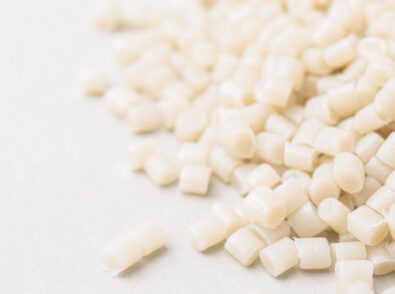
Our proprietary compound combines Upcycled Agave Fibers with a PLA/PBAT bioplastic blend and an enzyme masterbatch. Each component plays a specific role in the final product’s performance.
The PLA/PBAT bioplastic blend provides the moldable matrix that forms the product’s shape. The Agave Fibers reinforce this matrix, providing the strength and rigidity we covered earlier in this article.
The enzyme masterbatch is what sets our compound apart for certain products. The enzyme masterbatch is integrated during compounding at 160–190°C. It catalyzes hydrolysis of PLA polymer chains, enabling full biodegradation at ambient temperatures (20–30°C). This is specifically what enables TÜV Austria OK Compost HOME certification — it is not a general property of PLA. This enzyme technology is what allowed our Compostable Upcycled Agave Straws to earn TÜV Austria OK Compost HOME certification.
Our Compostable Upcycled Agave Cutlery carries BPI Commercial Compostability certification and requires industrial composting infrastructure. Standard PLA without enzyme technology, like our Compostable Upcycled Agave Cutlery, requires industrial composting at temperatures between 55 and 60°C and cannot achieve HOME certification. We’re clear about this distinction because accurate claims matter under FTC Green Guides.
Extrusion and Injection Molding
Different products require different forming processes:
- Straws: Produced through extrusion, where the compounded material is heated and pushed through a die to create a continuous tube shape, then cut to length.
- Cutlery: Produced through injection molding, where the compound is heated and injected into molds shaped like forks, knives, and spoons.
Our facility operates with a reduced energy footprint. Because we compound and manufacture under one roof, we can fine-tune formulations for each product type and maintain traceability from raw fiber to finished product.
How Agave Fiber Compares to Bamboo, Wheat Straw, and Conventional Plastic
Choosing a fiber source for foodware isn’t just about what’s “natural.” It’s about sourcing ethics, transport logistics, competing uses, and what happens to the product after you throw it away.
| Factor | Agave Fiber | Bamboo | Wheat Straw | Conventional Plastic |
|---|---|---|---|---|
| Sourcing region | Jalisco, Mexico (regional to our facility). | Primarily Southeast Asia. | Global agricultural regions. | Petroleum supply chains worldwide. |
| Competing uses | None. Post-tequila waste with no other market. | Construction, textiles, food. | Animal feed, soil amendment. | Fuel, chemicals, manufacturing. |
| Transport footprint | Short regional supply chain. | Long-haul international shipping. | Varies by region. | Global petroleum logistics. |
| Compostability pathway | Home compostable (straws with TÜV Austria OK Compost HOME certification) or industrial compostable (cutlery with BPI Commercial Compostability certification). | Varies by product and treatment. | Varies by product and treatment. | Not compostable. |
| Waste-to-value model | Pure upcycling of agricultural waste. | Cultivated crop. | Byproduct, but has existing demand. | Virgin fossil-fuel extraction. |
The standout difference is competing use. Agave waste is genuinely unwanted material that we’re giving a second life. That’s a sourcing story most alternative fibers and all conventional plastics simply can’t match. When your customers ask where your disposables come from, you have a real answer.
Build Your Menu Around Agave-Based Foodware
The science behind agave fiber composition translates directly into products you can trust during busy service. Our compostable agave foodware, certified by TÜV Austria and BPI, gives you a clear answer when customers ask what your disposables are made of. It also helps you stay ahead of tightening packaging regulations in states like California, New York, and Washington.
Choosing the right product for your operation starts with understanding your local waste infrastructure — 57% of U.S. composting facilities accept only yard trimmings:
- Limited composting access: Our Compostable Upcycled Agave Straws with TÜV Austria OK Compost HOME certification offer a genuine home compostable option.
- Commercial composting available: Our Compostable Upcycled Agave Cutlery with BPI Commercial Compostability certification fits that pathway.
- No composting infrastructure: Our Upcycled Agave (PCR) Straws and Upcycled Agave (PCR) Cutlery use post-consumer recycled content and Agave Fibers to reduce reliance on virgin plastic without making end-of-life claims your operation can’t support.
Durable, certified compostable (TÜV Austria OK Compost HOME and BPI Commercial Compostability), and built from agricultural waste that would otherwise go nowhere. Our agave-based products let you run a profitable operation while making choices your customers and your community can stand behind.
Explore our products to find the right fit for your menu, or contact us today and we’ll help you match the right product line to your specific setup.


Traditional vs. Compostable Cups: Carbon Footprint Compared Choosing between traditional and compostable cups affects more than your waste bin. It…
PLA Certification Standards Every Restaurant Owner Should Know PLA certification standards help you confirm that the compostable products you’re buying…

The Circular Future of Foodservice Disposables At Greenprint®, we believe disposable foodware doesn’t have to mean disposable thinking. In this…