

Circular Future of Disposables: A Foodservice Guide



The Circular Future of Foodservice Disposables
At Greenprint®, we believe disposable foodware doesn’t have to mean disposable thinking. In this guide, we break down how circular economy principles apply to the cups, plates, straws, and containers your restaurant uses every day, and how choosing the right materials and end-of-life pathways can reduce waste, keep you compliant, and strengthen your brand.
Key Takeaways
- A circular approach to disposable foodware means every product is designed from the start to be composted, recycled, or returned to the earth rather than sent to a landfill.
- Understanding the real differences between compostable, recyclable, and packaging marketed with vague breakdown claims protects your business from misleading claims and helps you choose what actually works.
- Plant-based materials like Upcycled Agave Fibers and sugarcane bagasse are turning agricultural waste into high-performance foodware with a defined, verifiable end of life.
What Does a Circular Economy Mean for Disposable Foodware?
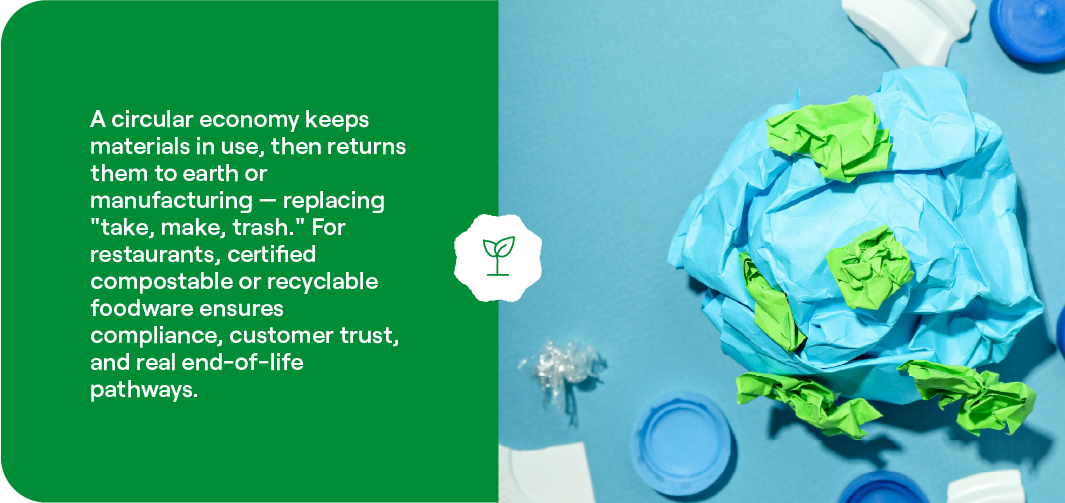
A circular economy is a system where materials are kept in use for as long as possible, then returned to the earth or remade into new products instead of becoming waste. This means every cup, plate, and straw is designed from the start with a planned next life.
For foodservice, the circular model replaces the old “take, make, trash” approach. Instead of using a fork once and sending it to a landfill, you use a fork that can be composted into soil or recycled into something new. The goal is simple: nothing is designed to be garbage.
This shift changes how you think about purchasing decisions. You’re no longer just asking “Is this affordable?” You’re also asking “Where does this go after my customer uses it?” Products with a clear, verified end-of-life pathway give you a defensible answer to that question.
For restaurant owners, this matters more every year. Plastic bans are expanding across states and cities. Customers are paying closer attention to how you run your business. Compostable food packaging with proper certification gives you both compliance and credibility; BPI alone certifies over 51,000 products as commercially compostable.
The circular approach also creates real value from waste. Agricultural byproducts like agave fibers and sugarcane bagasse become the raw materials for your foodware. What would have been discarded becomes something useful. That’s the heart of circular thinking applied to disposables.
Compostable and Recyclable Packaging Compared
Not all sustainable-sounding packaging works the same way. Confusing these terms can cost you money, hurt your brand, or put your business on the wrong side of regulations. The real differences between compostable, recyclable, and biodegradable matter for your purchasing decisions. The FTC Green Guides specifically warn against broad, unqualified environmental claims, so understanding these distinctions protects your business.
Here’s how the three main categories compare:
| Attribute | Compostable | Unverified Breakdown Claims | Recyclable |
|---|---|---|---|
| Material source | Plant-based fibers, bioplastics | Varies widely | Virgin or recycled plastics, metals, glass |
| End-of-life pathway | Composting (home or industrial) | Undefined without certification | Recycling facility |
| Timeframe defined? | Yes, by certification standards | No standard timeframe required | N/A |
| Certification required? | Yes (BPI, TÜV Austria) | No universal standard | Varies by material and region |
| Best for restaurants? | Takeout, events, food-soiled items | Unreliable as a purchasing criterion | Clean, uncontaminated items |
Compostable Packaging
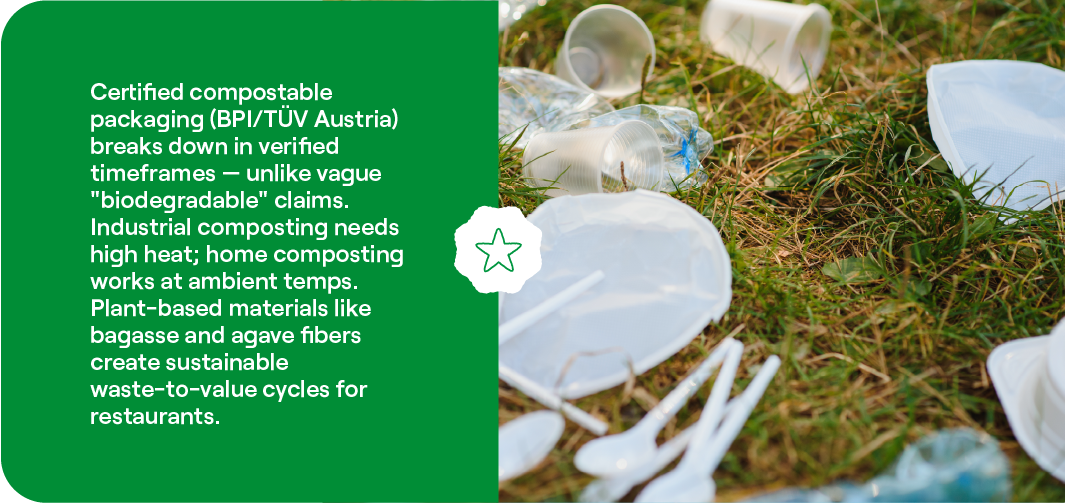
Certified compostable food packaging is packaging that breaks down into nutrient-rich material within defined timeframes under specific composting conditions. This means the product must pass rigorous third-party testing from organizations like BPI or TÜV Austria, the world market leader in bioplastics certification, to carry a certified compostable claim.
Two main categories exist:
- Industrial compostable: These products require the high temperatures and controlled conditions found at commercial composting facilities. Our Fiberware™ plates carry TÜV Austria OK Compost INDUSTRIAL certification (Cert ID: TA8012206794, valid through June 2027).
- Home compostable: These products break down at lower, ambient temperatures in a backyard compost bin. Our Upcycled Agave straws carry TÜV Austria OK Compost HOME certification.
Each certification type tells you exactly what infrastructure the product needs. This lets you match your purchasing decisions to your local waste systems rather than guessing.
The certification isn’t just a label. It’s backed by standardized testing that measures how completely and how quickly the material breaks down. When you see a BPI or TÜV Austria seal, you know the product has been independently verified to perform as claimed; BPI field trials show over 1,000 certified items breaking down in fewer than 50 days at composting facilities.
Unverified Breakdown Claims
Vague breakdown claims on packaging are potentially misleading on their own. They tell you nothing about how long breakdown takes, what conditions are required, or whether anything harmful remains afterward.
Under FTC Green Guides, marketers should not use unqualified breakdown claims. Nearly everything breaks down eventually given enough time, so the term is essentially meaningless without specifics.
A product labeled with a vague breakdown claim could take decades to break down in a landfill. That’s functionally no different from conventional plastic. Without a defined timeframe, a required testing standard, or a recognized certification, this term doesn’t give you the information you need to make a responsible purchasing decision.
As a restaurant operator, certified compostable products with clear end-of-life pathways are a far more reliable choice for you. You get specific, verifiable claims instead of marketing language that sounds good but means little.
Recyclable Packaging
Recyclable foodware fits the circular model by returning materials to the manufacturing stream for reuse. This means the material can be collected, processed, and made into new products.
When composting infrastructure isn’t available in your area, recyclable products offer a practical alternative for keeping materials out of landfills. However, food contamination is a real challenge for foodservice operations.
Grease, sauces, and food residue often disqualify foodservice items from recycling streams. A pizza box soaked with oil can’t be recycled. A cup with dried smoothie residue creates problems at the processing facility.
That’s why recyclable packaging works best for items that stay relatively clean during use:
- Cold drink cups and lids.
- Utensil wrappers.
- Beverage carriers.
The FTC Green Guides note that recyclable claims should be qualified when recycling facilities aren’t available to a majority of consumers where the product is sold. Know what your local recycling program actually accepts before making claims to your customers.
Plant-Based Materials and Innovations Driving the Circular Shift
Plant-based materials turn agricultural waste into high-performance foodware. This creates a true waste-to-value cycle where byproducts from one industry become raw materials for another.
Instead of relying on virgin petroleum-based plastics, circular packaging starts with renewable inputs that already exist. These plastic alternatives for restaurants solve both environmental and performance challenges. These materials would otherwise be discarded, so using them for foodware solves two problems at once.
Sugarcane bagasse is a good example. Bagasse is the fibrous material left over after sugarcane juice is extracted. Rather than being thrown away, it’s molded into sturdy plates, bowls, and clamshells. Our Fiberware™ line uses this material to create foodware with TÜV Austria OK Compost INDUSTRIAL certification.
Our Agave Fibers represent another waste-to-value story. The agave plant waste left over from tequila production has no competing commercial use. We source these fibers from farming families in Mexico, creating direct revenue for those communities while diverting agricultural waste from disposal.
What makes our home compostable packaging genuinely different is the technology behind it. Our Upcycled Agave straws use an enzyme masterbatch integrated during compounding at 160–190°C. This enzyme catalyzes hydrolysis of PLA polymer chains, enabling full breakdown at ambient temperatures (20–30°C).
This is why our straws carry TÜV Austria OK Compost HOME certification, while our Compostable Upcycled Agave cutlery carries BPI Commercial Compostability certification and requires industrial composting conditions. The enzyme technology is what makes the difference between home and industrial compostability for our agave products.
Standard PLA without enzyme technology, like our Compostable Agave Cutlery, requires industrial composting at 55–60°C and cannot achieve HOME certification.
Our internal breakdown study (GP-BIO-001) supports this performance, documenting full breakdown of agave straws by Week 20 in home compost conditions (20–30°C), validated in triplicate. This data corroborates the TÜV HOME certification and gives us confidence in real-world results.
The innovation here isn’t just about materials. It’s about engineering products that actually work within existing waste systems. A compostable product that requires infrastructure you don’t have access to isn’t solving your problem. Matching the right product to the right end-of-life pathway is what makes circular foodservice practical.
When Compostable Disposables Are the Right Fit for Your Restaurant
Compostable disposables make the most business sense when your operation, your local infrastructure, and your customers align around keeping organic waste out of landfills. They’re not the right answer for every situation, and being honest about that helps you invest wisely.
Here are the scenarios where compostable packaging delivers the strongest return:
- High-volume takeout and delivery: Food-soiled containers can’t be recycled, so compostable options give those items a productive end of life instead of a landfill destination.
- Catered events with collection systems: When you control the waste stream at an event, you can set up clearly labeled compost bins and ensure products actually reach a composting facility.
- Regions with composting infrastructure: If your city or waste hauler offers commercial composting pickup, certified compostable products integrate seamlessly into that system.
- Areas with plastic bans: Many states and cities are phasing out conventional single-use plastics. Certified compostable products keep you compliant without disrupting your operations.
- Customer-facing brand building: Guests notice what you serve their food in. Certified compostable packaging signals that your sustainability commitment is specific and verified, not just a label.
On the cost-performance side, compostable products have become increasingly competitive with conventional disposables. They need to hold up during service just like any other product. Our Upcycled Agave straws don’t get soggy in drinks. Our Fiberware™ clamshells hold hot, saucy foods without leaking. Performance isn’t something you sacrifice for sustainability.
If your area lacks composting infrastructure, recyclable options may be the better fit right now. The key is matching the product to the waste system that actually exists where you operate, not where you wish it did. A home compostable straw is only valuable if your customers have access to home composting or your waste hauler accepts compostables.
Start by auditing your current disposables. Which items generate the most waste? Which items are most likely to be food-soiled and therefore unable to be recycled? Those are your best candidates for switching to certified compostable alternatives.
Build a Circular Future With Greenprint®
We designed our product lines so you can match the right solution to your local waste system. Every product we offer has a defined end-of-life pathway backed by third-party certification. This isn’t a one-size-fits-all approach.
Here’s how our lineup maps to your needs:
- Upcycled Agave Straws: Home compostable with TÜV Austria OK Compost HOME certification. Your customers can compost these in a backyard bin.
- Compostable Upcycled Agave Cutlery: BPI Commercial Compostability certified for industrial composting facilities. Sturdy forks and spoons that perform during service.
- Fiberware™ Clamshells, Plates, and Bowls: Made from sugarcane bagasse with TÜV Austria OK Compost INDUSTRIAL certification. Built to handle heavy, hot, saucy foods.
- Renewacups™: Hot cups that are PFAS-free across a comprehensive panel of tested compounds, verified by Intertek.
- Clearly Compostable™ Cups: PLA-based clear cups for cold beverages, certified compostable by BPI.
Every certified product line has also undergone third-party PFAS testing, verified by Intertek.
Building a circular operation doesn’t require overhauling everything at once. Start by identifying your highest-volume disposable items. Check what composting or recycling infrastructure exists in your area. Swap in the products that fit your local systems.
The circular future of foodservice isn’t about perfection. It’s about progress. Every product you switch from landfill-bound to compostable or recyclable moves your operation in the right direction. Your customers notice. Regulators notice. And your waste stream gets smaller.
We’re here to help you figure out what works for your specific situation. Explore our products to see the full range, or contact our team to get guidance tailored to your restaurant’s needs.

Food waste composting turns kitchen scraps into rich compost. Learn simple methods for home and business, what to compost, and how to get started today.

Rhode Island plastic bans and regulations explained: what the Plastic Waste Reduction Act prohibits, who must comply, penalties, and compliant bag options.

Virginia’s plastic ban covers polystyrene foam containers and a local bag tax. See what’s banned, key deadlines, and compliant compostable foodware options.