

Compostable Spoons: Everything to Know Before You Buy



Content
- Key Takeaways
- How Compostable Spoons Are Made
- Compostable Spoons vs. Traditional Plastic Spoons
- What Certifications to Look for in Compostable Spoons
- How Long Do Compostable Spoons Take to Break Down?
- How to Choose the Right Compostable Spoon for Your Restaurant
- Make the Switch to Compostable Spoons With Greenprint®
- Frequently Asked Questions About Compostable Spoons
Compostable Spoons: What to Know Before You Buy
Choosing the right compostable spoon for your restaurant means understanding what it’s made of, how it’s certified, and where it actually ends up after your customer walks out the door. This guide covers materials, certifications, composting realities, and cost considerations so you can make a purchasing decision that’s good for your business and the planet.
Key Takeaways
- The material a compostable spoon is made from determines how it performs during service and whether it will actually break down in a composting facility.
- Only spoons carrying BPI Commercial Compostability or TÜV Austria OK Compost certification can legally claim compostability under FTC Green Guides, so always check for verified seals before you buy.
- Matching your spoon choice to your menu, your local composting infrastructure, and your budget is the most practical way to make the switch without disrupting your operations.
How Compostable Spoons Are Made
The material inside a compostable spoon determines everything from how it feels in your customer’s hand to whether it will actually break down after use. Understanding these materials helps you choose products that perform well during service and deliver on their sustainability promise.
Not all compostable spoons are created equal. The differences come down to three main material categories: bioplastics, wood and bamboo, and agave fiber compounds. Each has distinct characteristics that affect durability, temperature tolerance, and end-of-life options.
PLA and CPLA Bioplastics
PLA stands for polylactic acid. This is a plant-based bioplastic typically made from corn starch or sugarcane. It looks and feels similar to traditional plastic, which is why it’s the most common material used in compostable spoons across the foodservice industry.
CPLA is crystallized polylactic acid. This is a heat-treated version of PLA that offers better performance with warm foods. The crystallization process makes the material more rigid and heat-resistant.
Here’s what matters for your restaurant:
- Temperature limits: Standard PLA softens with heat, making it better suited for cold foods like ice cream, salads, or cold desserts.
- Composting requirements: Both PLA and CPLA require industrial composting facilities operating at high temperatures (55–60°C) to fully break down. A PLA spoon tossed into a backyard compost bin won’t decompose the way you’d expect.
- Market availability: Most competitor spoons on the market today are made from PLA or CPLA, so you’ll encounter these materials frequently when comparing suppliers.
Bamboo and Wood
Bamboo and wooden spoons take a completely different approach. They skip bioplastics altogether and rely on natural plant materials that will break down on their own over time. These materials don’t need a specific composting certification to decompose because they’re simply wood.
The trade-offs are worth considering before you stock your restaurant:
- Durability concerns: Bamboo and wood spoons can feel less sturdy than their bioplastic counterparts. They may not perform well with certain foods like soups, yogurt, or anything with significant moisture.
- Sourcing footprint: Most bamboo is shipped long distances from Asia, which adds transportation impact to the product’s overall environmental story.
- Texture and taste: Some customers notice a woody taste or texture, which can affect their experience with certain menu items.
For restaurant owners, the practical question is whether these spoons can hold up during actual service without compromising the dining experience.
Agave Fiber Compounds
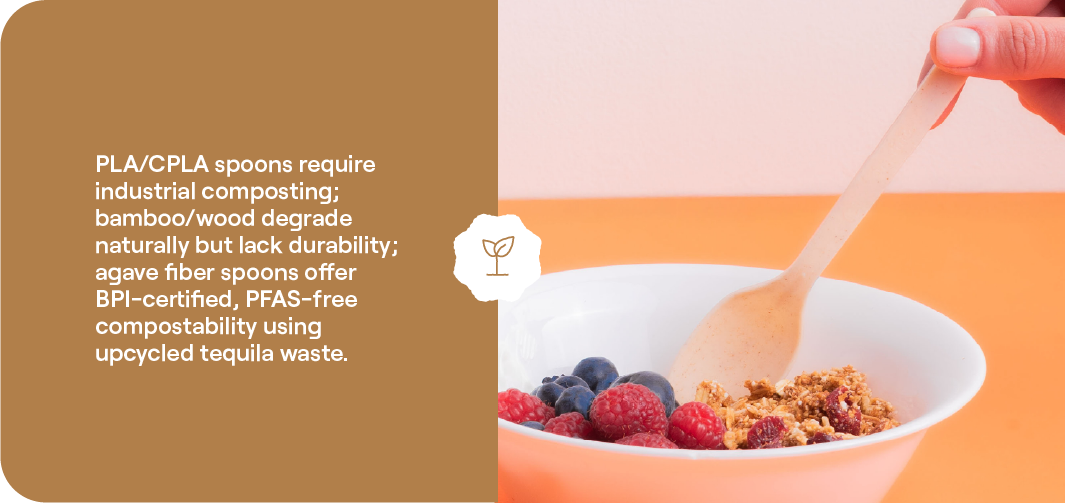
Our Green Dot Compostable Upcycled Agave Cutlery line represents a different material category. We make these spoons (SKU: CS1000) from a compound that combines Upcycled Agave Fibers with a bioplastic blend. The Agave Fibers come from post-tequila agricultural waste, a raw material with no competing use. This means we’re turning genuine waste into functional products rather than diverting crops from food or animal feed.
What sets our approach apart is vertical integration. We compound and manufacture our cutlery at our own facility rather than purchasing pre-made bioplastic blends like most competitors. This gives us full control over material quality and consistency.
Our Green Dot Compostable Upcycled Agave Cutlery carries BPI Commercial Compostability certification (for Cutlery). Every piece is also third-party verified PFAS-free, meeting BPI’s requirement of less than 100 ppm total fluorine, which means you can offer these spoons to your customers with confidence about both their compostability and their safety.
Compostable Spoons vs. Traditional Plastic Spoons
Compostable spoons replace petroleum-based materials with plant-based alternatives that can return to the earth through composting instead of sitting in a landfill for centuries. For restaurant operators, this means a direct way to reduce waste while meeting growing customer expectations.
Here’s how the two options compare across the factors that matter most for your business:
| Factor | Traditional Plastic Spoon | Compostable Spoon |
|---|---|---|
| Material source | Petroleum-based virgin plastic | Plant-based materials like PLA, agave fiber, or bamboo |
| End-of-life pathway | Landfill or limited recycling | Commercial composting facility |
| Certifications available | None for compostability | BPI Commercial Compostability or TÜV Austria OK Compost (HOME or INDUSTRIAL) |
| Durability | Sturdy across all temperatures | Varies by material and temperature |
| PFAS status | Varies and often undisclosed | Third-party verified options available |
The practical benefit for your restaurant is straightforward. Compostable spoons give you a verifiable sustainability story you can share with customers. They also position your business ahead of expanding plastic bans across states and cities. Major brands like Starbucks and McDonald’s have already begun transitioning away from traditional plastics, signaling where the industry is headed.
What Certifications to Look for in Compostable Spoons
Compostable certifications, such as BPI Commercial Compostability or TÜV Austria OK Compost (HOME or INDUSTRIAL); means a product has been independently tested and verified to break down within specific conditions and timeframes. This is the only way to know a spoon will actually compost under the specified conditions; whether industrial or home composting; rather than just sit in a pile indefinitely.
Per FTC Green Guides, only products carrying recognized certification, such as BPI Commercial Compostability or TÜV Austria OK Compost, can legally claim to be compostable. Two certification bodies matter most in the U.S. market:
- BPI (Biodegradable Products Institute): This is the leading U.S. certification for commercial compostability, with over 51,000 certified products. A BPI Commercial Compostability–certified spoon has been tested to break down in an industrial composting facility operating at high temperatures (55–60°C). Our Green Dot Compostable Upcycled Agave Cutlery carries this certification.
- TÜV Austria OK Compost: This European certification, from the world market leader in bioplastics certification, comes in two tiers. OK Compost INDUSTRIAL verifies breakdown in commercial facilities. OK Compost HOME verifies breakdown at lower temperatures found in a backyard compost bin.
If a spoon doesn’t carry one of these certifications, treat any compostability claims with caution. When you’re comparing suppliers, ask for the specific certification and verify it independently. Vague terms like “plant-based” or “natural” don’t guarantee compostability.
How Long Do Compostable Spoons Take to Break Down?
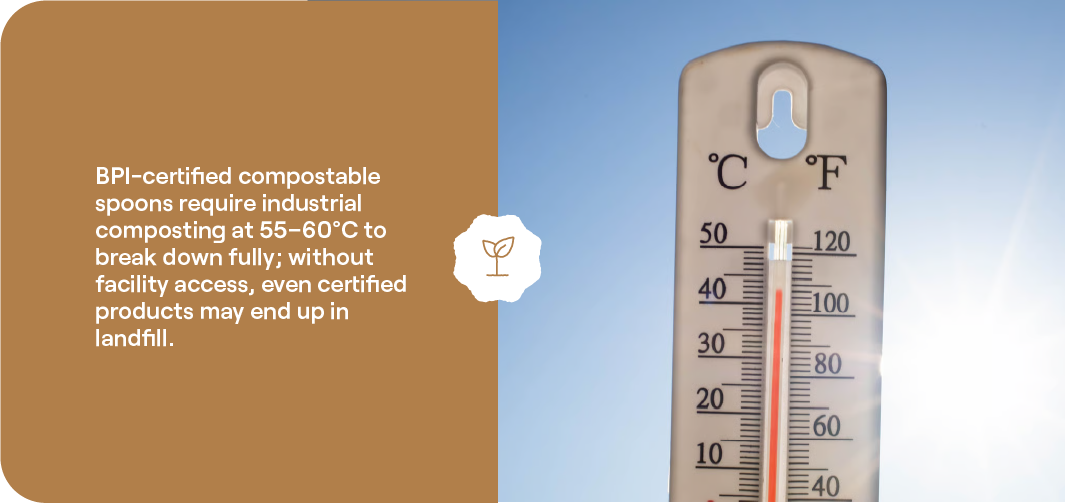
Spoons certified under BPI Commercial Compostability or TÜV Austria OK Compost break down fully within the timeframes established by their certification, but the composting environment matters significantly. In an industrial composting facility with controlled heat (55–60°C), moisture, and aeration, compostable spoons made from PLA-based materials are certified to break down fully within the timeframes established by BPI Commercial Compostability or TÜV Austria OK Compost INDUSTRIAL standards.
Home composting is a different story. Standard PLA requires the high temperatures (55–60°C) found only in industrial composting facilities to decompose properly. Our Green Dot Compostable Upcycled Agave Cutlery carries BPI Commercial Compostability certification (for Cutlery), meaning it’s designed for industrial composting rather than backyard bins. We’re transparent about this distinction because it matters for your waste management planning.
Unlike our home compostable agave-based straws, our cutlery line does not currently carry TÜV Austria OK Compost HOME certification. Our cutlery requires the higher temperatures (55–60°C) of industrial composting to fully decompose.
The bottom line: if you’re choosing compostable spoons, make sure you have access to a commercial composting facility that accepts certified compostable foodservice products. Without proper infrastructure, even certified products may end up in landfill.
How to Choose the Right Compostable Spoon for Your Restaurant
Switching to compostable spoons is both a values decision and a business decision. You want to do the right thing, but you also need products that work for your operation and your budget. Here’s how to work through each factor.
Match the Spoon to the Menu
Our Green Dot Compostable Upcycled Agave spoons work best with cold and lukewarm meals. Because the compound includes PLA, it’s not designed for high-temperature use. Think about what your customers actually order most:
- Cold desserts and ice cream.
- Salads and grain bowls.
- Yogurt parfaits and açaí bowls.
- Lukewarm soups and oatmeal.
If your menu leans heavily toward hot soups or dishes served at high temperatures, you’ll want to factor that into your decision. A spoon that performs well with your top menu items will deliver a better customer experience than one that technically checks a sustainability box but doesn’t hold up during service.
Check Your Local Composting Infrastructure
Before committing to certified compostable products, verify that your area has commercial composting facilities that accept foodservice packaging. Not every city or region has this infrastructure in place yet. A compostable spoon that ends up in a landfill doesn’t deliver on its environmental promise.
If commercial composting isn’t available where you operate, our Upcycled Agave (PCR) cutlery line offers a meaningful alternative. This line blends Upcycled Agave Fibers with post-consumer recycled plastic. We want to be clear about an important distinction: the Upcycled Agave (PCR) line is not compostable and does not carry BPI or ASTM D6400 certification.
Per FTC Green Guides, we don’t make composting claims for this line. Its sustainability story rests on what goes into the product, including reclaimed agave fiber and recycled plastic content, rather than its end-of-life pathway. It’s third-party verified PFAS-free and built for operators who want a lower-impact option without relying on composting infrastructure that isn’t available in their area.
Evaluate Cost per Unit at Volume
Certified compostable spoons typically carry a modest premium over conventional plastic. That’s a real consideration when you’re managing food costs and margins. But the math isn’t just about the per-unit price.
Consider the broader picture:
- Customer loyalty: Sustainable packaging can build genuine customer loyalty, especially as diners increasingly look for restaurants that align with their values.
- Compliance preparation: As plastic bans continue expanding across states and municipalities, investing in certified compostable products now can save you from scrambling to comply later.
- Brand differentiation: In a competitive market, your commitment to verified sustainability can set you apart from restaurants still using conventional plastic.
Think of the premium as both a brand investment and a compliance hedge rather than simply an added cost.
Make the Switch to Compostable Spoons With Greenprint®
We designed our cutlery line to stand up to the scrutiny of procurement officers, ESG auditors, and the everyday demands of foodservice. Every spoon is produced at our own facility, which means we control the material and the quality from start to finish. Our products are third-party verified PFAS-free, and our compostable line carries BPI Commercial Compostability certification (for Straws and Cutlery) you can verify independently.
Whether you’re running a single restaurant or managing purchasing for a multi-location operation, we’re here to help you find the right fit. Explore our cutlery to see the full lineup, or contact our team to get samples and pricing for your volume.
Frequently Asked Questions About Compostable Spoons
Are spoons labeled “compostable” always certified?
No. Only spoons that carry BPI Commercial Compostability or TÜV Austria OK Compost certification have been independently tested and verified to break down in composting conditions. Per FTC Green Guides, products without BPI Commercial Compostability or TÜV Austria OK Compost certification cannot legally claim to be compostable, so always look for the certification seal before purchasing.
Do certified compostable spoons leave microplastics behind?
Spoons certified under BPI Commercial Compostability or TÜV Austria OK Compost are tested to break down fully within established timeframes without leaving persistent plastic residues. Our Green Dot Compostable Upcycled Agave Cutlery is also third-party verified PFAS-free, meaning it’s been tested for harmful chemical compounds beyond just compostability.
What makes “compostable” different from other environmental claims?
“Compostable” means a product meets specific certification standards with defined timelines and conditions for breakdown, verified by organizations like BPI (Commercial Compostability) or TÜV Austria (OK Compost HOME or OK Compost INDUSTRIAL). Other common terms have no regulated standard or required timeline, which makes them vague and potentially misleading under FTC Green Guides.
Are edible spoons a practical alternative to compostable spoons?
Edible spoons are made from ingredients like wheat, rice, or other grains that customers can eat after use. While they eliminate waste entirely when consumed, they present practical challenges for most restaurant operations, including shelf life, texture changes with certain foods, and customer acceptance. Certified compostable spoons offer a more familiar dining experience while still providing a verified end-of-life pathway.


Nanoplastics vs. microplastics comes down to size. Learn how they differ, why researchers worry more about nanoplastics, and simple ways to reduce exposure.

Earth Day facts that show the scale of the environmental crisis, from plastic and landfill waste to CO2 and wildlife loss. See what the numbers mean for you.

Minnesota plastic ban rules for businesses, including city bag fees, Green To Go takeout packaging, PFAS limits, compostable labels, and EPR dates to plan for.