

Microplastics in Cups: What’s Leaching Into Your Coffee


Content
- Key Takeaways
- Why Most Disposable Coffee Cups Contain Plastic
- How Many Microplastics Do Disposable Cups Release?
- How Heat and Cup Material Affect Microplastic Release
- What Microplastic Exposure From Cups Means for Your Health
- What Cups Don't Have Microplastics?
- Serve Hot Drinks Without the Microplastic Risk
Microplastics in Cups: What’s Really Leaching Into Your Coffee
Most disposable cups release tiny plastic particles into hot beverages, and the cups that look like paper are often the biggest culprits. In this guide, we explain where microplastics in cups come from, how they affect your customers, and what cup options actually eliminate the problem for your foodservice operation.
Key Takeaways
- Most paper coffee cups contain a hidden plastic lining that sheds microplastic particles into hot drinks.
- Hotter liquids and longer contact times increase the amount of microplastics released from disposable cups.
- Bio-coated paper cups made without plastic linings offer a verified way to serve hot beverages without microplastic exposure.
Why Most Disposable Coffee Cups Contain Plastic
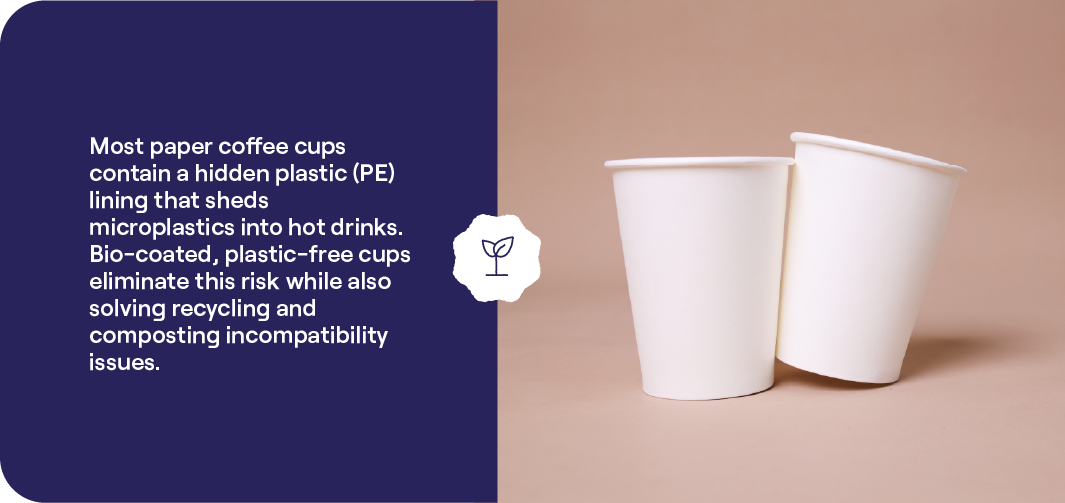
Most paper coffee cups are lined with polyethylene, commonly called PE, contributing to the widespread impact of plastic cups on health and the environment.
PE is a thin layer of petroleum-based plastic applied to the inside of the cup to prevent liquids from soaking through the paper. Without this lining, a paper cup would absorb your customer’s latte in minutes and fall apart in their hand.
This creates a problem most people don’t realize. A cup that looks and feels like paper is actually a plastic-paper composite. The plastic layer is bonded directly to the paper fibers, making them impossible to separate during recycling.
For restaurant owners, this hidden plastic matters in two important ways:
- Your customers drink from a plastic surface: Every standard paper cup puts hot liquid in direct contact with PE plastic, even though the cup appears to be made of paper.
- These cups don’t fit recycling or composting systems: The PE lining means these cups can’t go through paper recycling, and they fragment into persistent microplastics rather than break down in composting facilities.
The result is a disposable cup that looks sustainable but delivers neither recyclability nor a plastic-free drinking experience. Your customers assume they’re drinking from paper, but they’re actually drinking from plastic-coated paper that ends up in landfills.
How Many Microplastics Do Disposable Cups Release?
Standard disposable cups release significant amounts of microplastic particles into beverages, especially hot ones. Microplastics are tiny plastic fragments, often too small to see with the naked eye, that break off from larger plastic materials.
Published research from the University of New Mexico and studies indexed in PubMed Central has documented that a single disposable cup can shed large quantities of these microscopic plastic fragments into the liquid it holds. The particles come from the PE lining described above. As hot liquid contacts the plastic surface, the heat accelerates the breakdown of the lining into tiny fragments.
These findings aren’t theoretical. Multiple peer-reviewed studies confirm that microplastics in coffee served in standard disposable cups represent a measurable and consistent source of human exposure. Every hot drink you serve in a PE-lined cup delivers microplastic particles to your customer.
For your business, this creates both a health consideration and a customer trust issue. As awareness grows about microplastics in hot beverages, your customers will start asking questions about what’s in their cups; and compostable cups keep your business compliant with evolving regulations, given nearly a third of U.S. states have introduced or passed EPR packaging laws.
How Heat and Cup Material Affect Microplastic Release
Two factors determine how many microplastics end up in a drink: the temperature of the liquid and the material the cup is made from. Understanding both helps you make better purchasing decisions for your operation.
The practical takeaway is simple. Hotter drinks in plastic-containing cups mean more microplastics. The type of cup matters too, but not in the way most people expect.
Temperature and Exposure Time
Hotter liquids release significantly more microplastics from plastic-lined cups than cooler beverages. Heat softens and breaks down the PE lining, causing it to shed particles into the drink at a faster rate.
Time matters too. The longer hot liquid sits in contact with the cup wall, the more particles accumulate. A fresh-brewed coffee sitting in a PE-lined cup for several minutes will contain more microplastic particles than a cold drink in the same cup.
For restaurants and cafes where customers often carry their drinks for extended periods, this creates a longer exposure window. Your customer’s morning commute with a hot latte; stirred with plastic coffee stirrers; means more contact time between the beverage and plastic materials.
The bottom line: if you serve hot beverages in plastic-lined cups, your customers face greater microplastic exposure than those drinking cold beverages; consider switching cold drinks to compostable clear cups as well.
Plastic Cups vs. Plastic-Coated Paper Cups
Both solid plastic cups and PE-coated paper cups release microplastics into beverages. They do so through different mechanisms, but neither gives your customers a plastic-free experience.
Solid plastic cups are made entirely from materials like polypropylene or polystyrene. The entire interior surface is plastic, so every part of the cup that touches the liquid can potentially shed particles.
PE-coated paper cups expose a thinner plastic layer to the beverage. However, this thin layer can fragment more easily under heat stress, potentially releasing particles at a faster rate when hot liquids are involved.
| Feature | Solid Plastic Cup | PE-Coated Paper Cup |
|---|---|---|
| Material | Polypropylene or polystyrene | Paper with polyethylene lining |
| Lining type | No lining (entire cup is plastic) | Thin PE film bonded to paper |
| Microplastic risk | Present from full plastic contact | Present and accelerated by heat on thin lining |
| End-of-life pathway | Limited recyclability depending on local systems | Typically landfill (not recyclable or compostable) |
Neither option eliminates microplastic exposure. Both contribute particles to beverages, and both create waste management challenges at the end of their useful life.
What Microplastic Exposure From Cups Means for Your Health
Microplastics ingested from disposable cups accumulate in human tissue over time. Published studies in peer-reviewed journals have detected microplastic particles in human blood, lung tissue, and organ samples. This confirms that these particles don’t simply pass through the body.
The health implications are still being studied. Researchers have not yet reached definitive conclusions about specific diseases caused by microplastic ingestion. However, the scientific community has raised concerns about several potential effects:
- Inflammatory responses: Microplastic particles may trigger inflammation in tissues where they accumulate.
- Cellular stress: The presence of foreign particles can stress cells and potentially affect their normal function.
- Chemical exposure: Microplastic particles can carry chemical additives, including plasticizers used during manufacturing, into the body.
For restaurant owners, the takeaway is practical. Your customers are increasingly aware of microplastic concerns. Serving beverages in cups that contribute to this exposure creates a reputational risk, even before the science is fully settled.
Choosing cups that eliminate plastic contact with beverages is a straightforward way to protect your customers, and it’s part of a broader shift toward plastic alternatives for restaurants.
It also demonstrates that your business takes their well-being seriously.
What Cups Don’t Have Microplastics?
Cups made without any plastic lining or plastic material eliminate microplastic release into beverages entirely. There are two main categories that achieve this: reusable cups made from non-plastic materials and disposable bio-coated paper cups that replace the PE lining with a plant-based barrier.
The good news for foodservice operators is that you don’t have to choose between convenience and protecting your customers. We offer verified plastic-free disposable options that perform just as well as traditional cups.
Reusable Cups Made From Stainless Steel or Ceramic
Reusable stainless steel and ceramic cups are the most effective way to eliminate microplastic exposure from hot beverages. These materials are inert, meaning they don’t shed particles into liquids at any temperature.
For personal use, reusable cups are an excellent choice. Many of your customers already own them and appreciate when you offer a discount for bringing their own cup.
However, reusable cups don’t solve the disposable cup need that drives most foodservice operations. Takeout orders, delivery, catering, and high-volume counter service all require single-use cups and sipping lids.
You can encourage customers to bring reusable cups, but you still need a disposable option that performs without leaching plastic into drinks.
Bio-Coated Paper Cups Without Plastic Linings
Bio-coated paper cups replace the traditional PE plastic lining with a plant-based coating that holds liquids without any petroleum-based plastic. The term “bio-coated” means the liquid barrier is derived from renewable biological materials rather than fossil fuels. This gives the cup its ability to hold liquid without the microplastic risk.
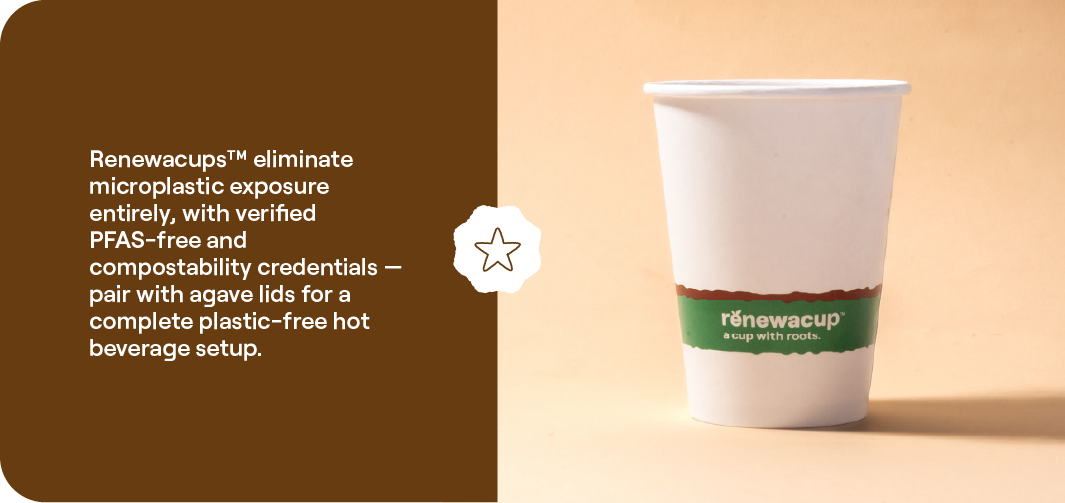
At Greenprint®, our Renewacups™ line uses Foopak Bio Natura material, a bio-coated paper verified as plastic-free by Flustix and Control Union. This verification means the cup has been independently tested and confirmed to contain no conventional plastic in its construction. For your operation, that translates to a single-use paper cup that won’t shed PE microplastics into your customers’ coffee.
Our Renewacups™ also carry Intertek-verified PFAS-free status. PFAS, sometimes called “forever chemicals,” are another class of compounds found in some food packaging that have raised health concerns. Our cups were tested by Intertek using both LC-MS/MS and GC-MS methods across a comprehensive panel of compounds, with all results coming back as not detected. This broad testing panel is a strong differentiator when your procurement team or local regulations require documented proof, and we’re happy to share the full results.
Beyond the plastic-free and PFAS-free credentials, our Renewacups™ are also certified for both industrial and home compostability by ISEGA (certification ID available upon request). This gives our cups a clear end-of-life pathway. Instead of heading to a landfill like PE-lined cups, they can be composted in the appropriate system, as certified by ISEGA.
For your business, this means:
- No hidden plastic: Your customers get a genuinely plastic-free drinking experience.
- Verified claims: Third-party testing backs up every claim, which matters for FTC Green Guides compliance.
- A real end-of-life solution: Our cups can actually be composted (ISEGA certified), unlike PE-lined alternatives.
Serve Hot Drinks Without the Microplastic Risk
Switching to our verified plastic-free cups is one of the simplest changes you can make to protect your customers and strengthen your brand. Every hot drink you serve in a plastic-lined cup delivers microplastic particles that your customers didn’t ask for.
Your customers notice these choices. As awareness of microplastics in hot beverages grows, the restaurants that act first build the most trust. Our verified plastic-free cups tell your customers that you’ve done the research and made the better choice on their behalf.
The cups you choose say something about your business. They signal whether you’re paying attention to emerging health concerns or sticking with the status quo because it’s easier.
Our Renewacups™ eliminate microplastic exposure entirely while giving you documented credentials for PFAS-free status and compostability (ISEGA certified). You get a cup that performs well; pair it with our agave lids for a complete plastic-free setup; protects your customers, and gives you a genuine sustainability story to tell.
Explore our cups to find the right fit for your operation, or contact our team to request samples and discuss your specific needs.

Earth Day facts that show the scale of the environmental crisis, from plastic and landfill waste to CO2 and wildlife loss. See what the numbers mean for you.

Minnesota plastic ban rules for businesses, including city bag fees, Green To Go takeout packaging, PFAS limits, compostable labels, and EPR dates to plan for.
Reduce reuse recycle explained in plain terms. Learn what each of the 3 Rs means, why the order matters, and how compost completes the set as the 4th R.