

How Compostable Straws Perform with Hot and Cold Drinks



Content
- Key Takeaways
- What Are Compostable Straws Made Of?
- Why Compostable Straws Are a Smart Switch for Restaurants
- How Each Straw Material Handles Heat and Cold
- Real-World Performance at Every Beverage Temperature
- Common Myths About Compostable Straws and Temperature
- How Long Do Compostable Straws Take to Break Down?
- Storage and Handling Tips for Restaurant Operators
- Frequently Asked Questions About Compostable Straws
- Choose the Right Compostable Straw for Your Restaurant
How Compostable Straws Perform with Hot and Cold Drinks
Choosing the right compostable straw means knowing which materials actually hold up across your full drink menu. This guide breaks down how different compostable straw types perform at every beverage temperature, so you can make a confident purchasing decision that works for your customers and your bottom line.
Key Takeaways
- Not all compostable straws perform the same way in hot and cold drinks, and material choice is the biggest factor in durability and mouthfeel.
- Agave-based straws deliver a plastic-like feel across cold and warm beverages without getting soggy, unlike paper alternatives.
- Verified certifications like TÜV Austria OK Compost HOME and BPI are the only reliable way to confirm that a compostable straw will actually break down as promised.
What Are Compostable Straws Made Of?
Compostable straws are made from plant-based materials designed to break down in composting conditions. This means they return to natural elements when composted under the right conditions; either home or industrial, depending on the material and its certification; rather than sitting in a landfill for decades like conventional plastic.
The four main material categories you’ll encounter are paper, PLA, PHA, and agave-based compounds. Each one comes from a different source, handles temperature differently, and requires a specific composting pathway. Understanding these differences helps you predict how a straw will perform in your customers’ drinks.
Common Materials and How They Differ
Paper straws are made from wood pulp and coated to resist moisture temporarily. PLA straws are made from corn starch or sugarcane and have a smooth, plastic-like feel. PHA straws come from bacterial fermentation and offer higher heat resistance. Agave-based straws, like our Greenprint® Green Dot Compostable Upcycled Agave Straws, are made with Upcycled Agave Fibers combined with a proprietary PLA/PBAT blend.
Here’s how these materials compare:
| Material | Source | Heat Tolerance | Texture | Composting Pathway |
|---|---|---|---|---|
| Paper | Wood pulp | Low | Softens quickly | Varies by product (check for certifications) |
| PLA | Corn starch or sugarcane | Low to moderate | Smooth, plastic-like | Industrial only (varies by product; check for certifications) |
| PHA | Bacterial fermentation | Moderate to high | Firm, plastic-like | Industrial or marine (varies by product; check for certifications) |
| Agave-based (Greenprint®) | Upcycled Agave Fibers | Moderate | Smooth, plastic-like | Home (TÜV Austria OK Compost HOME) or industrial (BPI) |
The texture column matters more than you might think. When customers complain about compostable straws, they’re usually talking about paper straws that get soggy. Agave-based and PLA straws feel much closer to conventional plastic, which makes for a better customer experience.
Certifications That Verify Compostability
A composting certification is a third-party verification that a product actually breaks down under specific composting conditions. This matters because, under the FTC Green Guides, claiming a product is “compostable” without specifying the conditions can be misleading, and Washington and Minnesota require third-party certification as legal proof of compostability claims.
Two certifications matter most for compostable straws in the U.S., where BPI certifies over 51,000 compostable products:
- TÜV Austria OK Compost HOME: Verifies that a product breaks down at ambient backyard compost temperatures. This is the harder standard to meet.
- BPI Commercial Compostability: Confirms that a product meets ASTM standards for breakdown in industrial composting facilities, which use temperatures of 58 ±2°C.
Our Greenprint® Green Dot Compostable Upcycled Agave Straws carry both TÜV Austria OK Compost HOME and BPI Commercial Compostability (for Straws and Cutlery) certifications. This dual certification is rare in the compostable straw category. It means our straws break down in both backyard compost bins (TÜV Austria OK Compost HOME) and industrial facilities (BPI), giving you flexibility regardless of your local waste infrastructure.
Why Compostable Straws Are a Smart Switch for Restaurants
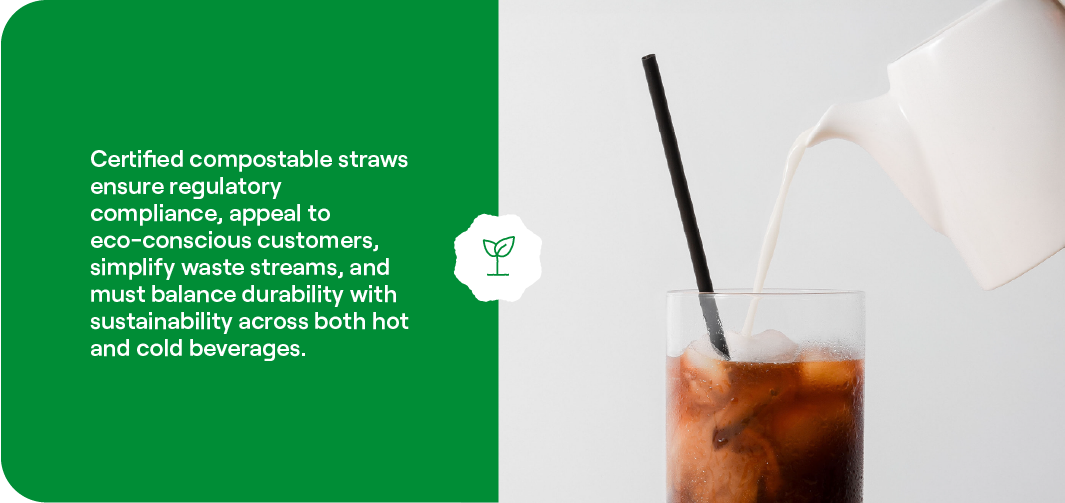
Compostable straws carrying certifications like TÜV Austria OK Compost HOME or BPI Commercial Compostability help you stay ahead of plastic-ban legislation while appealing to customers who expect responsible packaging choices. States like California, New York, Washington, Vermont, and Massachusetts have enacted single-use plastic restrictions or mandatory organics diversion laws that directly affect what straws you can offer.
Beyond compliance, your straw choice sends a message to guests. Diners notice details, and a straw that performs well and composts properly reinforces that you share their values. The key is choosing a straw that doesn’t sacrifice durability for sustainability. A product that fails during service costs you more than the one it replaced, both in waste and in customer frustration.
Compostable straws also simplify your waste stream. When food-soiled items can go into the appropriate compost bins; home or industrial, depending on the product’s certification; you reduce contamination in recycling and divert more material from landfill. For operators already working with composting services, compostable straws certified by TÜV Austria OK Compost HOME or BPI fit right into existing systems.
How Each Straw Material Handles Heat and Cold
Heat deflection temperature is the point where a material begins to soften under stress. Think of it as the temperature ceiling for reliable performance. Below that ceiling, your straw stays firm. Above it, you start running into problems.
This is why material choice matters so much for beverage service. A straw that works perfectly in iced coffee might soften in a hot latte. Understanding each material’s limits helps you match the right straw to the right drink.
Paper Straws
Paper straws begin losing structural integrity within minutes of contact with any liquid. They absorb moisture quickly, which leads to the soggy, collapsing texture that operators and customers complain about most.
For a quick sip of water, paper can work. But for any drink that sits on a table for more than a few minutes, paper straws are unreliable. This is the single biggest reason operators look for alternatives, and it’s why “compostable straw” and “soggy straw” have become unfairly linked in many customers’ minds.
PLA Straws
PLA stands for polylactic acid, a plant-based plastic made from corn starch or sugarcane. PLA straws perform well in cold beverages, offering a smooth, plastic-like feel that customers appreciate.
The problem shows up with warm and hot drinks. PLA’s heat deflection temperature is relatively low, so the material softens noticeably as beverage temperatures rise. PLA straws also require industrial composting to break down. Without access to an industrial facility, a PLA straw sent to landfill won’t decompose in any meaningful timeframe.
PHA Straws
PHA stands for polyhydroxyalkanoates, a material produced through bacterial fermentation. PHA offers higher heat tolerance than PLA and can handle a broader range of beverage temperatures. It also breaks down in marine environments, which is notable for coastal operations.
The trade-off is availability and cost. PHA straws remain limited in commercial supply and carry a higher price point than other compostable options. For high-volume foodservice operations, this makes them a harder fit.
Agave-Based Straws
Our Greenprint® Green Dot Compostable Upcycled Agave Straws deliver a plastic-like feel and firm texture across cold and warm beverages. The material maintains its structure during normal drink service, giving your customers a familiar sipping experience without the soggy texture of paper.
What makes this material different is the enzyme masterbatch integrated during compounding at 160–190°C, which catalyzes hydrolysis of PLA polymer chains, enabling full breakdown at ambient temperatures (20–30°C). During use, though, the straw stays firm and functional. You get the performance of conventional plastic with a verified composting pathway.
Real-World Performance at Every Beverage Temperature
Material specs matter, but what really counts is how a straw performs in the drinks you actually serve. Here’s how compostable straws hold up across the temperature ranges on a typical menu.
Cold Drinks (Iced Coffee, Smoothies, Water)
Most compostable straw types perform well in cold beverages, especially when paired with compostable cold cups. This is the easiest temperature range for any compostable material, and even paper straws can last through a quick cold drink.
The difference shows up in mouthfeel and staying power. Our Upcycled Agave straws maintain a smooth, plastic-like texture throughout the entire drink, even in thick smoothies that require more suction. Paper straws, by contrast, begin to soften before the drink is finished. For operators who want straws that feel like plastic but compost like plant material, agave-based options solve this problem.
Warm Drinks (Tea, Warm Lattes)
Warm beverages are where material differences become obvious. This temperature range sits between cold drinks and fresh-brewed hot beverages, and it’s where PLA straws may start to soften.
Paper straws deteriorate even faster in warm drinks than they do in cold ones. Agave-based and PHA straws hold up well in this range. If your café serves warm lattes, chai, or other drinks in the warm-but-not-boiling category, these materials give you the most reliable service.
Hot Drinks (Fresh-Brewed Coffee and Tea)
At peak hot-brew temperatures, most compostable straws face limitations. This includes agave-based options. No compostable straw on the market today is designed for prolonged immersion in just-brewed, near-boiling beverages.
The practical solution is one most operators already use: serve hot drinks with lids and allow a brief cool-down before straw use. This approach works well with our Upcycled Agave straws, which perform reliably once the beverage drops below peak brewing temperature. Most customers don’t use straws for their hottest sips anyway.

Common Myths About Compostable Straws and Temperature
You’ve probably heard complaints about compostable straws that don’t hold up to reality. Here are the most common myths and what’s actually true:
- Myth: Compostable straws melt in hot drinks. Compostable straws don’t melt. Some materials soften at high temperatures, but with standard serving practices like lids and a brief cool-down, agave-based and PHA straws perform reliably across most hot drink scenarios.
- Myth: All compostable straws are just soggy paper. Paper is only one category of compostable straw. Agave-based and PLA straws offer a firm, plastic-like feel that holds up throughout normal drink service. The “soggy straw” problem is a paper straw problem, not a compostable straw problem.
- Myth: Compostable straws can’t handle daily, high-volume service. Compostable straws certified by TÜV Austria OK Compost HOME or BPI, made from agave-based or PLA compounds, are manufactured to the same durability standards as conventional plastic straws. Our Greenprint® Green Dot Compostable Upcycled Agave Straws are built for exactly this kind of daily use.
How Long Do Compostable Straws Take to Break Down?
Straws certified to TÜV Austria OK Compost HOME break down at ambient backyard temperatures. Straws certified to BPI Commercial Compostability or TÜV Austria OK Compost INDUSTRIAL require the sustained high heat of a commercial composting facility. The pathway depends entirely on the material and its certification.
Our Greenprint® Green Dot Compostable Upcycled Agave Straws achieve home compostability because of an enzyme masterbatch integrated during compounding at 160–190°C, which catalyzes hydrolysis of PLA polymer chains, enabling full breakdown at ambient temperatures (20–30°C). This is what allows us to carry TÜV Austria OK Compost HOME certification. Standard PLA without enzyme technology, like our Compostable Agave Cutlery, requires industrial composting at 55–60°C and cannot achieve HOME certification.
For operators without access to industrial composting, straws certified to TÜV Austria OK Compost HOME offer a practical advantage. Your customers can dispose of them in backyard compost bins, and the straws will break down as verified by our TÜV Austria OK Compost HOME certification, without requiring specialized infrastructure.
A straw lifecycle assessment can help you weigh the environmental impact of drinking straws.
Storage and Handling Tips for Restaurant Operators
Store compostable straws in a cool, dry location away from direct sunlight and heat sources. These materials are designed to break down under composting conditions, so keeping them away from moisture and warmth during storage preserves their performance.
If you operate in a hot climate or offer outdoor service, pay attention to summer transport and delivery conditions. Brief heat exposure during shipping won’t trigger breakdown, but storing straws in a hot warehouse or near kitchen equipment for extended periods can affect stiffness.
Here are the key storage practices:
- Temperature: Keep straws in climate-controlled spaces, ideally below room temperature.
- Moisture: Store in dry areas away from sinks, dishwashers, and steam.
- Rotation: Use older inventory first to maintain the best quality.
- Packaging: Keep straws in original packaging until ready for use.
Frequently Asked Questions About Compostable Straws
Do agave-based and PLA straws get soggy in cold drinks like paper straws do?
No. Agave-based and PLA straws maintain a firm, plastic-like feel throughout cold beverages. The soggy texture is specific to paper straws, which absorb moisture quickly.
What is the difference between home compostable and industrial compostable straws?
Home compostable straws break down at ambient backyard temperatures, while industrial compostable straws require the high heat of a commercial facility. TÜV Austria OK Compost HOME certification is the verifiable standard for home compostability.
Will compostable straws start breaking down if they get hot during shipping?
Brief heat exposure during transit won’t trigger breakdown. Prolonged storage above recommended temperatures can reduce stiffness over time, but normal shipping conditions won’t affect performance.
Choose the Right Compostable Straw for Your Restaurant
The right compostable straw depends on three things: the temperature range of your drink menu, the composting infrastructure available in your area, and what your customers expect from the experience.
If you serve a mix of cold and warm beverages and want a straw that feels like plastic, holds up during service, and carries verified TÜV Austria OK Compost HOME and BPI Commercial Compostability certifications, our Greenprint® Green Dot Compostable Upcycled Agave Straws are built for exactly that. They solve the soggy-straw problem while giving you a verified end-of-life pathway; certified by TÜV Austria OK Compost HOME and BPI Commercial Compostability (for Straws and Cutlery), that works with or without industrial composting access.
Explore our compostable straws to find the right size and format for your operation, or contact us for samples and a custom quote tailored to your restaurant’s needs.

Worm composting turns kitchen scraps into rich castings. Learn which worms to buy, how to set up a bin, what to feed them, and how to harvest compost.

Illinois plastic bans and regulations explained: hotel bottle law, Chicago bag tax and foodware rules, local bans, and pending bills. Plan your compliance now.

Learn how to reduce carbon footprint at home with simple steps for energy, heating, food, and waste. Start with easy swaps your whole household can keep up.